Sudan’s civil war is often presented as a brutal internal collapse driven by rival generals, militias, and the erosion of state authority. In reality, Sudan has long been a battleground for external powers layered atop domestic implosion. What has changed is not foreign involvement itself, but the degree to which Sudan has become structurally entangled in wider regional survival strategies none more consequential than those emanating from Tehran. At the center of this entanglement lies not simply Iran’s influence, but the durability of the Iranian regime and the institutional machinery chiefly the Islamic Revolutionary Guard Corps (IRGC) that projects its power abroad.
Iran’s relationship with Sudan is neither new nor improvised. During the era of Omar al-Bashir, Sudan was one of Tehran’s most permissive African partners. Iranian weapons transited Port Sudan, Revolutionary Guard advisers trained Islamist factions, and Sudanese territory became a logistical corridor supporting Hamas and Hezbollah. Israeli airstrikes on weapons convoys inside Sudan during the 2000s were early acknowledgements that Tel Aviv already understood Sudan’s strategic value within Iran’s regional architecture. Although Khartoum formally distanced itself from Tehran after Bashir’s fall seeking Gulf aid and later flirting with normalization with Israel the rupture was never absolute. Iran’s networks were disrupted, not dismantled.
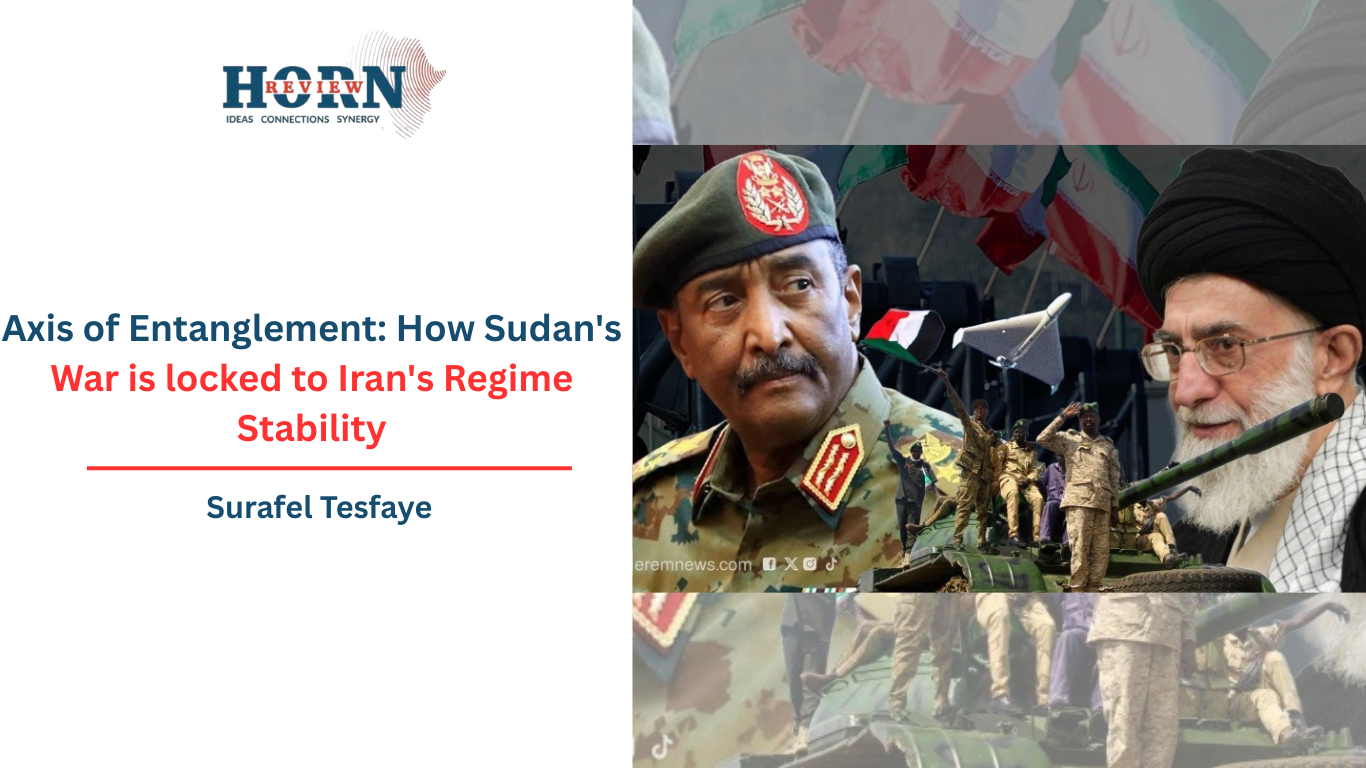
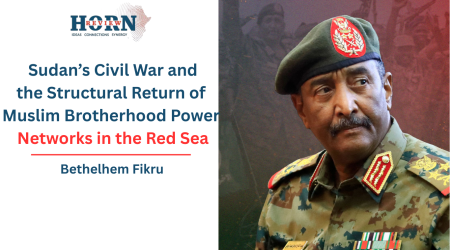
The civil war that erupted in 2023 reactivated this dormant relationship. As General Abdel Fattah al-Burhan’s Sudanese Armed Forces became diplomatically isolated sanctioned, criticized, and increasingly portrayed as illegitimate Iran emerged as the one actor willing to provide immediate, unconditional, and politically unconcerned support. Iranian assistance was not symbolic. Mohajer-6 and Ababil-3 drones altered the battlefield in 2024 and 2025, enabling the SAF to blunt RSF advances and reclaim strategic districts in Khartoum and Omdurman. Intelligence sharing, training pipelines, and technical sustainment followed. Military analysts were blunt: without Iranian drones, the SAF might not have survived the war’s early phase.
This support, however, was never altruistic. It reflected a convergence of needs. For the SAF, Iran offered survival without lectures on human rights, reform, or civilian transition. For Tehran, Sudan offered geography. Sudan’s 530-mile Red Sea coastline, anchored by Port Sudan, sits opposite to Saudi Arabia and near the Bab al-Mandab chokepoint one of the most sensitive arteries of global trade and Israeli maritime security. Embedding itself in Sudan’s war offered Iran a renewed pathway to secure a western Red Sea foothold, completing a geopolitical arc stretching from Lebanon through Syria and Yemen to Africa. From Yemen, Iran pressures Bab al-Mandab; from Sudan, it would threaten the western Red Sea, Israeli shipping routes, and Suez-bound commerce.
This strategic logic intensified as Israel expanded its own Red Sea and Horn of Africa footprint. Somaliland’s normalization with Israel and the emergence of Berbera as a potential Israeli logistical and intelligence node did not create Iran’s Sudan strategy, but it accelerated it. In Tehran’s eyes, Berbera symbolized the encroachment of Israeli power into what Iran considers its southern strategic flank. Sudan, by contrast, offered something far more valuable than Somaliland ever could: sovereignty, scale, and a functioning port on the western Red Sea. If Israel gained access to Berbera, Iran’s answer was not Hargeisa it was Port Sudan.
This is why Sudan has become a source of acute anxiety for Israel, Saudi Arabia, Egypt, and the United States. Iranian warships docking in Port Sudan would not merely symbolize influence; they would materially threaten global shipping and regional security. It is also why the SAF has learned to weaponize access itself. Far from being a passive recipient of foreign aid, the SAF has demonstrated considerable strategic agency.
By courting Iran for drones, negotiating a long-term naval base deal with Russia, and simultaneously engaging Saudi Arabia and Turkey, the SAF has turned dependency into leverage. Port Sudan has become less an asset than a bargaining chip used to ensure that no single external actor can afford to abandon the army outright.
Beyond ports and drones lies a quieter but no less consequential dimension: uranium. Iran’s interest in Sudan’s mineral wealth, particularly uranium deposits, should be understood as long-term and strategic rather than immediately operational. Sudan’s uranium is not currently mined at commercial scale, but in an era where Iran’s enrichment facilities at Natanz and Fordow have been damaged and sanctions pressure remains intense, access to future supply chains matters. Control over raw material pathways alone provides strategic insurance. As long as the SAF remains aligned with Tehran, that option remains open. An RSF victory given its alignment with the UAE and other anti-Iranian actors would almost certainly foreclose it.
Iran’s influence in Sudan also intersects with the internal composition of the SAF itself. Many of the army’s most committed units are drawn from Kizan Islamist networks shaped during the Bashir era and ideologically receptive to Tehran’s posture of resistance. Iranian support has reinforced not only battlefield capability but ideological morale within these factions. In this sense, Tehran’s influence extends into Sudanese command structures more deeply than is often acknowledged. Losing Iran would not simply mean losing drones; it could fracture the SAF’s internal cohesion and intensify struggles between Islamist hardliners and pragmatists willing to accept a Saudi-brokered settlement.
It is important, however, not to over-personalize this relationship. Sudan’s war is not about the survival of Ayatollah Ali Khamenei as an individual. Iran’s foreign policy is institutionalized, driven primarily by the IRGC and a state doctrine that treats expeditionary power as essential to regime survival. Khamenei matters because he anchors this system, but the strategy itself is broader. The crucial point is that Sudan has become embedded in the regime’s survival logic. Tehran uses Sudan to project power, deter adversaries, and secure strategic depth. If that regime is destabilized through leadership collapse, succession crisis, or internal implosion the consequences for Sudan would be immediate.
That scenario is not abstract. Iran is already diverting proxy assets the very tools of its foreign policy to domestic repression amid sustained internal unrest. The same networks that project power abroad are increasingly needed at home. A full-blown regime crisis would not merely pause Iranian foreign policy; it would cause an abrupt severance of the drone supplies, technical support, and intelligence coordination upon which the SAF now depends. One of the army’s last unconditional patrons would vanish overnight.
The shockwaves would extend beyond Tehran and Khartoum. The RSF, backed by the UAE, would likely interpret such a rupture as a strategic opening either launching renewed offensives or hardening its negotiating position. Egypt, which views Sudan as an extension of Nile Valley security and fears instability on its southern flank, would intensify its support for the SAF. Russia’s role would remain characteristically ambiguous: Wagner-linked elements have reportedly operated alongside the RSF, even as Moscow pursues a naval base agreement with the SAF, underscoring Sudan’s status as a crowded geopolitical marketplace rather than a binary proxy war.
The broader regional calculus is equally revealing. For Israel and the United States, the weakening or collapse of the Iranian regime would remove what Israeli strategists openly describe as the “head of the snake,” crippling Iran’s proxy network and securing Israel’s emerging African corridor from the Red Sea to the Horn. For Saudi Arabia and Turkey, the benefits are quieter but substantial.
Iran’s exit removes a rival for influence over the SAF and allows Riyadh and Ankara to present themselves as the legitimate protectors of Sudan’s state institutions against the UAE-backed RSF. Saudi Arabia gains leverage to push for a negotiated settlement; Turkey gains space to expand its drone diplomacy without confronting Iranian competition. Even the UAE, despite tactical gains through the RSF, would have to recalibrate if regional patrons converge on stability over escalation.
The likely outcome is not total victory for either side. If Iran’s regime falters, the SAF would be forced toward compromise as its most unconditional supporter disappears. Yet the RSF, too, could face pressure if its primary backer concludes that alignment with Saudi Arabia or Egypt matters more than decisive military triumph. Sudan’s war may end not when one side wins, but when external patrons align around a stabilized partition of influence rather than continued destruction.
Sudan’s tragedy, then, is not only its internal collapse but its position at the intersection of rival survival strategies. The fate of the Iranian regime now shapes the flow of drones over Khartoum, the contest over Port Sudan, and the security architecture of the Red Sea. When Tehran recalculates, Khartoum absorbs the consequences and if Iran’s regime fractures, Sudan will feel the impact long before the region settles into whatever comes next.
By Surafel Tesfaye, Researcher, Horn Review