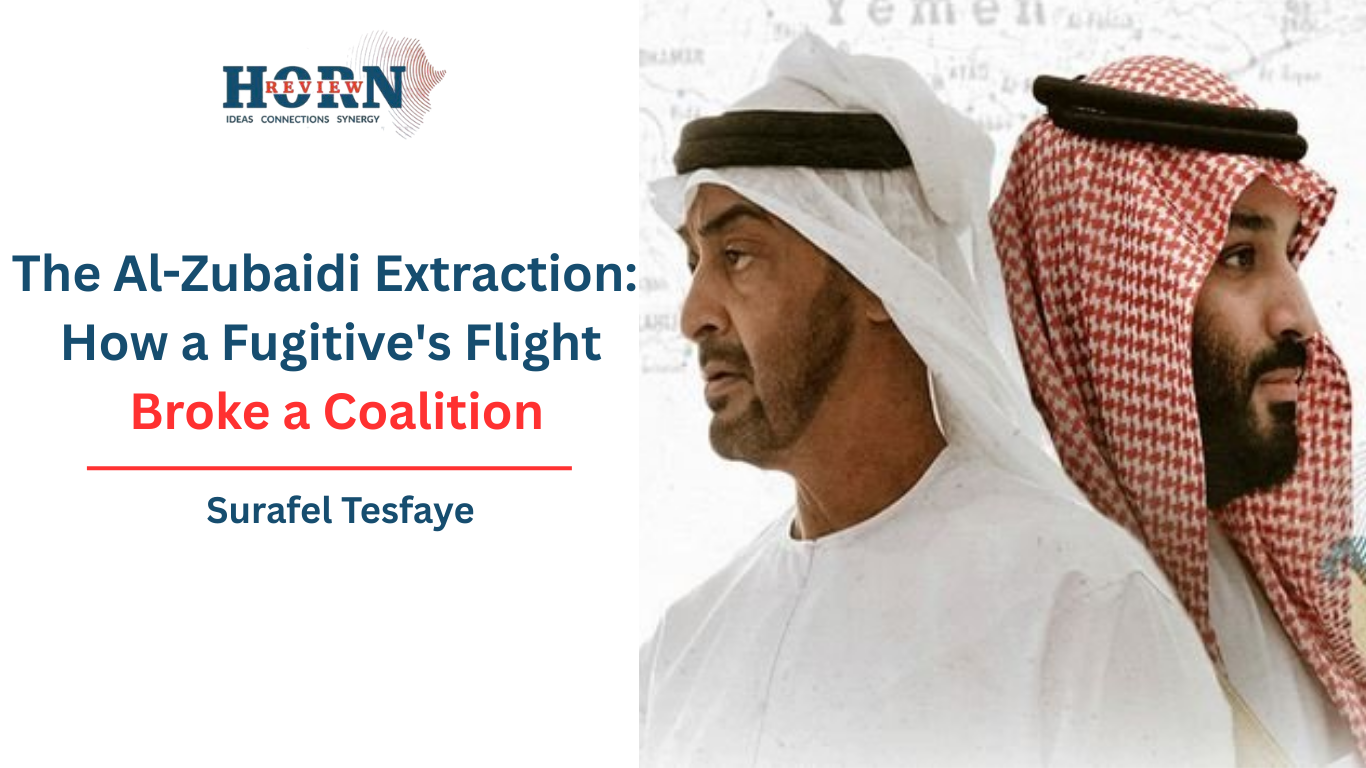
The Saudi-led coalition’s disclosure of Aidarous al-Zubaidi’s flight from Yemen to Somaliland, onward to Mogadishu, and ultimately to Abu Dhabi marks more than the removal of a single political figure. It represents a decisive inflection point in the Yemen war and a public rupture in what was once a tightly coordinated Saudi–Emirati alliance. What unfolded in early January 2026 is not a tactical disagreement but a strategic divorce one that exposes increasingly divergent visions for southern Yemen, regional security, and the balance of power across the Red Sea and the Horn of Africa.
At its core, al-Zubaidi’s extraction underscores that Riyadh and Abu Dhabi are no longer managing differences behind closed doors. They are now openly backing rival Yemeni actors with competing political trajectories. Saudi Arabia has prioritized a unified, federally structured Yemen that secures its borders and limits long-term instability, while the UAE has, over several years, invested in southern political and security networks that emphasize local autonomy, port control, and influence along strategic maritime corridors. The result is a convergence of proxy competition and internal Yemeni fragmentation with broader regional implications.
According to the Saudi-led coalition, al-Zubaidi the president of the UAE-backed Southern Transitional Council (STC) did not simply travel abroad. He was extracted through a discreet, multi-leg operation supervised by Emirati officers. He departed Yemen by boat, reached Somaliland, boarded an aircraft that briefly stopped in Mogadishu, and then continued onward to Abu Dhabi, transiting through Omani airspace. The coalition’s decision to publicly outline the route, the supervision, and the technical details of the journey was unusual and deliberate. It appeared designed to document a coordinated operation aimed at removing a political figure who had been charged with high treason by the internationally recognized Yemeni authorities.
For nearly a decade, Saudi Arabia and the UAE had presented a unified front in Yemen, even while quietly supporting different local partners. By openly detailing the mechanics of al-Zubaidi’s departure, Riyadh signaled that it no longer felt compelled to obscure these differences or absorb political costs on Abu Dhabi’s behalf. The episode thus became not only a Yemeni political development but also a message about the state of Gulf coordination.
The rupture itself did not emerge suddenly. Its immediate trigger came in December 2025, when STC forces expanded into Hadramout and al-Mahra, two provinces bordering Saudi Arabia. These areas are closely linked to Saudi security and economic planning, particularly al-Mahra, which has long featured in Riyadh’s discussions over alternative energy export routes. The STC’s move was therefore interpreted in Saudi decision-making circles not simply as a local assertion of influence but as a strategic encroachment with direct implications for Saudi national interests and border security.
Until that point, Saudi Arabia had largely tolerated Emirati-backed control over parts of southern Yemen’s coastline and islands, viewing it as manageable within the broader coalition framework. The December incursions changed the calculus. Riyadh responded with aerial operations, ground deployments, and direct pressure on both STC and Emirati forces to withdraw. What followed was not de-escalation, but confrontation within the coalition itself.
Al-Zubaidi’s political position collapsed rapidly under this pressure. After declining to attend crisis talks in Riyadh and reportedly overseeing the distribution of weapons to mobilize loyal forces, he was expelled from the Presidential Leadership Council and formally charged with high treason on January 7, 2026. In practical terms, this amounted to the complete removal of his legitimacy within Yemen’s internationally recognized governing structure.
With Saudi-backed forces advancing in Aden and Saudi-controlled airspace limiting his options, al-Zubaidi’s ability to remain inside Yemen narrowed sharply. A direct departure from Aden was effectively impossible, and maritime routes were heavily monitored. The solution was an indirect extraction through Somaliland and Mogadishu locations where the UAE maintains logistical access before continuing to Abu Dhabi via Omani airspace. The choice of route reflected both operational caution and political calculation, relying on jurisdictions outside Saudi control and on Oman’s long-standing role as a neutral transit space in regional conflicts.
For Abu Dhabi, extracting al-Zubaidi was not a show of strength but a strategic retreat. After pulling its troops from Yemen, the UAE faced a stark choice: escalate against Saudi Arabia by continuing to back secessionist advances along the Saudi border, or preserve its core asset by placing him under direct protection.
Smuggling the leader rather than fighting the kingdom was the rational option. Supporting the STC militarily against Riyadh carried unacceptable risk, including a direct confrontation with a far more powerful neighbor. By extracting al-Zubaidi, the UAE achieved two immediate objectives: it protected a high-value ally from arrest or elimination, and it preserved political leverage by keeping the leader of its primary Yemeni proxy alive and dependent.
In Abu Dhabi, al-Zubaidi remains a “client” for future bargaining. His presence allows the UAE to continue influencing southern Yemeni politics from afar, keep the idea of secession alive, and counter Saudi dominance in any future negotiations.
Al-Zubaidi’s departure, however, had immediate and destabilizing consequences for the STC. Deprived of its central figure and facing coordinated pressure on the ground, the council fractured along geographic and political lines. On January 9, 2026, senior STC figures present in Riyadh announced the dismantling of the council’s institutional structure, arguing that its continuation no longer served its purpose under prevailing conditions. Saudi-backed forces, including the Homeland Shield units and the Southern Giants Brigade, moved swiftly to secure Aden, taking control of the international airport, the presidential palace, and key security installations.
At the same time, STC officials based in Abu Dhabi rejected the dissolution as illegitimate, asserting that the decision had been made under duress and that only al-Zubaidi, as president, could formally dissolve the council. Public statements from STC spokespersons such as Anwar al-Tamimi dismissed the announcement as “ridiculous,” highlighting the depth of the internal split. Regardless of competing claims, the STC’s loss of territorial control, military cohesion, and official standing within the recognized government has left it significantly weakened, with its remaining influence increasingly exercised from exile.
From Riyadh’s perspective, these developments have opened space for a recalibration of southern leadership. With al-Zubaidi removed from the domestic arena and his secessionist agenda sidelined, Saudi Arabia has moved to elevate figures viewed as more pragmatic and institutionally cooperative. Abdulrahman “Abu Zara’a” al-Mahrami, commander of the Southern Giants Brigade, has emerged as a central actor in this transition, overseeing security in Aden and coordinating closely with Saudi officials. His growing role reflects Riyadh’s preference for stability and managed decentralization over immediate secession.
Saudi Arabia is now preparing to host a “Southern Cause Conference,” in Riyadh, bringing together a wide array of southern factions to negotiate a future framework centered on federalism within a unified Yemeni state. This process effectively bypasses al-Zubaidi’s political project and reasserts Riyadh as the principal broker of Yemen’s southern question.
At the same time, the broader strategic consequences extend beyond the southern arena. The visible rupture within the coalition objectively benefits the Houthis, whose principal adversaries are now divided and preoccupied with intra-coalition competition. While the Houthis are not directly involved in the events surrounding al-Zubaidi’s exile, the weakening of coordination among anti-Houthi forces reduces pressure on them and complicates any future effort to present a unified negotiating or military front.
Regionally, Saudi Arabia’s firmer stance is also shaped by wider concerns over Emirati activities in the Horn of Africa and Syria, where Abu Dhabi has cultivated local partnerships that Riyadh sometimes views with caution. Within Yemen, the STC’s efforts to gain broader international recognition including tentative outreach toward Israel added another layer of sensitivity, raising concerns about political backlash in the south and unease among regional actors.
In the immediate sense, these events can be read as a Saudi tactical gain. Riyadh has reasserted control over Aden, sidelined a disruptive actor, and positioned itself to shape the next phase of southern political dialogue. For the UAE, extracting al-Zubaidi avoided a more damaging outcome but came at the cost of losing its primary lever inside Yemen.
Yet defining the outcome as a clear “Saudi victory” is an oversimplification. While Saudi Arabia has gained short-term control and momentum, the longer-term picture remains uncertain. Al-Zubaidi’s exile may harden Emirati reliance on indirect influence and external sponsorship of southern actors, potentially creating a persistent spoiler dynamic that complicates Riyadh’s vision for a unified Yemen. In that sense, the rupture could prove costly over time, embedding a structural rivalry that outlasts the immediate crisis.
What this episode ultimately reveals is that the Yemen war has entered a new phase one no longer defined solely by coalition unity against the Houthis, but by competition among former partners over the post-war order. Southern Yemen has become the principal arena for that contest, with implications that will shape not only Yemen’s future, but also the wider regional balance across the Red Sea and the Horn of Africa.
By Surafel Tesfaye, Researcher, Horn Review