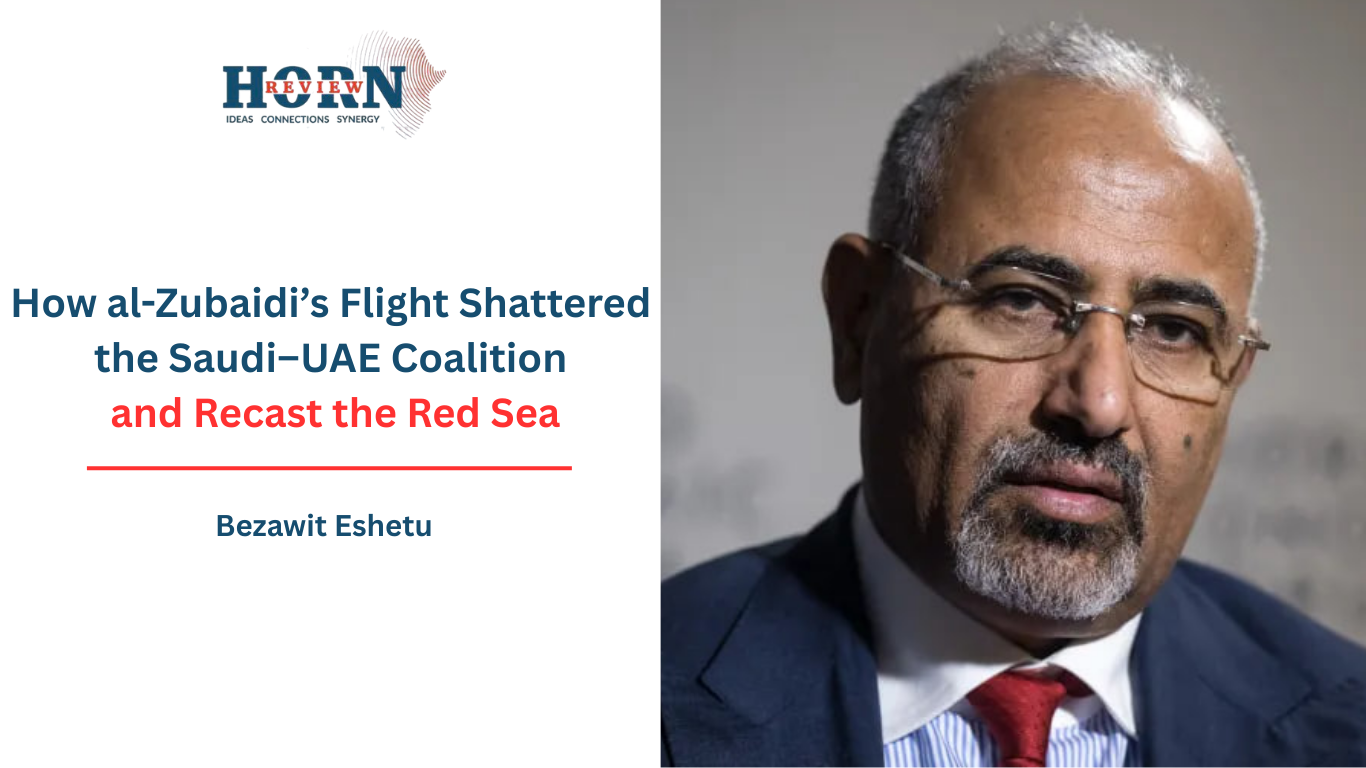
The extraction of Aidarous al-Zubaidi from the port of Aden to the Emirati capital is a critical indicator in Yemen’s protracted conflict; it signifies a significant fracture within the decade-long Arab coalition into competing patrons, each pursuing distinct and incompatible agendas. Saudi-led coalition statements and multiple contemporaneous reports indicate that al-Zubaidi left Aden by boat for Berbera in Somaliland and was then flown to Abu Dhabi after a brief transit via Mogadishu. The choreography of that route, corroborated by flight-tracking and coalition communications, converts what might otherwise have been plausible deniability into a documented operation with identifiable logistics and actors, and thus a deliberate political statement by those who enabled it.
The immediate political consequence in Riyadh was stark and performative: The Presidential Leadership Council expelled al-Zubaidi, accused him of treason, and Saudi authorities publicly framed the extraction as an affront to Yemeni sovereignty. Riyadh’s reaction was matched by kinetic measures in southern Yemen, including airstrikes on locations the kingdom linked to UAE-backed forces and the reassertion of government control in contested provinces. Those steps suggest that Saudi Arabia no longer views the STC as a manageable partner within a common coalition framework but as a security liability to be neutralized when necessary. In practical terms, what had been a strategic partnership against the Houthis has inverted into a duel over legitimacy and control inside Yemen.
Somalia’s swift decision to investigate the use of Mogadishu’s airspace and restrictions on UAE military and cargo flights demonstrates how the fallout from the extraction radiates across the Horn of Africa. Mogadishu’s response is a rare assertion of authority in a landscape where external powers have long relied on permissive transit routes and informal arrangements. By probing the alleged unauthorized transit, Somalia is signaling that its airports and airspace are no longer passive logistics nodes for Gulf competition and that using them without explicit consent carries diplomatic and operational costs.
The maritime leg of the journey and the disabling of tracking systems expose a parallel, semi-clandestine logistics architecture that has been integral to the UAE’s regional posture. Reports identify a vessel named BAMEDHAF sailing under the flag of Saint Kitts and Nevis, which allegedly switched off its Automatic Identification System while approaching Berbera. Such actions mirror prior patterns attributed to unauthorized arms shipments and reveal how commercial or flagged shipping can be repurposed as a covert bridge between the Arabian Peninsula and the Horn. The use of these non-transparent maritime practices is not an operational afterthought; it is a deliberate capability that converts economic infrastructure into a tactical instrument for patron states.
The aircraft involved in the extraction, an Ilyushin Il-76TD registered as 7Q-ASU and linked to Zebu Air, highlights the dual-use nature of aviation in this conflict. Planes like this typically serve multiple roles, including commercial freight, humanitarian efforts, and paramilitary logistics, allowing states and proxies to present a façade of civilian activity while facilitating the swift movement of personnel and supplies across vulnerable regional airspace. The reported transit through Mogadishu, confirmed by Somali authorities and flight trackers, effectively turned Somalia’s international airport into a stopover for a leader labeled a fugitive by Riyadh, raising concerns about sovereignty and international norms regarding national airspace usage.
To understand why Abu Dhabi would facilitate such an extraction, it’s essential to view Emirati policy as part of a strategic “archipelago” approach: establishing and securing key ports, nurturing local proxies, and maintaining influence through logistical capabilities rather than permanent military presence. Berbera, Aden, Socotra, and Mukalla are not just trade hubs; they serve as leverage points that, when controlled by allied local actors, give the UAE significant influence over maritime routes and local governance. Hosting al-Zubaidi in Abu Dhabi is therefore more about sustaining a network of clients that supports Emirati interests in the southern Red Sea region. This strategy explains why Abu Dhabi has consistently invested in infrastructure and security partnerships that yield geopolitical benefits during crises.
In contrast, Riyadh’s key goal is to maintain a centralized Yemen that ensures border stability and prevents fragmentation into separate territories. Saudi strikes against shipments and positions linked to the UAE are strategic efforts to cut off the support that sustains these territories. This conflict is as much about differing doctrines as it is about tactics: Saudi Arabia believes that consolidating the state and having a single authority is the only effective way to ensure regional stability, while the UAE prioritizes localized control as a means to protect its trade and security interests. This fundamental disagreement makes it extremely challenging to reach a mediated compromise, as the success of one patron undermines the strategic objectives of the other.
The immediate military and political implications within Yemen are perverse and potentially long-lasting. By turning southern politics into a contest between Gulf patrons, the coalition’s rupture unintentionally strengthens the Houthis, who remain the only unified military force across large swathes of northern Yemen. Fragmentation among government-aligned actors and now overt confrontation between their external backers dissipates the political consensus and operational capacity needed to check Houthi consolidation. History suggests that protracted proxy competition, especially when anchored in maritime logistics and local militias, favors patient insurgent movements that can exploit patron fatigue and division.
Beyond Yemen, this episode reshapes regional perceptions of threats related to control of the Bab al-Mandeb and nearby maritime routes. Disruptions or the emergence of competing territorial claims in this corridor increase shipping risks, necessitate the redirection of naval resources, and encourage states from Cairo to Muscat to reevaluate their security strategies. The involvement of commercial port operators and private logistics firms in sovereign disputes further complicates diplomatic efforts, as these economic actors can serve both as conduits of influence and as potential flashpoints for state tensions. This extraction underscores how economic globalization and privatized logistics are now integral to modern geopolitics, creating shadow networks of influence that are hard to manage through traditional multilateral frameworks.
Aidarous al-Zubaidi’s flight to Abu Dhabi thus crystallizes a new strategic reality: the struggle for Yemen is no longer exclusively about defeating a northern insurgency but about which external patron secures the corridors of influence that structure the country’s future. The man’s movement mapped, in physical space, the contours of a post-coalition order defined by corridor control, dual-use logistics and proxy empowerment. Reversing this trajectory demands a rare convergence of patron incentives toward a unified Yemeni settlement, an outcome that current policies make implausible. Unless Riyadh and Abu Dhabi reconcile their competing doctrines, Yemen’s fragmentation will harden into externally sustained fiefdoms even as the Houthis remain the single unified force capable of exploiting the resulting vacuum.
The extraction is therefore both an event and a lens: an event because it moved a leader across borders under the auspices of a powerful patron, and a lens because it reveals the strategic architecture now shaping the Red Sea corridor. How Riyadh, Abu Dhabi and regional actors respond in the coming weeks will determine whether this moment accelerates a durable fragmentation or becomes a bargaining chip in a broader effort to recompose a fractured coalition. For now, the man who fled Aden has become the emblem of a conflict that has migrated from pitched battles to the more enduring realm of logistics and patronage. The longer those patterns persist, the less Yemen will resemble a state to be rebuilt and the more it will look like an arena to be carved.
By Bezawit Eshetu, Researcher, Horn Review