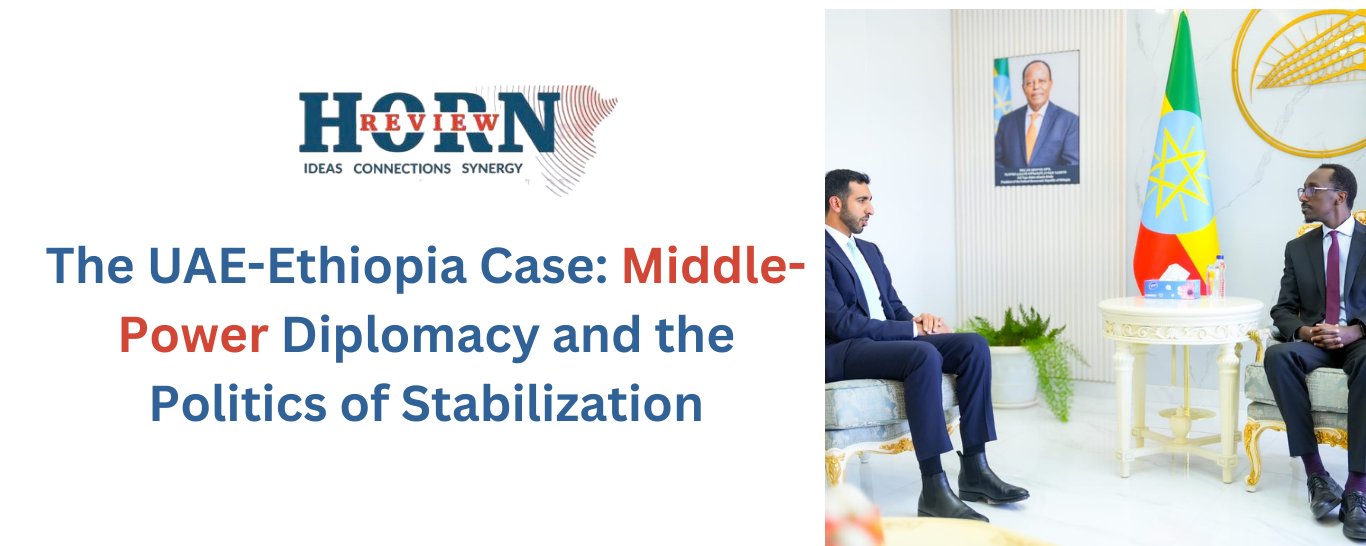
The joint ministerial statement issued following high-level discussions between the United Arab Emirates and the Federal Democratic Republic of Ethiopia on 6 January 2026 represents more than a routine affirmation of bilateral ties. Rather, it reflects a calibrated exercise in strategic alignment and normative signaling at a moment when the Horn of Africa, the Red Sea basin, and adjacent geopolitical theatres are experiencing sustained instability and competitive external engagement.
At a conceptual level, the statement situates the UAE–Ethiopia relationship within a framework of shared responsibility for regional order. The repeated invocation of peace, security, territorial integrity, and economic interests signals a mutual recognition that sovereignty and stability are increasingly interdependent across regions. For Ethiopia, a pivotal state in the Horn of Africa, and the UAE, a Gulf actor with expanding strategic depth in Africa, this framing elevates the partnership from transactional cooperation to what may be described as order-supportive diplomacy.
Sudan emerges as the primary locus through which this convergence is articulated. The language deployed – condemning attacks against civilians while assigning responsibility for conflict termination to the warring parties themselves – reflects a deliberate balance between moral positioning and strategic restraint. By avoiding explicit attribution or prescriptive intervention, both states preserve mediation space while reinforcing core humanitarian norms. This approach underscores a broader regional trend toward privileging conflict containment and humanitarian stabilization over externally imposed political outcomes.
The reference to the High-Level Humanitarian Conference for the People of Sudan convened in February 2025 is particularly instructive. It functions not merely as historical recall but as a legitimizing device, anchoring current positions in prior multilateral engagement involving the African Union and IGAD. In doing so, the statement situates UAE and Ethiopian diplomacy within recognized institutional architectures, mitigating perceptions of unilateralism while enhancing credibility as conveners capable of mobilizing international support.
Equally significant is the integration of global governance agendas into the bilateral dialogue. The UAE’s endorsement of Ethiopia’s preparations for COP32, framed explicitly as a continuation of the COP28 “UAE Consensus,” reflects a strategic effort to construct continuity across climate summits and to embed emerging powers within global climate stewardship. This linkage underscores a shift from episodic climate diplomacy toward a more structured inter-summit governance logic, one that leverages partnership to sustain momentum and legitimacy.
Water security, addressed through the forthcoming 2026 UN Water Conference co-hosted by the UAE and Senegal, further illustrates this approach. By emphasizing innovation and scalable solutions in pursuit of SDG6, both states align developmental imperatives with technocratic governance models. For the UAE, this reinforces a soft-power strategy predicated on expertise and technological leadership; for Ethiopia, it offers an avenue to frame water challenges within global sustainability discourse rather than narrow geopolitical contestation.
Notably, the statement’s silences are as analytically revealing as its explicit commitments. The absence of references to Nile basin politics, Ethiopia’s internal security dynamics, or broader Red Sea militarization suggests intentional issue compartmentalization. This selective articulation reflects diplomatic prudence, allowing both parties to consolidate cooperation on convergent interests while deferring engagement on structurally contentious dossiers.
In aggregate, the joint statement exemplifies a form of contemporary middle-power diplomacy characterized by normative alignment, multilateral embeddedness, and strategic ambiguity. It reveals a partnership oriented less toward immediate policy breakthroughs than toward shaping the discursive and institutional environments in which future outcomes will be negotiated. In a regional context marked by fragmentation and external competition, the UAE–Ethiopia relationship appears increasingly configured as a stabilizing axis – one that seeks to reconcile regional agency with global governance imperatives.
By Horn Review Editorial