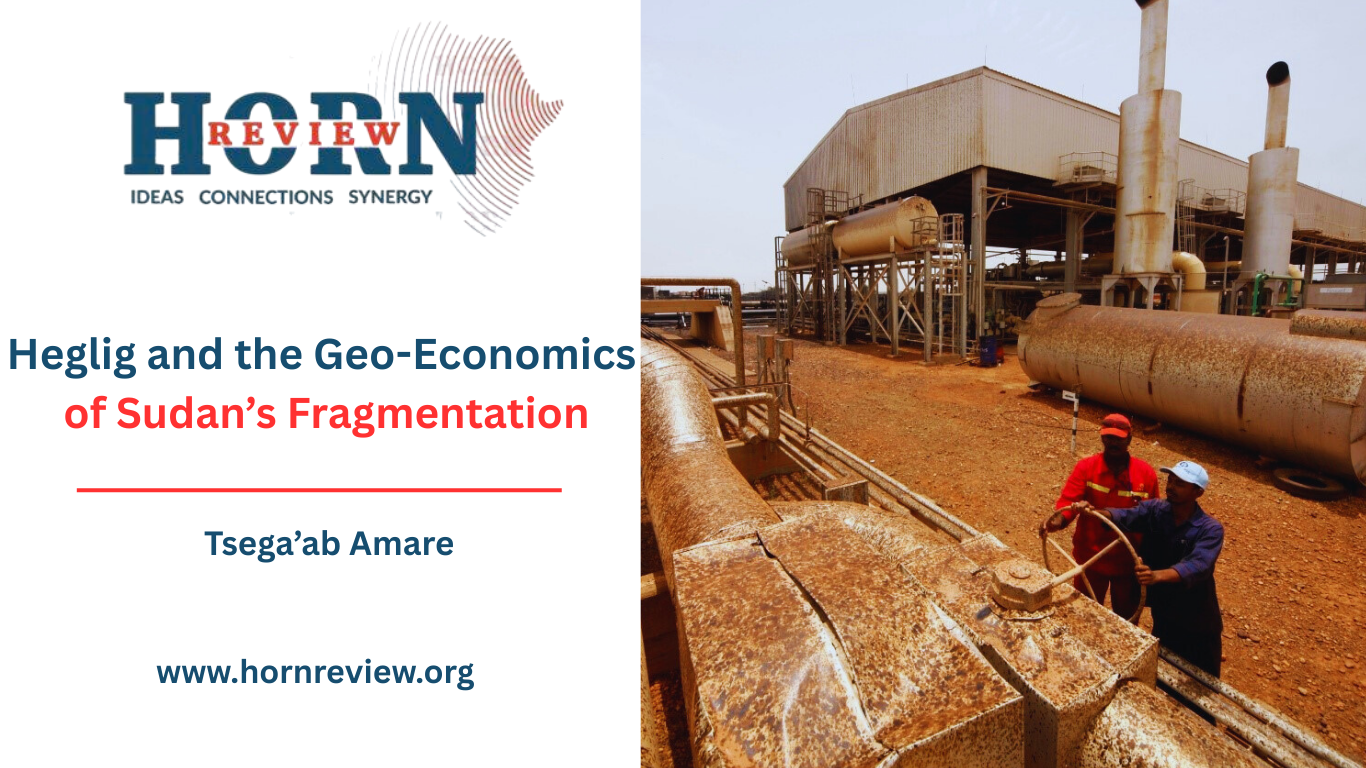
On December 8, 2025, the Rapid Support Forces (RSF) consolidated control over the Heglig oil region in West Kordofan, depriving Sudan’s government of one of its last significant economic lifelines in the west. The Sudanese Armed Forces (SAF) described the withdrawal of its 90th Infantry Brigade as a strategic redeployment into South Sudanese territory to protect oil installations. The outcome, however, was the effective transfer of control over a critical energy hub to a non-state armed actor, accelerating the erosion of state authority in an already fragmented war economy.
As the conflict approaches the 1,000-day mark, the fall of this strategic hub has catalyzed a cascade of diplomatic, economic, and humanitarian crises that threaten the territorial integrity of both Sudan and South Sudan.
Heglig is the backbone of the regional hydrocarbon economy. The field contains approximately 75 producing wells and a central processing facility with an installed capacity of around 130,000 barrels per day (bpd). Its loss represents not merely a territorial setback, but a decisive shift in the conflict’s economic geography.
By late December, RSF control over this undemarcated frontier introduced a non-state armed actor into a zone previously governed through bilateral state arrangements between Sudan and South Sudan. This development created conditions under which the RSF could utilize oil infrastructure as leverage in political negotiations.
Heglig is not an isolated production site. It functions as a critical node within a 1,600-kilometer energy corridor linking South Sudan’s Unity State to Port Sudan via the Greater Nile Oil Pipeline. The field processes an estimated 80,000–100,000 bpd, serving as the primary gathering and stabilization point for South Sudanese crude exports.
The prolonged shutdown of this system carries severe technical risks. The crude, known as Nile Blend, is characterized by high paraffin content, requiring continuous heating and flow to prevent coagulation. A sustained interruption risks paraffin gelling, which could permanently damage the pipeline’s integrity. Remediation costs would likely reach several billion dollars, well beyond the fiscal capacity of either Sudan or South Sudan.
Before the war, Port Sudan reportedly earned approximately $146 million per month in transit and processing fees. By late 2025, revenues are estimated to have fallen below $48 million per month, significantly constraining the government’s capacity to sustain security operations and core state functions.
Neutralization Without Authority
Recognizing the existential threat posed by the shutdown, an expedited diplomatic intervention produced a tripartite understanding involving SAF leader Gen. Abdel Fattah al-Burhan, RSF commander Gen. Mohamed Hamdan Dagalo, and South Sudanese President Salva Kiir Mayardit. The arrangement authorized the deployment of the South Sudan People’s Defence Forces (SSPDF) to Heglig to secure critical infrastructure and neutralize the area.
Despite the deployment, operational resumption remains blocked. Between December 13 and 16, a high-level South Sudanese delegation led by Tut Gatluak met SAF officials in Port Sudan to establish a Supreme Economic Committee tasked with technical coordination. While SAF and Juba reportedly reached provisional understandings, the RSF retaining effective control of the terrain, introduced additional conditions for reopening production. Negotiations have primarily stalled over the structural conditions imposed by the RSF. Although Port Sudan officials maintain that the infrastructure is technically ready, production remains offline due to this political impasse.
The fragility of the neutralization arrangement became evident on December 20, 2025, when tensions emerged between SSPDF units securing the core facilities and nearby RSF forces. The incident reportedly involved the movement of an RSF military vehicle near the processing plant and exposed the absence of a unified command-and-control structure. RSF commander Abdel-Hafeez al-Imam Qasoum publicly dismissed reports of clashes as misinformation circulated by what he termed the “Port Sudan group.” Military sources, however, acknowledged that a serious miscalculation occurred and was narrowly contained through ad hoc de-escalation.
One of the most consequential secondary effects of the Heglig crisis has been the decision by the China National Petroleum Corporation (CNPC) to terminate its operations in Sudan. In a letter dated November 19, CNPC invoked force majeure to end its production-sharing agreements for Block 6 (Balila) and associated pipeline infrastructure by December 31.
The decision reflects cumulative infrastructure damage from repeated drone attacks, declining commercial viability in an increasingly insecure operating environment, and the inability to guarantee the safety of foreign personnel. CNPC’s withdrawal signals heightened risk perceptions among potential post-war investors and suggests that any future recovery will confront a severe capital deficit.
The Heglig crisis has also accelerated a shift in Egyptian policy. During Gen. Burhan’s visit to Cairo on December 18, 2025, President Abdel Fattah al-Sisi reportedly characterized the Sudanese war as a direct threat to Egypt’s national security rather than a purely internal conflict. Invoking the 1976 Joint Defense Agreement, Egypt and Sudan launched a joint security operation in Blue Nile State on December 22. While officially framed as a border stabilization effort, the operation which featured advanced military assets signals Cairo’s apparent unwillingness to see parallel authorities exercise control over assets viewed as sovereign.
The conflict is increasingly interpreted through a proxy lens. UN monitoring mechanisms have assessed that the RSF may benefit from external logistical support routed through regional air corridors. In parallel, the multi-billion-dollar financing arrangement between South Sudan and an Abu Dhabi–linked entity have raised questions about Juba’s room for maneuver in confronting RSF leverage at Heglig.
Heglig has become a symbol of the shared vulnerability of Sudan and South Sudan. Infrastructure designed to bind the two economies has instead been transformed into an instrument of coercion, undermining the foundations of both states.
Absent a negotiated and credibly neutral framework for oil governance, Heglig will remain not merely a contested asset but a strategic accelerant. Control over the field increasingly shapes military endurance, fiscal survival, and regional alignments simultaneously. Whether through the consolidation of non-state control over southern resource corridors, the reconfiguration of South Sudan’s export routes away from Port Sudan, or a deeper securitization of the conflict under existing Egyptian defense commitments, the trajectory points toward externalization rather than containment. In this context, Sudan’s civil war risks evolving from a power struggle into a regional contest over energy, sovereignty, and strategic access.
By Tsega’ab Amare, Researcher, Horn Review