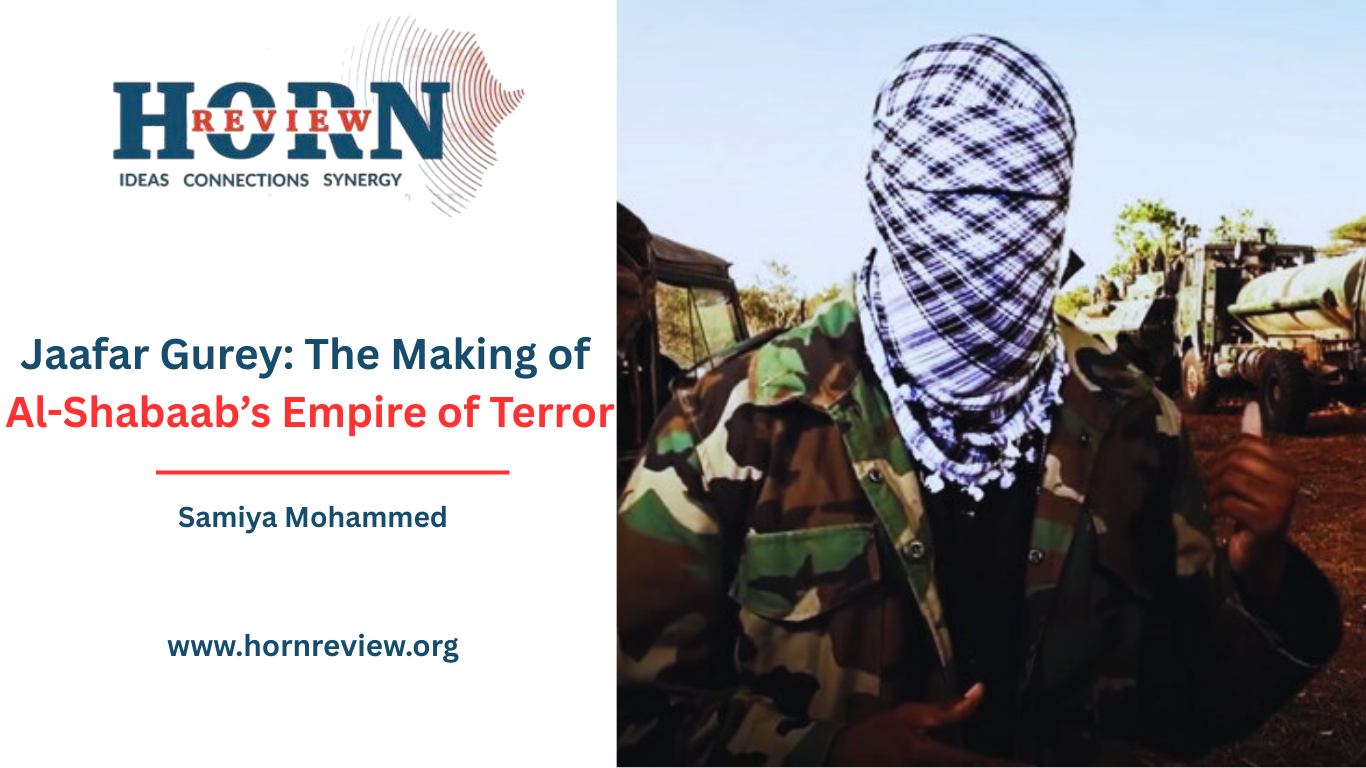
In the stealthy cloister of global jihadist networks certain names acquire near mythical status not through public pronouncement however through devastating silence that surrounds them. Mahmoud Abdi Hamud known exclusively by his alias Jaafar Gurey occupied precisely such a void. For two decades his apparition shaped the very design of Al-Shabaab which a node binding the terrorist organization’s operational lethality, financial sustenance, and internal security. More than a just operative, Gurey functioned as a foundational pillar and a covert strategist with unique mastery of penumbra warfare transformed an insurgent faction into a persistent regional threat. His role as spymaster, bomb maker, and financier created a buoyant and adaptable insurgency. His reported demise in the group’s Middle Juba forces which a retribution with the legacy of a man who operated from the deepest pall to inflict immense suffering and raises the perennial question of whether a movement built on ideological fervour and institutional resilience can ever be dismantled by removing one man no matter how central.
In a Somali society where identity, security, and power are tied to kinship and clan, Jaafar Gurey was abstract anomaly, a man without a public biography. No confirmed date of birth, no known clan affiliation, and no photographs exist in the public domain. This was not an accident of history. it is the deliberate artistry of a master of operational security. The very biographical void that surrounds him is the ultimate testament to the effectiveness of the internal security apparatus the Amniyat, which he helped to build and lead. He was a ghost who personifies the paranoia and perfectionism required to sustain a terror group under constant siege.
Gurey transpired from the Somalia’s chaos. His path to power began with the rise of the Islamic Courts Union in the early 2000s which a coalition of Sharia courts that filled a governing void and for a brief period in 2006 brought stability to Mogadishu by expiring secular warlords. The ICU’s de facto rule collapsed under Ethiopian military invasion in late 2006 and From this defeat, the ICU’s militia wing transformed into the insurgent force known as Al-Shabaab with Gurey among its founding cadre.
His survival and ascent within Al-Shabaab are as telling as his secrecy. He served as a close confidant to successive emirs where a leader notorious for his violent purges of internal rivals. That Gurey not only survived but thrived through this period of intense paranoia shows the deep, unquestioned trust placed in him at the highest levels. He was not just a lieutenant but he was a foundational pillar upon which the emir’s authority and the group’s security rested. Gurey’s unique and devastating power stemmed from his command over the three essential pillars of a modern insurgency, security, warfare, and funding. He was not a specialist but a generalist of terror, and his combination of roles made him irreplaceable for years.
As a chief planner of the Amniyat, Gurey built the machine that ensured Al-Shabaab’s endurance. This secret service with members operating with a central command structure and regional units often isolated from one another to limit penetration. Its functions are omnivorous, intelligence gathering, counterintelligence, assassination, suicide operations, and logistical support. if it did not exist, there would be no Al-Shabaab.The Amniyat’s primary mission is internal security where drilling fear into the rank and file to prevent dissent and espionage. Its methods are brutal, including the imprisonment and execution of suspected moles. Externally, the Amniyat runs sophisticated informant networks, even within the Somali government’s own National Intelligence and Security Agency to enable complex attacks. For Gurey, holding the titles of Head of External Security, Head of Leadership Security, and Head of Intelligence Tracking meant he was simultaneously the group’s chief hunter of spies and the ultimate protector of its leaders.
While his intelligence work was shrouded, Gurey’s operational hand was viscerally public. The U.S. Rewards for Justice program which placed a $3 million bounty on his head explicitly identified him as Al-Shabaab’s chief of explosives and the commander responsible for attack operations in Mogadishu. This put him in command of the group’s campaign of improvised explosive devices , vehicle-borne bombs, and suicide assaults that have defined Somalia’s urban conflict for a generation. The human cost of this portfolio is incalculable but etched in recurring headlines. While Gurey’s direct involvement in specific attacks is not always detailed the tactics he oversaw are the group’s signature. The Amniyat wing he helped lead was implicated in the planning of catastrophic cross-border attacks .His role ensured that the threat of sudden, devastating violence became a permanent feature of life in Somalia and a persistent danger to the region.
Far of the trigger and the detonator, Gurey was also a financier and strategist. Alongside Godane, he played various financial schemes to bankroll the insurgency. A primary method was and remains systematic extortion dressed as taxation from businesses and civilians in territories Al-Shabaab controls or influences. The group is estimated to raise millions per month through this illicit taxation, funds that pay for everything from fighter salaries to weapons procurement and intelligence operations. By controlling the purse strings and the security apparatus, Gurey wielded unparalleled influence over Al-Shabaab’s strategic direction and day to day survival.
The reported strike that killed Gurey in Bu’aale Middle Juba fits a clear pattern. It is the latest in a series of targeted killings aimed at eroding Al-Shabaab’s institutional memory by eliminating its founding generation. In late 2022, co-founder and proselytizing chief Abdullahi Yare was killed. In late 2024, Mohamed Mire the group’s de facto interior minister met a similar fate. These operations, often supported by U.S. intelligence and airpower show a deliberate strategy to decapitate the historical leadership. However, a crucial caution prevails. Al-Shabaab has not commented on Gurey’s death which is a standard practice to deny adversaries a propaganda victory. Furthermore, history warns against premature declaration. In December 2023, the Somali government announced the death of senior commander Maalim Ayman only for a UN report to confirm months later that he was still alive. Verification in the shadows of this conflict is inherently difficult.
Even if Gurey’s death is confirmed the central dilemma of counter-terrorism in Somalia remains unresolved. The loss of a figure so deeply woven into the group’s fabric creates a significant space. Al-Shabaab has repeatedly proven its organizational resilience. It is not a one-man operation but a multifaceted, adaptive organization with a deep bench of mid-level commanders, a financial system, and a compelling, if brutal, governance model for areas under its control. As evidenced by its ability to launch major assaults, like a brazen attack on a Mogadishu intelligence prison or seizures of towns in central Somalia, the group’s operational tempo can continue despite leadership losses.
Gurey’s legacy therefore is dualistic. He was a ghost whose genius for security, terror, and finance helped build an enduring jihadist state within a state. His death removes a key plan and a living repository of two decades of jihadist experience. But the machine he helped build is designed to outlast its engineers. The Amniyat itself is structured to survive the collapse of the main fighting force. The answer to who was Jaafar Gurey ultimately matters less than the sobering reality his career exemplifies like defeating an insurgency this requires more than hunting ghosts. It demands dismantling the very systems of control, fear, and survival that men like him spent their lives perfecting.
By Samiya Mohammed, Researcher, Horn Review