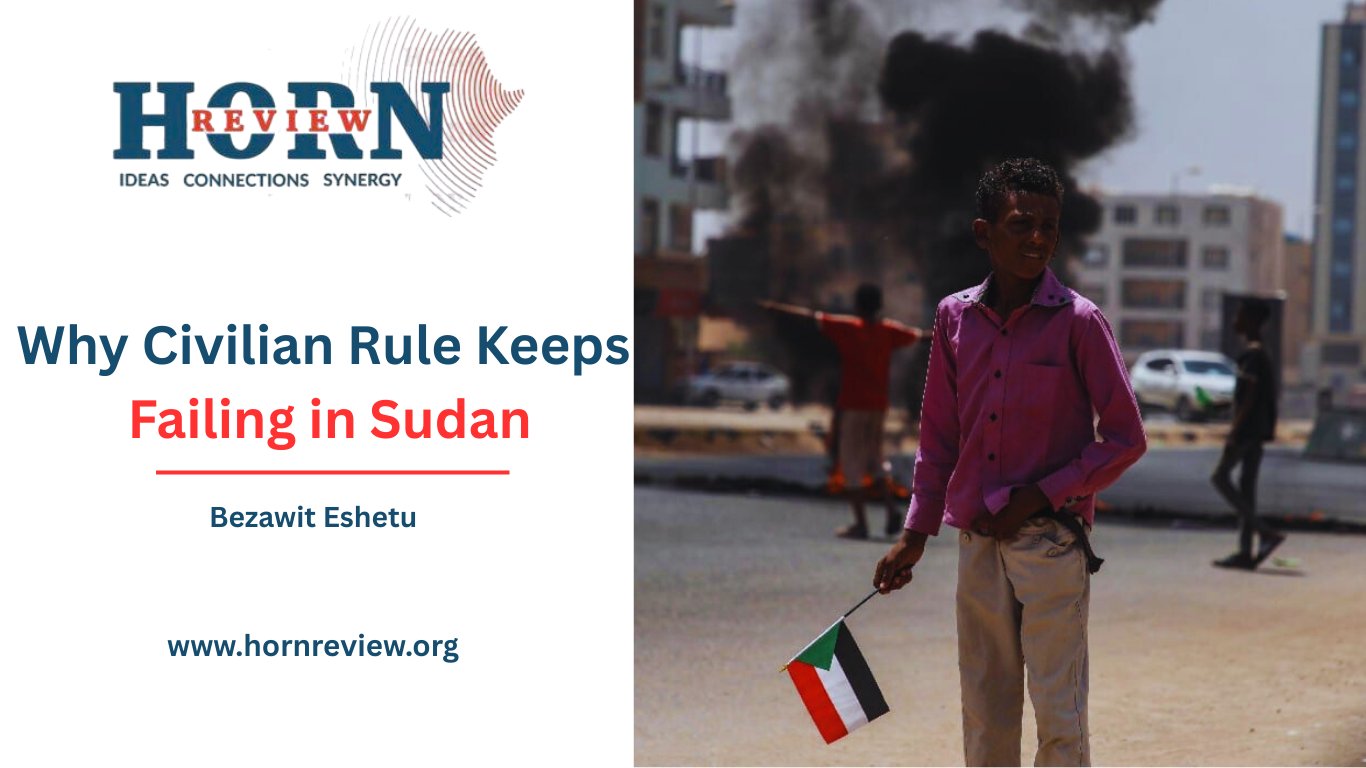
The United States and regional partners have renewed an assertive push in recent months to end Sudan’s descent into mass violence. In September, Egypt, Saudi Arabia, the United Arab Emirates and the United States issued a joint statement committing to restore peace and security in Sudan. More recently, on December 19, Saudi and U.S. mediators were reported to have presented a three-point proposal to Sudan’s army chief, General Abdel Fattah al Burhan, seeking a ceasefire, humanitarian access, and a sequence toward civilian rule. Despite this diplomatic choreography, a central question remains: can Sudan be governed by a civilian leader in the near term?
Skepticism rests on a simple empirical pattern. Since independence, Sudan’s political life has repeatedly been interrupted by coups and extended periods of military rule. Military institutions have not only seized power episodically but have also entrenched themselves as decisive arbiters of politics. Even when international diplomacy sketches a path to a civilian transition, those plans run headlong into actors for whom political influence is inseparable from armed capacity. That reality helps explain why, in November, General Abdel Fattah al Burhan publicly rejected a U.S. led ceasefire proposal as biased and unacceptable.
Two interlocking dynamics make a clean handover to a civilian administration unlikely. First, fragmentation and militarization of power inside Sudan mean civilian politicians often lack the coercive instruments needed to enforce national bargains. Urban political parties, whether long established groups such as the Umma or coalitions born of the 2019 uprising, are organizationally weak outside a handful of cities and rely more on international recognition than on territorial control. By contrast, armed formations, most notably the Sudanese Armed Forces and the paramilitary Rapid Support Forces, control troops, revenue streams and, in many places, the local economy. Where the balance of influence is enforced by force, electoral legitimacy alone is an insufficient guarantor of policy or security. The result is a governance ecology in which civilian officeholders are structurally subordinate to armed actors.
Second, the Rapid Support Forces’ transformation into an independent economic and territorial power complicates any transfer of authority to civilians. Over the past decade the RSF and its leadership consolidated fortunes and patronage networks through avenues such as control of gold production and trading networks, and through mercenary deployments, creating revenue streams that finance autonomous military capacity. That economic base allows the RSF to operate as a quasi-state actor and to resist political settlements that would subordinate it to civilian oversight. Any plan that assumes armed actors will disarm quickly or subordinate themselves to civilian institutions is therefore just overly optimistic unless it is backed by credible coercive guarantees, which are difficult to assemble given the fragmentation of regional and international positions on Sudan.
Regionally, Cairo’s posture creates an additional impediment to civilianization. Egypt’s security calculus toward Sudan is shaped by concerns over the Nile, border stability and a preference for predictable regimes that align with Cairo’s strategic priorities. In recent years Khartoum’s military leadership has been a natural interlocutor for Cairo because it offers what Egyptian officials view as greater predictability on cross border flows and defense posture. The prospect of a civilian government that might reorient policy or loosen military ties has generated strategic anxiety in Cairo, and Egyptian statements and actions in late 2025 underscore a willingness to protect what Egypt regards as core interests, including through formal defense arrangements and active leverage. That dynamic pushes Egyptian policy toward favoring military actors in Sudan over uncertain civilian coalitions.
A full appraisal must also account for the multiplicity of armed actors with local grievances and ambitions. Beyond the SAF-RSF duopoly, Sudan’s peripheries shelter well-armed insurgent groups: Darfur movements, the SPLM North in the south west, Beja and eastern militias, and a variety of local commanders, each with distinct political projects, economic interests and territorial aims. Many of these groups have been shaped by decades of marginalization and have little incentive to accept a central civilian government that cannot credibly deliver security, services or meaningful power sharing. For some, the logic of autonomy or conditional alignment with armed patrons looks safer than a risky bet on a fragile, urban centered civilian administration.
This is not merely a technical governance problem. Civilian politicians frequently lack the cross regional legitimacy or bargaining leverage to bring armed proxies into a stable national compact. Civil society coalitions such as the Somoud Alliance demonstrate deep civic energy and legitimacy born of grassroots activism, but their capacity to translate moral authority into territorial or coercive control is limited. In a bargaining environment where armed groups can veto political outcomes by force, civilian leaders negotiate from a position of weakness unless external actors are prepared and able to provide credible security guarantees. Regional actors have historically been reluctant to furnish guarantees that would significantly weaken their own leverage.
External patrons further complicate incentives for domestic actors. The Quad itself exemplifies divergent external agendas. The United States has publicly emphasized a preference for a civilian transition, while Gulf capitals and Cairo have at times cultivated ties with rival Sudanese security actors. The United Arab Emirates has been repeatedly accused in reporting and investigations of logistical and material links that benefited the Rapid Support Forces, while Egypt and Saudi Arabia has traditionally aligned more closely with the Sudanese Armed Forces. When outside states offer alternative patrons, armed groups can secure resources, sanctuary and diplomatic cover instead of having to compromise at the negotiating table. That external safety net lowers the political cost of rejection for spoilers and creates an equilibrium in which military or paramilitary actors find it rational to resist integration. If the regional balance of incentives supplies funding, weapons or the implicit promise of impunity after a settlement, then civilian governance becomes an inferior and unstable outcome that is difficult to reach and easy to unravel.
This is not merely a theoretical consideration; it reflects a historical pattern in Sudan’s recent past, where repeated civilian openings have consistently collapsed when faced with entrenched armed power and competing external patrons. The 2019 popular uprising successfully toppled Omar al-Bashir, yet the subsequent transition was forged on a precarious bargain between civilians and the security sector. Prime Minister Abdalla Hamdok faced significant challenges in translating public legitimacy into effective control over the security services. Following the military’s seizure of power on October 25, 2021, Hamdok initially entered into a brief agreement with military leaders; however, he resigned on January 2, 2022, citing his inability to stabilize the transition or achieve a workable consensus.
This pattern is not isolated. Historical precedents further underscore the vulnerability of civilian administrations in Sudan, particularly when they fail to assert control over force and patronage networks. The 1989 overthrow of Sadiq al-Mahdi serves as a stark reminder that civilian governments are often susceptible to coup when lacking the necessary means to neutralize armed veto players. Additionally, the involvement of external actors complicates the landscape, as they can incentivize spoilers, undermining the fragile victories achieved by civilian governance. Collectively, these episodes highlight the persistent challenges faced by civilian political gains in Sudan, revealing a landscape where stability remains elusive without a robust mechanism to counteract militarized power.
Because the core problem is the entrenched interaction of domestic armed capacity and external patronage, any transition to civilian rule remains a theoretical exercise unless four conditions are satisfied at once. Those four conditions are mutually reinforcing and precisely defined: a single, fully accountable chain of command; a political compact that devolves meaningful authority and resources to peripheral regions so that they have a stake in the state; coordinated regional action that effectively severs external lifelines to armed actors; and a functioning domestic administrative architecture capable of delivering basic services, adjudicating disputes, and sustaining local peace agreements. None of these prerequisites exists at scale today. Sudan has moved toward a de facto partition in which competing authorities have taken root, with the army reconstituting a center of power in Port Sudan while the paramilitary Rapid Support Forces have entrenched rival control across western territories. The capture of El Fasher and the mass atrocities reported there have further destroyed local governance and social trust. Famine conditions confirmed in El Fasher and in Kadugli have compounded the collapse of administrative capacity and the ability to sustain any political bargain.
These dynamics make the usual policy prescriptions far harder to implement in practice. On paper the priorities are clear: secure credible protections for civilians, use calibrated leverage to manage spoilers, and pursue pragmatic incremental gains through local ceasefires that can be consolidated into broader arrangements. In reality the regional and strategic environment is fragmented, with influential capitals pursuing different and sometimes competing objectives, which has allowed external support to continue despite international statements in favor of a roadmap to peace. The contest for key economic assets has joined the military logic of territorial control to a struggle for revenue and leverage, as fighting around the Heglig oil complex has shown, turning what might have been a contained hotspot into a central lever in the conflict. Unless those regional incentives change and external actors accept the priority of Sudanese stability over short term strategic gains, the four necessary conditions for a genuine civilian transition will remain unattainable and civilian governance will continue to be undermined by competing armed authorities and a shattered administrative base.
By Bezawit Eshetu, Researcher, Horn Review