Sudan’s descent into catastrophic civil war in April 2023, now one of the world’s largest humanitarian crises, was not an unforeseen tragedy. Rather, the transition institutionalized incentives that made elite conflict more rational than compromise. The 2019 revolution, which toppled Omar al-Bashir’s thirty-year of dictatorship, gave way to a fragile power-sharing arrangement that entrenched a Dual Power Trap.
This arrangement, established under the 2019 Constitutional Declaration, tasked a technocratic civilian cabinet with the burden of state survival and macroeconomic stabilization while systematically denying it the authority to control the country’s coercive instruments or its lucrative economic assets. The failure of Prime Minister Abdalla Hamdok’s government thus reflects a fundamental contradiction: the demand for deep structural reform within a political vacuum where sovereignty remained firmly in the hands of the generals.
The Constitutional Declaration was met with initial jubilation but contained the seeds of its own destruction. By granting the military a permanent veto over civilian policy through the Sovereignty Council, the document created a governance model in which civilians held responsibility without authority. Sovereignty Council members were granted essentially lifetime appointments with no mechanism for removal, enabling the military to hijack the cabinet’s functions during delays in government formation.
A critical turning point was the failure to establish the Transitional Legislative Council; this was not merely a product of elite fragmentation but the result of deliberate military obstruction, tacitly enabled by civilian disunity and external pressure that prioritized speed and stability over institutional completeness.
In the absence of a legislative body, the military-led Sovereignty Council assumed lawmaking powers, effectively allowing the security apparatus to block any reform that threatened its interests. This institutionalized ambiguity enabled the military to stall progress on security sector reform and transitional justice while maintaining a ‘civilian facade’ to secure international legitimacy.
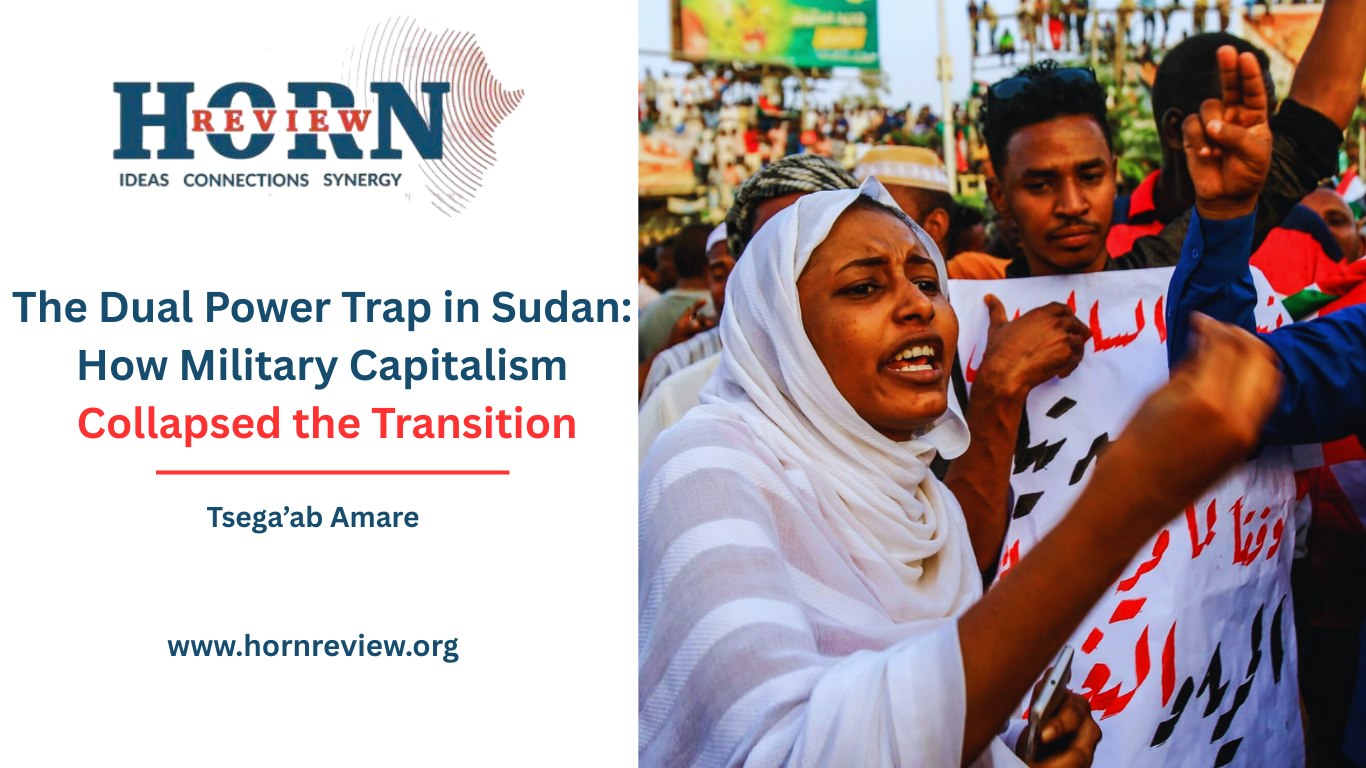
While the institutional framework faltered, a parallel diagnosis emerged from Sudan’s streets. The Neighborhood Resistance Committees (RCs), the decentralized networks that had engineered the mass mobilization against Bashir served as both the conscience and the Cassandra of the transition.
Unlike the political parties of the Forces of Freedom and Change (FFC), who accepted the Dual Power arrangement as a pragmatic necessity, the RCs treated the military’s involvement in politics as fundamentally incompatible with civilian rule. Through instruments such as the Revolutionary Charter for People’s Power, they articulated a bottom-up governance model explicitly rejecting the elite pact in favor of full civilian rule. They accurately predicted that the so-called partnership was not a bridge to democracy but a stalling tactic allowing the generals to consolidate their patronage networks.
This created a significant legitimacy gap for Prime Minister Hamdok. While the cabinet sought validation and funding from Western capitals, it lost its anchor in the streets. The RCs’ slogan “No negotiation, no partnership, no legitimacy” was more than rigid idealism; it was a detailed analysis of Sudan’s power dynamics. By ignoring these warnings in favor of stability, the transition alienated the only constituency capable of defending it, leaving the civilian government isolated when the generals moved to terminate the experiment in October 2021.
The transition was further undermined by the military’s role as a dominant economic actor. Under Bashir, the policy of Tamkeen (empowerment) allowed the security sector to seize control of major corporate assets. The Sudanese Armed Forces (SAF) control the Defense Industries System (DIS), a conglomerate generating an estimated $2 billion in annual revenue across hundreds of subsidiaries in agriculture, banking, and transport. DIS operates with broad exemptions from taxation and public audits, contributing little to the national budget even as the civilian government faced a $250 million monthly deficit.
Parallel to the SAF, the Rapid Support Forces (RSF) constructed a gold shadow state. Following the seizure of the Jebel Amer mine in 2017, gold replaced oil as Sudan’s primary source of foreign currency. The RSF utilizes firms such as Al Junaid and UAE-based front companies like Tradive General Trading to manage gold exports and procure military equipment, bypassing formal state oversight. For the generals, civilian demands for transparency and the transfer of state-owned enterprises to the Ministry of Finance were perceived as existential threats to their material survival.
The international community reinforced the Dual Power Trap by prioritizing short-term macroeconomic stabilization over political restructuring. International Financial Institutions (IFIs) pushed for stringent reforms, including fuel subsidy removal and exchange rate unification, to satisfy the Heavily Indebted Poor Countries initiative. While necessary to address Sudan’s $56.6 billion debt burden, these measures placed the full costs of austerity on the civilian cabinet.
This stabilization bias allowed the military to remain insulated from public anger while civilian support eroded under hyperinflation, which reached 150.3 percent in 2020. External actors continued to engage the SAF and RSF as indispensable partners in regional security, signaling to the generals that their international relevance was decoupled from any genuine commitment to democratic transition.
Sudan’s experience mirrors a broader pattern in hybrid regimes where militaries concede governance roles without relinquishing coercive control. In Myanmar, the 2008 military-drafted constitution forced civilians to cohabit with an army that retained 25 percent of parliamentary seats and control over key security ministries. In Egypt, the military entrenched expansive prerogatives to shield itself from civilian oversight. Sudan’s unique vulnerability lay in the fragmentation of this military power; competition between the SAF and RSF over state revenues rendered a peaceful transition structurally impossible.
The October 2021 coup and the subsequent 2023 war demonstrate that dual power is not a transitional phase but a trap that culminates in state collapse. Future transitions must treat the establishment of a unified national army under civilian oversight as a non-negotiable benchmark. This requires sequenced enforcement: third-party verified audits of military-owned enterprises, targeted disruption of the commercial networks and front companies that finance armed actors, and conditional international engagement tied to measurable progress in security sector reform.
Ultimately, Sudan’s best hope lies in the civic structures that have survived the state’s collapse. However, this potential can only be realized if the international community ceases to treat armed actors as the only architects of the future and begins to engage the grassroots networks that actually represent the Sudanese people.
By Tsega’ab Amare, Researcher, Horn Review