
19
Dec
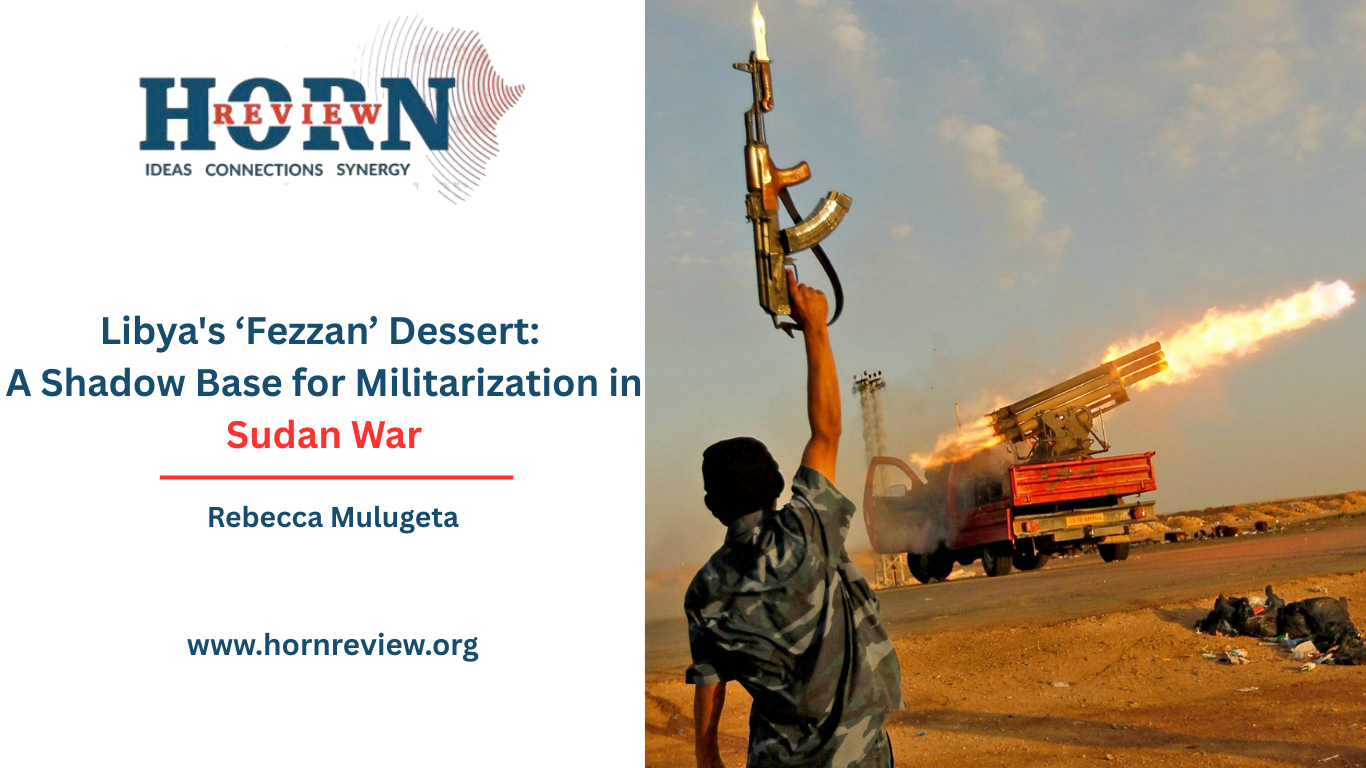
Libya’s ‘Fezzan’ Dessert: A Shadow Base for Militarization in Sudan War
This desert route is more than empty sand rather it is a political engine that devours nations. The area known as Fezzan and, more specifically, the vast territory of ungoverned desert that stretches from southern Libya, through northern Chad, into Darfur, has effectively become a perpetual bottleneck where the future of Sudan, Somalia, and even lands farther afield is implicitly determined. It is a sector where governments do not, or cannot penetrate yet politics is palpably at work only it is a politics that uses convoys, Kalashnikovs, and pieces of drones rather than constitutions and parliaments.
The history of the Fezzan Desert is one that began with Gaddafi and has not ended since. His regime began to arm the Tuareg and Tebu groups living at the rim of the Fezzan to extend his influence into Chad and Niger, protecting himself against threats from the south. When Gaddafi’s hold on power weakened, these weapons didn’t collect dust; instead, they became the assets of new factions. Smugglers and mini-warlords realized that capturing a desert border-crossing might garner them influence over a larger area. Since the Libyan conflict divided the country into a Tripoli and an eastern state, there was no legitimacy or strength to regain the desert. So the Fezzan has effectively slipped out of the world of hard politics and into a twilight zone governed by demand and supply and the need to survive.
So, in this grey zone, the Sahara itself is a choke point. Who controls the Sahara Corridors will, by extension, control the flow of weapons, fuel, fighters, and illicit goods into and out of the zone. And this flow is merely passing through: it changes the politics of every country it passes through. A good case in point is the recent civil war in Sudan. The conflict between the Sudanese Armed Forces and the RSF is, of course, told in a way that is more focused an internal conflict for a greater Sudanese objective, fought between rival elements of a now largely unified army, but the longevity and hardness of this conflict is inescapably bound up with the fact that all sides have access to the corridor, and can call upon it for resupply. The RSF leaders in Darfur exchange enough gold and such to procure arms and transportation to pass through this particular corridor, while elements of the armed forces have also nurtured their own connections in Libya and Chadians, such that this corridor means that, for either side, it is in every way an open-and-shut case of war without end, since there is no such thing as running dry, as there is simply, well, the Sahara. SAf use this desert indirectly to access fuel and commercial supplies when other corridors are blocked, and also as intelligence and monitoring zone where SAF watches the RSF supply lines and tracks
This indeed changes the political calculus of the conflict in Sudan because a loss without the desert would mean the loss of relevance for a political faction, but the desert means the loss is merely a redeployment to a rear area that is out of the Sudanese state’s grasp, and there the fighters can reform, retrain, and rearm and return to the fray. This is no mere remote-thinking consideration because it informs choices about what to do and when because the hard men on both sides know that they are not going to be finished no matter whether they choose to compromise or not because of the desert, and so the desert is a major reason why the conflict in Sudan has been so recalcitrant to compromise because even the most promising ceasefires have defaulted back into conflict.
The ungoverned nature of this realm also ensures that there is a political economy which links Sudan’s war to actors outside its immediate surroundings. The smugglers of guns southwards rarely differentiate between different groups in Sudan; guns are sold to those with cash. Foreign powers with interests in Libya or Sahel regions find an opportunity to make inroads in Sudan through their agents with access to this market. The jihadists, in turn, since they had access to some parts of the Sahara, follow the same routes to move people and goods. Thus, in some ways, the war in Sudan is also fought in distant places, that is, in smoky cafes in Sabha, in Agadez, or in other remote border towns with not a single Sudanese in sight.
The inevitable result of this dynamic is the over‑militarisation of Sudan’. Arms flowing from Fezzan and similar nodes do not remain in the hands of main factions alone. They leak into local markets, tribal militias, criminal gangs, and self‑defence groups. Regions such as Darfur and Kordofan become saturated with small arms and heavy weapons. Once such densities have been reached, violence becomes a default tool of politics. Grievances which might otherwise be negotiated through customary institutions or local councils are instead expressed through ambushes, raids and sieges. The desert choke point thus does not just fuel the central war but transforms everyday politics on the periphery into a series of micro‑wars.
The same corridor and the rational framework that sustains it are also, however, pressing eastward to Somalia. In this instance, the impact is more scattered, but equally significant. The conflict between Somalia and al-Shabaab has had a regional character all along, but a significantly militatised strip between Fezzan and Sudan establishes a broader set of circumstances through which weapons, combatants, and know-how flow quite readily. Al-Shabaab has a strong connection to such a set-up, whether directly or incidentally. Weapons that transit through Sudan’s territory tend to migrate to areas along eastern Sudan, through the Red Sea, to those along the Gulf of Aden as “landing spots.” When these reach that particular body and coastal area, these are then readily available to Somali suppliers via distant partners, or via outright smuggling ventures.
This enhances al‑Shabaab’s bargaining position inside Somalia: a movement that can rely on external resupply is harder to contain. It can absorb losses, replace equipment, and sustain more ambitious operations. Meanwhile, the existence of a regional war economy makes it easier for Somali local elites to hedge their bets. A governor, a clan chief, or a militia leader in Jubaland or Puntland confronts a choice: bind their fate to a fragile federal government, or cultivate relations with transnational networks that can deliver cash and guns. The more that Sudan’s conflict depends on the desert, the more normalized those networks become, and the more tempting it is for Somali actors to engage with them. Hence, Somalia’s stability erodes not only because al‑Shabaab becomes stronger, but because the whole political marketplace tilts toward armed, transactional, and externalized forms of power.
Ethiopia cannot remain untouched by this logic. The country sits to the southeast of this militarised belt, but violence radiates outward. Sudan’s implosion is already displacing people into Ethiopia’s western borderlands. If arms and fighters continue to flow across the desert into Sudan, many will not stop there. Weapons will follow refugee flows into Gambela and Benishangul‑Gumuz, they will travel along ethnic and commercial networks. Ethiopia’s own internal fractures and recent memories of war in Tigray, mean that an influx of weapons and conflict‑hardened individuals from Sudan can act as an accelerant. Even if the country maintains a stronger central grip than Khartoum, every additional layer of militarisation at its borders increases the cost of governance and narrows the room for political solutions.
External actors willing to use the Fezzan–Sudan corridor as a channel of influence in Khartoum may be tempted to replicate similar strategies elsewhere. The idea that you can shape a state’s political path by arming proxies via ungoverned spaces becomes a template, not an exception. This is how a hotspot in the Sahara can end up distorting security calculations on the Abay, the Nile, and the Red Sea.
Beyond the Horn, the same corridor links the Sahel, North Africa, and the Red Sea basin into a single, fragile arc. In Mali, Niger, and Burkina Faso, coups and insurgencies have already created environments where desert-based armed actors hold more real power than formal institutions. Fezzan is part of that wider geography of ungoverned. The more entrenched its militarised order becomes, the more it acts as a model for other regions. proof that you can run a profitable war economy from the margins, that you can survive indefinitely without recognition, that you can weaponize geography against states. Over time, this risks creating a continuous belt of shadow sovereignties stretching from the Atlantic Sahel to the Indian Ocean, each feeding the others with fighters, weapons, and ideas.
What makes this particularly dangerous is not just the flow of arms, but the way it changes political imaginations. Militia leaders in Darfur, groups in Somali hinterlands, ambitious officers in the region commands all see that the desert offers a kind of open space freedom from central control, freedom from legal constraint, freedom from the budgetary limits that bind regular state institutions. As long as there is a demand for violence in Sudan’s cities, on Somalia’s roads, there will be money to be made in supplying it from these ungoverned corridors. The desert becomes not just a route, but an aspiration.
A serious political analysis of this situation must therefore move beyond seeing Fezzan and its satellites merely as sources of small arms or routes of trafficking. They are that, but they are also laboratories where new forms of authority are being tested and refined: authority based on control of movement rather than territory, on taxation of flows rather than populations, on relationships with foreign sponsors rather than domestic constituencies. Sudan’s war has already been redesigned by this model. Somalia’s fragile federal project is increasingly exposed to it. And beyond the Horn, the same model whispers to marginalized actors from the Sahel to the Red Sea
In this respect, the Fezzan corridor is the true choke point, not just in the sense that physical transit routes pass through it, but in the sense that the political futures are being narrowed by it. So long as it falls within the purview of the armed networks, so long will the transit routes remain and expand exponentially of the over-militarization, the breakdown of the state, the proxy wars that now reach well beyond Sudan and Libya. Here, then, the question is not one of “securing the border” or blasting the occasional convoy. On the contrary the Fezzan needs to have the elements of legitimate governance reintroduced, forcibly if need be, among those areas which have learned so well the benefits of functioning so well without them. Until such time as the desert stops making history in Sudan, Somalia, Ethiopia, or those nations which have yet to feel the sand but can yet anticipate the shockwaves.
By Rebecca Mulugeta, Researcher, Horn Review

RELATED
Posts
2
Apr
The New Security Reality of the Horn of Africa and Middle East
For a long time, political analysis treated the Middle East...
2
Apr
Somalia’s Blue Economy Deal with Turkey
The 2026 launch of SOMTURK marks a significant shift...
2
Apr
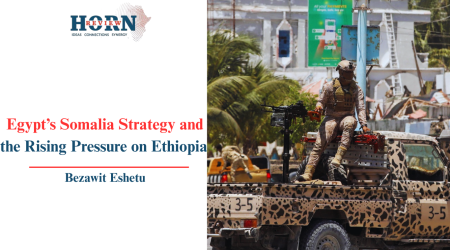
Egypt’s Somalia Strategy and the Rising Pressure on Ethiopia
As federal Somali National Army units, equipped with armor and...
2
Apr
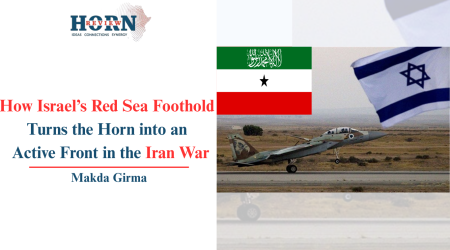
How Israel’s Red Sea Foothold Turns the Horn into an Active Front in the Iran War
Two weeks on from the joint U.S.-Israeli strikes that hit...
30
Mar
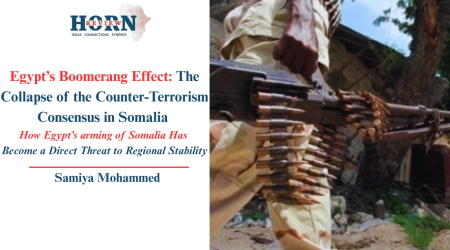
Egypt’s Boomerang Effect: The Collapse of the Counter-Terrorism Consensus in Somalia
How Egypt’s arming of Somalia Has Become a Direct...
30
Mar
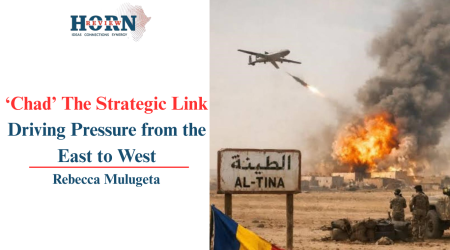
‘Chad’ The Strategic Link Driving Pressure from the East to West
There is a tendency to read Africa’s conflicts as if...
30
Mar
Sudan’s Shadow Alignment: Military Dependence and Diplomatic Denial Amid a Middle East War
The geopolitical orientation of the Sudanese Armed Forces (SAF), under...
30
Mar
Kenya’s Coast and the Future of Land Reform
President William Ruto’s plan to formalize unused coastal land is...
26
Mar
Sudan’s Shadow Alignment: Military Dependence and Diplomatic Denial Amid a Middle East War
The geopolitical orientation of the Sudanese Armed Forces (SAF), under...