
18
Dec
The Political Making of the Aswan High Dam: A Legacy of Failure and Missed Alternatives
By Yonas Yizezew, Researcher at Horn Review
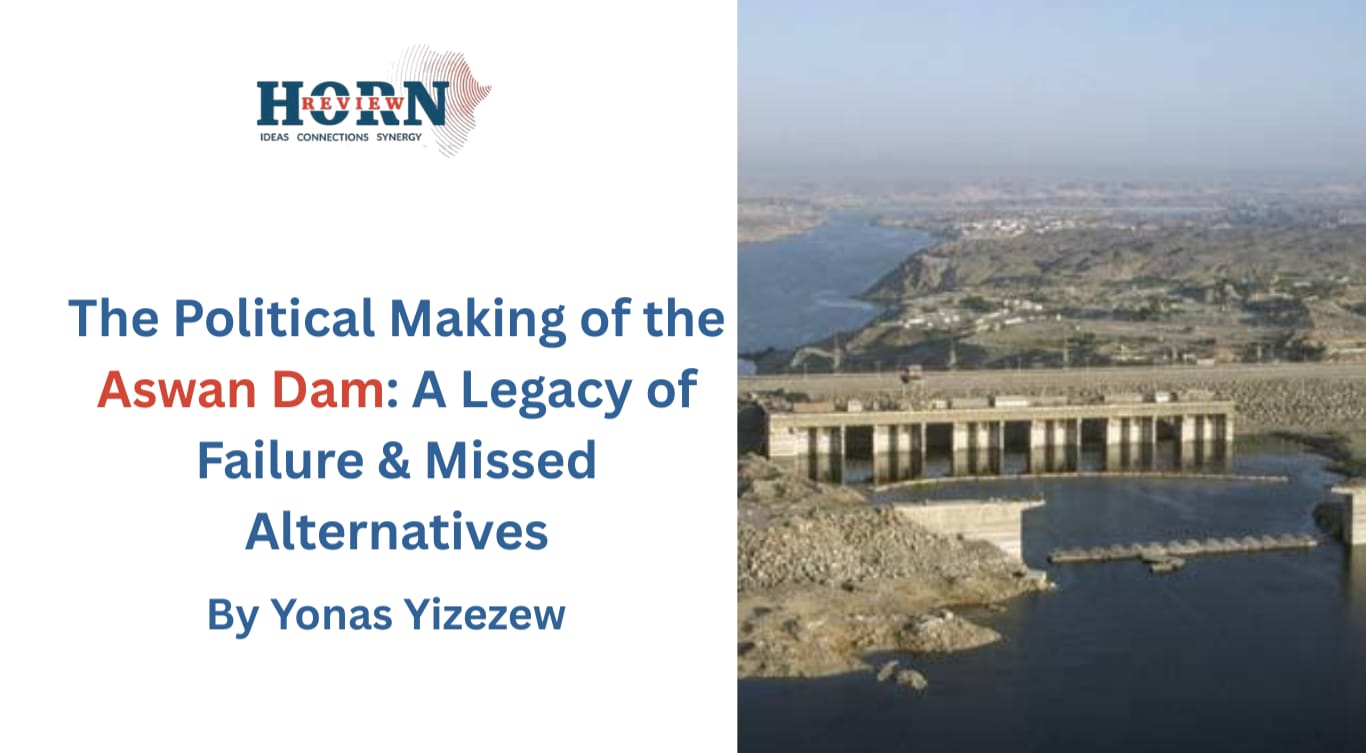
The Aswan High Dam ranks among the most audacious engineering projects of the twentieth century, yet its legacy exposes a cascade of political calculations that eclipsed scientific prudence and human equity. While it brought benefits in electricity generation and irrigation, the dam imposed enormous costs, including environmental disruption, social displacement, and the near-total destruction of Nubian civilization and culture. Its construction was inhumane and politically motivated, prioritizing state power over human welfare and producing inequitable distribution of costs and benefits, leaving a legacy of cultural genocide and long-term societal harm. Understanding the project requires examining the interplay of technical options, political priorities, and historical legacies.
The project exemplifies how political imperatives can override engineering rationality and impose disproportionate burdens on vulnerable populations and ecosystems. Colonial legacies established the foundational tension between upstream efficiency and downstream control. British engineers grappled with the Nile’s hydrology from the late nineteenth century and they understood that the Blue Nile, which originates in the Ethiopian highlands, supplies about most of the river’s annual flow. Lake Tana presented an optimal storage site since its natural basin and cooler climate would minimize evaporation. Yet successive regimes chose Aswan for its territorial legibility and centralized authority, and that choice shifted massive costs onto Nubian communities, downstream environments, and upstream riparian states. The technical literature and imperial records document viable alternatives that favored distributed highland regulation, and the path ultimately prioritized national symbolism over hydrological optimization and equitable basin management.
Colonial Hydrology and the Road Not Taken
British involvement in Nile control began with the occupation of Egypt in 1882. That intervention served to secure the Suez Canal and to stabilize the financial crisis created by Khedive Ismail’s debts. For the British, water management was primarily an instrument for protecting imperial economic interests. Egypt’s cotton exports fed British textile mills and the seasonal variability of the Nile posed both agricultural opportunity and political risk. Sir William Willcocks, designed the Aswan Low Dam and oversaw its construction with contractors such as Sir John Aird and Company. The Low Dam was later raised twice under Sir Murdoch MacDonald, yet Willcocks’ early reports from 1901 already warned about the limitations of lowland storage. He flagged sedimentation and evaporation as persistent technical problems and he advocated upstream solutions to capture Blue Nile flows at source.
The Century Storage Scheme emerged as the pinnacle of this hydrological foresight, a comprehensive blueprint crafted by British experts like Harold E. Hurst. It aimed to regulate Nile waters across seasons and years, capturing flood surpluses for drought deficits through a network of upstream reservoirs. This plan explicitly rejected downstream impoundment, spotlighting Aswan’s inadequacy due to evaporation rates that could squander up to 16 billion cubic meters annually from its vast, sun-baked expanse. Preliminary assessments pegged Tana’s evaporation at under 2 billion cubic meters yearly, a fraction of Aswan’s toll, while distributing storage would trap sediment at source, preserving downstream fertility and delta integrity. British hydrologists dismissed Aswan outright as “not worthy of serious consideration” and riddled with “mad ideas for the Nile,” a verdict rooted in empirical modeling that projected lowland reservoirs losing 12 to 15 percent of inflows before utilization. Politically palatable within Egyptian territory, Aswan supplanted the Century Scheme, inaugurating a hydro-hegemonic template that deferred reckoning with riparian interdependence.
Interest in Lake Tana grew in the 1920s when British engineers conducted surveys that identified the lake as a superior storage site. Various reports positioned Tana as technically attractive as its elevation and climate would reduce evaporation substantially. At about 1800 meters above sea level, the highlands are much cooler and they offer the practical advantage of storing water where losses to the atmosphere are lower. British political actors, including Lord Curzon, pressed for negotiations with Ethiopia in the 1920s that envisioned long term leases and technical assistance for development at Tana. Emperor Haile Selassie resisted these overtures on sovereignty grounds when he ascended the throne in 1930. The 1929 Anglo-Egyptian understandings codified downstream prerogatives by articulating Egyptian historical claims to the Nile and by embedding constraints on upstream projects. In effect, the colonial legal architecture limited Ethiopia’s freedom to develop storage in the highlands without downstream consent.
National Symbolism over Scientific Prudence
During King Farouk’s reign, infrastructure debates continued but progress stalled. Palace excesses and the disruptions of the Second World War weakened the monarchy’s legitimacy and the state found it difficult to marshal the finance and political will for a transformational project. By the early 1950s, competing priorities and institutional weakness meant the monarchy could not move decisively. Public discontent, elite fragmentation, and the allure of a dramatic national project created fertile political ground for the military.
When the Free Officers overthrew the monarchy in July 1952 they inherited a set of technical proposals that included high dam options. The new leadership needed national projects to produce visible change and to consolidate legitimacy. The Free Officers therefore treated the dam as a powerful state narrative that could be readily communicated to domestic and global audiences. Political urgency and the promise of a single, monumental achievement contributed strongly to the decision to prioritize a large reservoir within Egyptian territory.
The Aswan High Dam has been colloquially called ‘Nasser’s Pyramid,’ reflecting its status as a national project associated with Gamal Abdel Nasser. Under Nasser, the dam acquired its full political meaning as a symbol of modernization and getting political legitimacy. Nasser publicly framed the High Dam as the centerpiece of national development when he announced the project in 1954. He promised massive electrical production and wide irrigation gains to the people.
At first, the United States and the World Bank appeared willing to finance the project. In 1955 U.S. authorities pledged a large portion of the needed funds on conditions tied to Egypt’s political alignment. The Suez crisis of 1956 and the surrounding military interventions complicated this relationship. Following the Suez crisis, U.S. administration pressure, influenced by geopolitics and concerns about Soviet influence, led to the withdrawal of Western funding offers. Facing this vacuum, Egypt turned squarely to the Soviet Union, which provided loans, machinery, and technical assistance. Soviet assistance was decisive in keeping the project on the timeline that the Egyptian leadership wanted, and the Soviet role cemented the dam’s status as a Cold War symbol of third world assertion. With technical and financial backing secured from Moscow, construction began in earnest in 1960 and continued through the 1960s until the dam’s operational completion in 1970 and its formal inauguration in 1971. The political narrative of national achievement remained central to the regime’s legitimacy project even as the technical and environmental consequences of the site choice accumulated.
Environmental Costs of a Lowland Megadam
The physical consequences of placing the world’s large reservoir in a hot, lowland desert were predictable on scientific grounds and have been confirmed by subsequent hydrological research. A broad open water surface in high temperature and wind exposed conditions increases evaporation dramatically and Lake Nasser performs exactly as first principles predicted. Multiple studies and field measurements converge on annual evaporation losses ranging between 10 to 16 billion cubic meters. These losses are not an incidental inefficiency, they represent a material reduction of the Nile’s effective yield year after year and is equivalent to 20 to 30% of the Egyptian income from Nile water. If a significant share of long term storage had been sited in the cooler highlands, the evaporation debit would have been substantially lower and the basin’s net available water would have been larger. Those technical considerations transformed the site choice into a political lever as evaporation reduces the amount Egypt could reliably guarantee downstream and since it alters long term bargaining positions among riparian states.
Lake Nasser has lost 770 billion cubic meters of water to evaporation since full impoundment in 1970 through 2025. This uses the average rate of 14 billion cubic meters per year over 55 years. The total equals 4.6 times the lake’s live storage capacity of 90 billion cubic meters.
Engineering reports and historical studies record that highland storage options at Lake Tana and cascade schemes through Sudan would have reduced evaporation losses and improved sediment management. The decision to site the principal reservoir at Aswan therefore becomes intelligible as an intentional preference for territorial control and for a national demonstration that could be directly managed and claimed by Cairo. That political calculus explicitly traded hydrological efficiency for immediate national visibility and for relatively easy control. The result was a storage architecture that carried substantial transboundary costs through lost water and altered downstream dynamics.
Beyond evaporation, the High Dam produced another long run physical effect by interrupting the natural movement of sediment. Historically, the Nile’s annual inundation carried silt that replenished floodplain soils and maintained delta morphology. Once a single large reservoir trapped the majority of that sediment in Lake Nasser, the downstream floodplain lost its principal source of natural soil renewal. The reduction in nutrient flux downstream also altered Mediterranean coastal productivity and contributed to shifts in fishery composition, with effects felt by coastal communities that once relied on nutrient driven abundance.
The delta itself became more vulnerable since regular silt deposition had been a key process maintaining its elevation relative to sea level. Without that input the delta faced enhanced erosion and increasing exposure to sea level rise. Sediment accumulation in the reservoir also imposes a maintenance liability, as deposit build up progressively reduces live storage and may shorten the functional life of a reservoir unless costly dredging or other management measures are employed. These dynamics are structural and not merely transient side effects, and they have changed the long run resilience of Egyptian agriculture and coastal systems.
At about 100 million tons of Nile silt are trapped each year, forcing farmers to use more chemical fertilizers to maintain soil fertility. Fertilizer use rose sharply in the first decade after the dam and continues to grow, costing hundreds of millions of dollars annually and requiring large investments in state fertilizer plants like Abu Qir and Talkha. The loss of sediment also causes delta erosion, affecting around 124,000 hectares of farmland and coastal areas, with estimated annual losses of $100–200 million. Evaporation from Lake Nasser (10–16 BCM/year) represents another major loss, worth roughly $5–10 billion annually in potential water value. Additional expenses for drainage and salinity control exceed $500 million per year
Displacement and the Erasure of Nubian Life
The human costs of the Aswan project are concentrated most visibly in the fate of Nubian civilization and communities whose homes and cultural landscapes were inundated by Lake Nasser. The creation of the reservoir submerged vast tracts of Lower Nubia on both the Egyptian and Sudanese side of the border and required the relocation of hundreds of thousands of people. The resettlement program built new villages and provided housing, but the outcomes for livelihoods, civilization and cultural continuity were uneven. Traditional grazing lands and irrigation practices were lost, local ecological knowledge that had framed seasonal rhythms was disrupted, and sacred places and ancestral sites were inundated. The lived experience of many displaced families included declines in agricultural yields, strains on food security, fractures in social structure, and persistent psychological effects.
Scholarly fieldwork and longitudinal studies have documented these outcomes. Scudder’s resettlement research and other follow up work found that displacement produced complex welfare trajectories. In many cases long term social and cultural markers declined even where physical infrastructure was provided. UNESCO oversaw the largest artifact relocation of its time to save Nubian monuments threatened by the Aswan High Dam, yet the process itself inflicted significant damage. Many structures had to be cut, dismantled, and reassembled since they could not be moved intact, leaving scars that permanently altered their integrity.
The UNESCO campaign reportedly relocated 22 major temples and complexes costing $80 million in total, threatened by Lake Nasser’s flooding from the Aswan High Dam. Qasr Ibrim is the only site left in its original location. It is a medieval fortress with ancient chapels and a cemetery that became an island above water levels. The other 22 were all dismantled and moved. Eleven were rebuilt at nearby higher sites. These include Abu Simbel’s Great and Small temples cut into around a thousand blocks up to 30 tons each and raised 65 meters higher. They also include the Philae Temple complex, Kalabsha Temple, Amada Temple, Wadi es-Sebua, Dakka, Maharraqa, Beit el-Wali, Gerf Hussein, the Kiosk of Qertassi, and parts of Buhen fortress. Eleven were reassembled in new oases along Lake Nasser. Seven went to museums in Egypt such as smaller temples and parts like the Ptolomeion and Trajan’s Kiosk. Four were gifted abroad including the Temple of Debod to Spain, Dendur to the USA Metropolitan Museum, Taffeh to the Netherlands, and Ellesyia to Italy.
The Aswan High Dam continues to threaten Egypt’s ancient monuments. Most temples and tombs were built from limestone and sandstone, which naturally contain salt from ancient seas. For thousands of years, this salt stayed inactive. Since Lake Nasser was created and irrigation became year-round, groundwater has risen, carrying moisture toward the stone. When this water reaches the monuments, it dissolves the salt and brings it to the surface. As the water evaporates, the salt forms a crust that flakes off, taking paint and hieroglyphic inscriptions with it. In addition, the salinity within the blocks is expanding and weakening the chemical bonds that are holding the sediment together. As these bonds crumble, so do the monuments.
The Aswan High Dam imposes significant economic burdens. Millions of dollars are spent annually on preservation and restoration, and hundreds of millions over decades go toward infrastructure to control groundwater and salt damage. Additionally, deteriorating monuments reduce tourism revenue, while permanent, irreplaceable losses affect Egypt’s cultural heritage.
For the Nubian people, whose ancestral lands, sacred sites, and cultural landscapes were submerged, this intervention preserved stones but not the living heritage they embodied, an experience many describe as cultural genocide. Today, a global Nubian movement continues to demand acknowledgement and justice for the profound cultural and historical losses imposed by the project.
Official publications of the United Arab Republic (U.A.R.), such as the Yearbooks from 1959 to 1965, exemplify a calculated rhetoric that reframes the forced displacement of Nubians as a positive act of “emigration” and national development. These documents highlight state achievements in resettlement, emphasizing the construction of new villages and public utilities, while glossing over the trauma, loss, and cultural dislocation experienced by the Nubian people. The Nubian experience therefore stands as a central case for any account of dam induced displacement as it captures how the dam erases living cultures, fractures social systems, and imposes irreversible losses that far exceed the technical narratives used to justify them.
Changing a river from a seasonally fluctuating system to perennial standing water altered local ecology and human health in predictable ways. The expansion of perennial irrigation and the creation of new standing water habitats changed the epidemiology of water borne and vector borne diseases including schistosomiasis, since the new habitats favored parasite life cycles and vector populations. Aquatic weeds proliferated in clearer, nutrient laden channels and affected canal conveyance, which required additional management responses. Inland and reservoir fisheries developed in new forms as species adapted to the changed hydrological regime, but those fisheries were different from the riverine and floodplain systems that preceded the dam. These effects illustrate a larger lesson about the dam, which is that changes in hydrologic regime generate cascades across ecology health.
The project embedded political decisions that produced avoidable technical tradeoffs and that it shifted costs onto vulnerable people and fragile environments. The path selected prioritized national legibility and immediate political control from Cairo, and as a result basin equity was eroded.
Upstream Correction and the GERD Debate
The Grand Ethiopian Renaissance Dam reached completion in September 2025 as Africa’s largest hydroelectric project with 74 billion cubic meters of storage capacity and over 5000 megawatts of power generation on the Blue Nile. Egypt’s Ministry of Water Resources attributes October 2025 Delta inundations displacing thousands to GERD’s releases. Ethiopia counters that regulated outflows of 154.7 million cubic meters daily in August 2025 fell far below historical peaks of 800 million cubic meters while crediting GERD with averting catastrophe from highland rains. This confrontation resurrects the Aswan High Dam’s legacy of political tradeoffs that prioritized downstream control over basin-wide equity.
GERD addresses Aswan’s fundamental flaws through upstream efficiency yet Egypt clings to colonial-era vetoes that erode its own legitimacy. At its current operating elevation, GERD traps a significant amount of silt that extends Aswan’s reservoir life, regulates seasonal floods benefiting Sudan’s Gezira scheme and generates clean exportable power. Ethiopia financed the project domestically, rejecting foreign vetoes unlike Aswan’s reliance on Soviet loans.
Egypt’s flood accusations lack substantiation, especially given that Sudanese authorities themselves confirmed that the 2025 inundations were driven largely by exceptional White Nile contributions and widespread regional rainfall. Sudanese water experts publicly noted that the GERD’s regulated storage had actually helped moderate peak flows that would otherwise have intensified downstream flooding. Their assessments undercut Cairo’s narrative and exposed how Egypt’s attempt to politicize a natural hydrological event not only contradicted the empirical data but also undermined cooperative basin governance at a moment when evidence-based coordination was most needed. Cairo’s protests to the UN Security Council revive the absolutism of the 1929 Anglo-Egyptian Treaty while ignoring the Helsinki Rules on equitable utilization. This position perpetuates Aswan’s original sin of shifting costs upstream while hoarding downstream flows for exclusive benefit.
The Nile Basin requires a robust NBI compact that recognizes GERD rights alongside downstream protections. GERD was planned as part of broader Nile Basin Initiative projects, along with other dams like Karadobi in Gojjam and Dal-Kajbar in Sudan. It moved forward despite Egypt’s repeated delays and objections. Sudan has held back on building its own dams, since the water stored in Ethiopia’s reservoirs reduces the need for flooding farmland downstream.
GERD delivers precise advantages including Blue Nile flow regulation to avert floods and droughts, hydroelectric uplift, enhanced navigation on stabilized rivers, and sedimentation control that extends downstream reservoir lifespans. Unlike sedimentation traps, GERD benefits from Prime Minister Abiy Ahmed’s Green Legacy initiative, investing billions in watershed restoration that has planted billions of seedlings, conserving soil, purifying runoff, and generating additional water volumes through retention. Yielding 74 billion cubic meters from the reservoir plus scientifically verified usable water increments via reduced erosion and improved hydrology.
The Aswan High Dam prioritized political display over science and human welfare, causing severe environmental damage, cultural loss, and the forced displacement of Nubians. Technically superior options in the highlands were ignored, and the project entrenched downstream control at the expense of upstream equity. Its legacy is one of social injustice, ecological harm, and long-term hydrological inefficiency. This demonstrates that the Aswan High Dam is the wrong dam in the wrong place. It provided a local, short-term, one-sided political solution where hydrological irreversible shortcomings are becoming more and more visible. Unlike Aswan, GERD improves water management by regulating Blue Nile flows, trapping sediment and mitigating flood and drought risks for downstream communities.
References:
AbuWafa, Taher. 1963. “The Social and Economic Consequences of the High Aswan Dam.” In Impact of Science on Society, XIII (4): 253–272.
El-Molla, Anas, Amir M. Mobasher, R. F. Mohamed, and E. Anani. 2016. “Operation of Aswan High Dam Reservoir under Impact of Potential Climate Change Scenarios.” International Research Journal of Engineering and Technology (IRJET) 3 (3).
Elba, Emad, Brigitte Urban, Bernd Ettmer, and Dalia Farghaly. 2017. “Mitigating the Impact of Climate Change by Reducing Evaporation Losses: Sediment Removal from the High Aswan Dam Reservoir.” American Journal of Climate Change 6 (2). https://doi.org/10.4236/ajcc.2017.62012.
Elba, Emad, Dalia Farghaly, and Brigitte Urban. 2014. “Modeling High Aswan Dam Reservoir Morphology Using Remote Sensing to Reduce Evaporation.” International Journal of Geosciences 5 (2). https://doi.org/10.4236/ijg.2014.52017.
Fahmy, Abdelrhman, Laura Basell, Salvador Domínguez-Bella, and Eduardo Molina-Piernas. 2025. “Assessing the Impact of Nile Water Level Fluctuations on the Structural Stability of the Philae Temples in Aswan, Egypt.” Journal of Archaeological Science 180: 106278. https://doi.org/10.1016/j.jas.2025.106278.
Hassan, Ahmed, Sherine S. Ismail, Ashraf Elmoustafa, and Shaimaa Khalaf. 2018. “Evaluating Evaporation Rate from High Aswan Dam Reservoir Using RS and GIS Techniques.” The Egyptian Journal of Remote Sensing and Space Science 21 (3): 285–293. https://doi.org/10.1016/j.ejrs.2017.10.003.
Hassan, Ahmed Ali Ali, Sherine S. Ismail, Ashraf Elmoustafa, and Shaimaa Khalaf. 2017. “Evaluating Evaporation Rate from High Aswan Dam Reservoir Using RS and GIS Techniques.” The Egyptian Journal of Remote Sensing and Space Science 21 (3). https://doi.org/10.1016/j.ejrs.2017.10.001.
Hassan, Fekri. 2007. “The Aswan High Dam and the International Rescue Nubia Campaign.” African Archaeological Review 24 (3): 73–94. https://doi.org/10.1007/s10437-007-9018-5.
Heggy, Essam, Abotalib Z. Abotalib, Jongeun You, Emmanuel Hanert, and Mohamed Ramah. 2024. “Grand Ethiopian Renaissance Dam Can Generate Sustainable Hydropower While Minimizing Downstream Water Deficit during Prolonged Droughts.” Communications Earth & Environment 5: Article 757. https://doi.org/10.1038/s43247-024-02075-0.
Holleis, Jennifer. 2023. “Ethiopia’s GERD Dam: A Potential Boon for All, Experts Say.” Deutsche Welle (DW), April 8. https://www.dw.com/en/ethiopias-gerd-dam-a-potential-boon-for-all-experts-say/a-65254058.
International Institute for Asian Studies (IIAS). 2025. “Mapping the Upper Nile: Reviving Nubian Heritage for a Sustainable Future.” https://www.iias.asia/events/mapping-upper-nile.
Kebirhusien, M. J., and F. T. Yenieneh. 2025. “The Grand Ethiopian Renaissance Dam and Its Implications on Egyptian Hegemony Over the Nile Basin.” Journal of Asian and African Studies 0 (0). https://doi.org/10.1177/00219096251326917.
Kashef, Abdel-Aziz I. 1981. “Technical and Ecological Impacts of the High Aswan Dam.” Journal of Hydrology 53 (1–2): 73–84. https://doi.org/10.1016/0022-1694(81)90037-8.
Mobasher, Amir M. 2020. “Influence of the Reservoir Sedimentation on the Dam Operation – A Study of Aswan High Dam in Egypt.” JES. Journal of Engineering Sciences 48 (5): 927–950. https://doi.org/10.21608/jesaun.2020.120433.
Mohamed, Nader Noureldeen. 2019. “Negative Impacts of Egyptian High Aswan Dam: Lessons for Ethiopia and Sudan.” International Journal of Development Research 9: Article ID 16178.
Negm, Abdelazim, Mohamed Elsahabi, and Mohamed Tayie. 2018. “An Overview of Aswan High Dam and Grand Ethiopian Renaissance Dam.” https://doi.org/10.1007/698_2018_321.
Rycroft, Robert W., and Joseph S. Szyliowicz. 1980. “The Technological Dimension of Decision Making: The Case of the Aswan High Dam.” World Politics 33 (1): 36–61. https://doi.org/10.2307/2010254.
Sadek, M. F., M. M. Shahin, and C. J. Stigter. 1997. “Evaporation from the Reservoir of the High Aswan Dam, Egypt: A New Comparison of Relevant Methods with Limited Data.” Theoretical and Applied Climatology 57 (1–2): 57–66. https://doi.org/10.1007/BF00863783.
Scudder, Thayer. 2016. Aswan High Dam Resettlement of Egyptian Nubians. Singapore: Springer. https://doi.org/10.1007/978-981-10-1935-7.
Shapland, Joanna, Roger Wheeler, and Susana Cascão. 2025. The Nile Basin: Climate Change, Water, and Future Cooperation. Cascades, April 2025. https://www.cascades.eu/wp-content/uploads/2025/04/The-Nile-Basin-Climate-Change-Water-and-Future-Cooperation-Shapland-Wheeler-Cascao.pdf.
Smith, Scot E. 1986. “General Impacts of Aswan High Dam.” Journal of Water Resources Planning and Management 112 (4): 551. https://doi.org/10.1061/(ASCE)0733-9496(1986)112:4(551).
Tanner, Henry. 1975. “Debate Flares in Egypt Over Aswan Dam.” The New York Times, May 4. https://www.nytimes.com/1975/05/04/archives/debate-flares-in-egypt-over-aswan-dam.html.
UNESCO World Heritage Centre. 2025. “Monuments of Nubia — International Campaign to Save the Monuments of Nubia. https://whc.unesco.org/en/activities/172/.
Walz, Jay. 1960. “Aswan Dam Creates Problems for the Nubians It Will Displace; Third of Residents of Desert Area Hit by Project—They Seek Farms Elsewhere.” The New York Times, January 14. https://www.nytimes.com/1960/01/14/archives/aswan-dam-creates-problems-for-the-nubians-it-will-displace-third.html.
Wicaksono, Imam, Sherif Sa’ad alGayyar, and Ahmed Hassan Mohammad Hassan. 2024. “Cultural Adaptation and Environmental Challenges: A Case Study of Nubian Communities in Egypt through the Lens of Cultural Ecology Theory.” Journal of Middle East and Islamic Studies 11 (3): Article 7. https://doi.org/10.7454/meis.v11i3.192.

RELATED
Posts
13
Mar
The Horn of Africa Beneath the Shadow of Middle East Turbulence
The Horn of Africa has officially evolved from a silent...
13
Mar
Sudan’s Civil War and the Structural Return of Muslim Brotherhood Power Networks in the Red Sea
Sudan’s current foreign alignment reflects the structural imperatives imposed by...

13
Mar
South Sudan’s Violence and The Strategic Unraveling of The Horn
For decades, the Horn of Africa has been defined as...
13
Mar
The Geopolitics of Energy and the Global Shift Beyond Regional War
Many scholars ask that, Do current U.S. strategic maneuvers from...
12
Mar
The Asymmetry Problem: Egypt’s Quiet Dependency Crisis
Regional Power, Structural Weakness
From a distance Egypt appears structurally...
12
Mar
Iran, SAF, & Eritrea: The Shadow Alliance Threatening Red Sea Security
The intensifying confrontation between Iran and Gulf states, the ongoing...

12
Mar
Egypt's Strategic Duplicity: Gulf Security, Iranian Escalation & the Red Sea Power Struggle
Egypt has always been known for its duplicity without fail....

12
Mar
Who is Abdirisak “Eritrea” Mahamud Haji, Somalia’s New Air Force Chief?
According to reports released in late February, senior military officer...
12
Mar
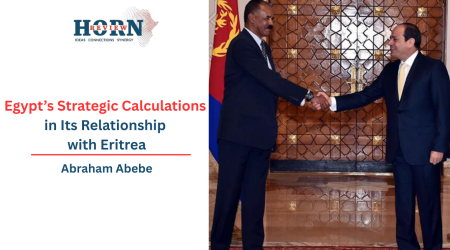
Egypt’s Strategic Calculations in Its Relationship with Eritrea
Egypt portrays its relationship with Eritrea as pragmatic cooperation in...

9
Mar
The U.S. Recalibrations, Global Governance, the Middle East Crisis and the Spillover effect in the Horn of Africa
Background
The Middle East crisis of 2026 ignited by U.S.-Israeli strikes...