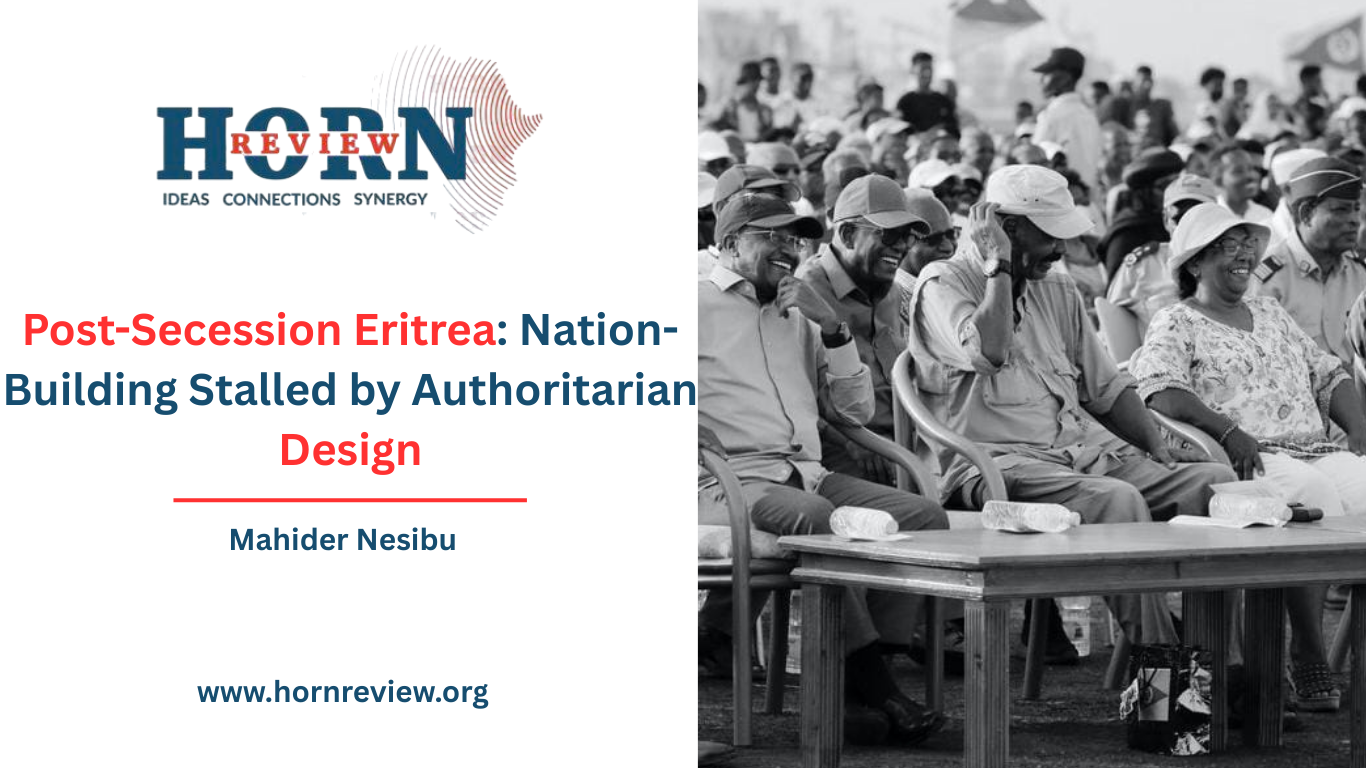
Eritrea’s independence in 1993 is often narrated as a moment of promise tragically derailed by the 1998–2000 border war with Ethiopia. According to this account, an initially well-intentioned revolutionary leadership was forced by external aggression to militarize politics, suspend democracy, and rule indefinitely by emergency. While this narrative is widely promoted by the Eritrean state, this interpretation fails to account for key empirical realities. The authoritarian character of the Eritrean state was not a consequence of war; it was embedded in the political architecture of the insurgency movement and reproduced intact after secession. The 1998 war did not create Eritrea’s political system – it merely exposed it.
From 1993 to 1997, Eritrea did not undergo a democratic transition interrupted by crisis. Instead, the Eritrean People’s Liberation Front (EPLF), later renamed the People’s Front for Democracy and Justice (PFDJ), governed the country as a “victorious liberation front” that never relinquished its vanguard role. Independence did not mark a transformation from insurgent movement to a civilian political order; it marked the territorialization of a command organization. Political pluralism was never permitted, opposition parties were never legalized, and civil society remained subordinate to party-controlled mass organizations. The absence of overt repression in the early 1990s reflected revolutionary legitimacy and disciplined acquiescence, not political freedom. Even during peacetime there were no elections, no independent media, and no institutional checks on executive power.
Decision-making remained centralized, opaque, and informal, concentrated in the hands of President Isaias Afwerki and a small inner circle. State institutions existed, but authority did not flow through them. The system functioned through personal rule and organizational loyalty rather than law. This governing style was not an emergency response; it was continuity of insurgency. While the 1997 constitution is frequently cited as evidence of democratic intent, its role remained largely symbolic. It was drafted without a parliament, without binding implementation timetable, without interim accountability mechanisms, and without any constraint on executive discretion. No preparations were made for elections, judicial independence, or legislative autonomy. A constitution that can be indefinitely postponed without consequence is not a foundation of constitutionalism; it is a legitimizing instrument. Its non-implementation was not a betrayal of intent, but an expression of intent. A constitution only matters if it binds power. If political leaders can ignore, delay, or suspend it without facing any legal, institutional, or political cost, then it is not functioning as a constitution in the real sense; it is merely a document.
Similarly, national service – often justified as a wartime necessity – predates the 1998 conflict. Conscription was introduced in 1994, and the Sawa system was established well before the border war. The underlying vision was that of a permanently mobilized society in which youth discipline, labor control, and political loyalty were fused and confused. The war expanded and brutalized this system, but it did not invent it. Indefinite national service is better understood as an extension of secession-era militarized social organization than as a temporary security response.
The internal political culture of the EPLF, now PFDJ, further undermines the war-as-cause argument. During the insurgency era itself, dissent was tolerated only within tightly controlled boundaries, and internal purges demonstrated the leadership’s intolerance of autonomous political organization. Much like the Tigray People Liberation Front (TPLF), the movement valued imposed unity over debate, obedience over institutional process, and secrecy over transparency. Independence did not democratize this culture; it nationalized it. Eritrea became a state governed as an insurgents camp.
What, then, did the 1998 war actually do? It eliminated residual ambiguity. It silenced reformist veterans who had begun questioning governance, provided a permanent justification for oversecuritised autocracy, and converted latent authoritarianism into open autocracy. The arrest of senior officials and journalists in 2001 was not a deviation from a democratic path, but the logical conclusion of a system that had never accepted limits on power. Peace, border rulings, and international reintegration have since failed to produce reform precisely because reform was never structurally intended.
This distinction matters. If Eritrea’s predicament were the result of exceptional external pressure, normalization might plausibly produce liberalization. But Eritrea did not experience democracy followed by war and dictatorship; it experienced militia authoritarianism followed by state authoritarianism, hardened over time. Sovereignty was used not to construct a social contract, but to insulate power from accountability.
In this light, Eritrea’s post-1993 history is not a tragedy of lost transition but a case of missed transformation. Statehood was treated as an endpoint rather than the beginning of nation-building. The state exists, but citizenship does not function meaningfully within it. Authority flows downward without consent, obligation flows upward without rights, and exit has replaced voice as the primary political act.
The fundamental failure of Eritrean statehood, therefore, is not that war corrupted a democratic project, but that a democratic project was never genuinely undertaken. The question Eritrea answered was how to secure sovereignty; the question it avoided was how to govern a free society. Until that second question is confronted, neither peace nor time will resolve the crisis at the heart of the Eritrean state.
By Mahider Nesibu, Researcher, Horn Review