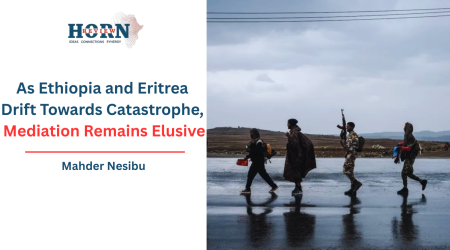
The increasingly prevalent narrative predicting renewed conflict between Ethiopia and Eritrea is often filtered through the reductive lens of maritime access. Commentators routinely assert, almost reflexively, that Ethiopia’s landlocked status inevitably drives a desire to reclaim ports. Yet this explanation collapses under even the most cursory scrutiny. Tensions between the two states have persisted even during periods when Ethiopia had already acquiesced to its loss of maritime access in 1993 – without legit negotiation and without demands for compensation or future guarantees from the Eritrean regime. The enduring friction between Addis Ababa and Asmara has never been a product of Ethiopia’s geography; it has been the consequence of Eritrea’s political temperament – its pattern of provocation, ideological hostility, and covert subversion, a pattern that predates the contemporary moment and has defined the bilateral relationship from its inception.
This paradox rests upon a historical contradiction that rarely enters mainstream discourse: Eritrea’s sovereignty was secured not through negotiated parity with Ethiopia, but largely through the unilateral decisions of the TPLF-led transitional government in Addis Ababa. The TPLF movement, forged over nearly two decades of armed struggle alongside the Eritrean People’s Liberation Front (EPLF, now PFDJ), emerged victorious from Ethiopia’s civil war. With neither popular mandate nor parliamentary authorization, it permitted Eritrea to hold a referendum and attain secession, ceding Ethiopia’s historical ports and acceding to every Eritrean demand presented. This concession, made in the name of revolutionary solidarity and the moral necessity of coexistence – even asymmetrical coexistence – was intended to extricate Ethiopia from two decades of protracted conflict.
Yet only a few years later, the very Eritrean regime that had benefited from TPLF facilitation declared political and military hostility against it. The reversal was not merely dramatic; it revealed entrenched ideological rigidity and personal animosities toward the Ethiopian state that had lain beneath the surface even during the secession struggle. The 1998–2000 war, often framed tactically, was fundamentally a strategic miscalculation: Eritrea assumed that its confrontation was with the TPLF alone, that Ethiopia as a nation would remain politically inert, and that a decisive strike could secure Eritrean control over Ethiopia’s trajectory. This misreading of Ethiopia’s political reality – this assumption that the Ethiopian populace would remain detached – remains among the most consequential strategic errors in the Horn of Africa’s modern history.
Eritrea’s hostility did not abate following the cessation of hostilities formalized under the Algiers Agreement. Rather, it hardened into a sustained strategy of undermining TPLF-led governance. Over subsequent decades, Eritrea acted as an external disruptor: cultivating proxy insurgencies, exacerbating internal fissures, and projecting influence to weaken the very political force that had facilitated its independence. Eritrean networks became active agents of disruption within Ethiopia, aiming not at border disputes or maritime grievances, but at destabilizing the state itself. This was, fundamentally, a political fixation – a decades-long determination not only to see the TPLF eradicated from Ethiopia’s political landscape, but also to insert EPLF/PFDJ back into Ethiopia’s political center.
This fixation resurfaced dramatically during Ethiopia’s Tigray conflict. Eritrea’s intervention was neither auxiliary nor reactive, as its supporters suggested, nor limited to immediate security imperatives. It represented a revival of historical hostility against Ethiopia under a new political context – a deliberate attempt to exact vengeance on the TPLF and to shape Ethiopia’s future in the post-TPLF era. Reports indicate Eritrean operations targeted TPLF leadership and Tigrayan civilians, driven not by the strategic exigencies of the moment but by grievances dating back to secession and its aftermath. Ethiopia’s internal fragility provided the opportunity; Eritrea’s longstanding agenda supplied the motivation.
Post-Tigray conflict, Ethiopia’s transitional phase only intensified these dynamics. Eritrea interpreted this period as an unprecedented opening, exploiting state fragility rather than contributing to regional stability. It sought to shape Ethiopian political outcomes by arming and training factions opposed to the federal government, even after the federal government had instructed Eritrean withdrawal and negotiated the Pretoria Peace Agreement with the TPLF. The brief rapprochement faded, revealing that Eritrean behavior was not simply anti-TPLF, but fundamentally anti-Ethiopia – a destabilizing force unconcerned with national coherence.
Recent Eritrean political realignments, including the emerging “Tsimdo” framework, must be understood within this historical continuum. These developments are not reactions to maritime aspirations nor to territorial imperatives. They constitute the continuation of decades of illegitimate interference, subversion, and distrust that have shaped the Horn’s political landscape far more than any questions of borders. Ethiopia’s strategic concern is not geography, but predictability: whether a neighboring state will operate according to standard diplomatic norms, or according to entrenched ideological enmities indifferent to cost or consequence.
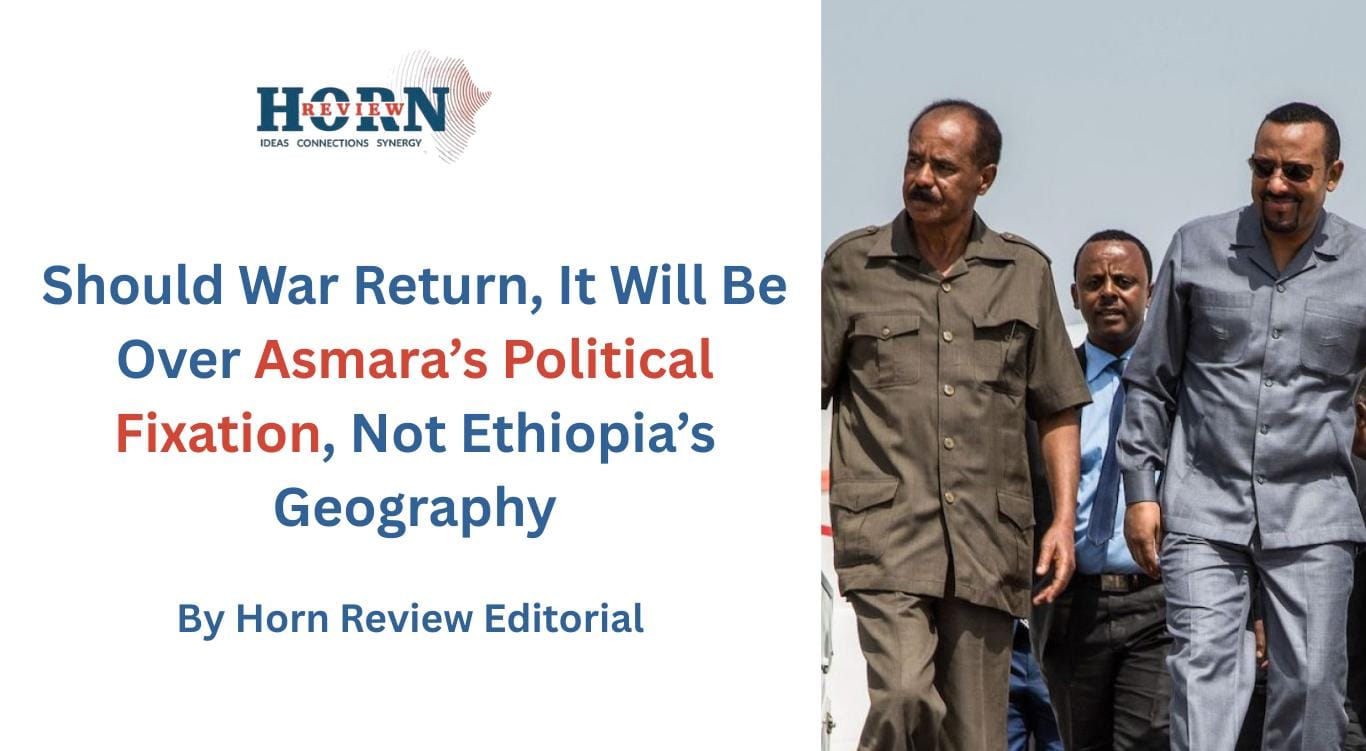
Returning to the central thesis: if war ever returns between Ethiopia and Eritrea, it will not be because Ethiopia lost its coastal territories up on Eritrea’s secession that happened two decades ago. Ethiopia has managed this reality for years, only recently reclaiming its historical coastline. Eritrea’s renewed hostility toward the Abiy Ahmed administration predates Ethiopia’s explicit pursuit of sovereign maritime access. Indeed, Abiy’s intentions regarding Assab were publicly acknowledged during the 2018 peace celebrations, with Isaias Afwerki officially welcoming the gestures. No friction emerged at that time; tension surfaced only once Ethiopia curtailed Eritrean interference in its internal affairs. By contrast, Eritrea waged war against the TPLF-led government in 1998 – the very entity that had facilitated its statehood and allowed it to sever Ethiopia’s coastline – while simultaneously pursuing decades of subversion. This history underscores the extent to which Eritrea has constructed its state identity and political economy around Ethiopia’s internal vulnerabilities.
What Ethiopia cannot – and no state could – tolerate is a neighbor that persistently undermines its political order, revives historical rivalries under new pretexts, and treats regional stability as expendable. Ports do not ignite wars. Political obsessions do. In the Horn of Africa, the central destabilizing force has never been Ethiopia’s loss of a coastline, but Eritrea’s persistent determination to reshape Ethiopia’s political future according to its unresolved grievances. The sea is a convenient distraction; the enduring story is far more political, far more personal, and far more consequential.
By Horn Review Editorial