By Blen Mamo
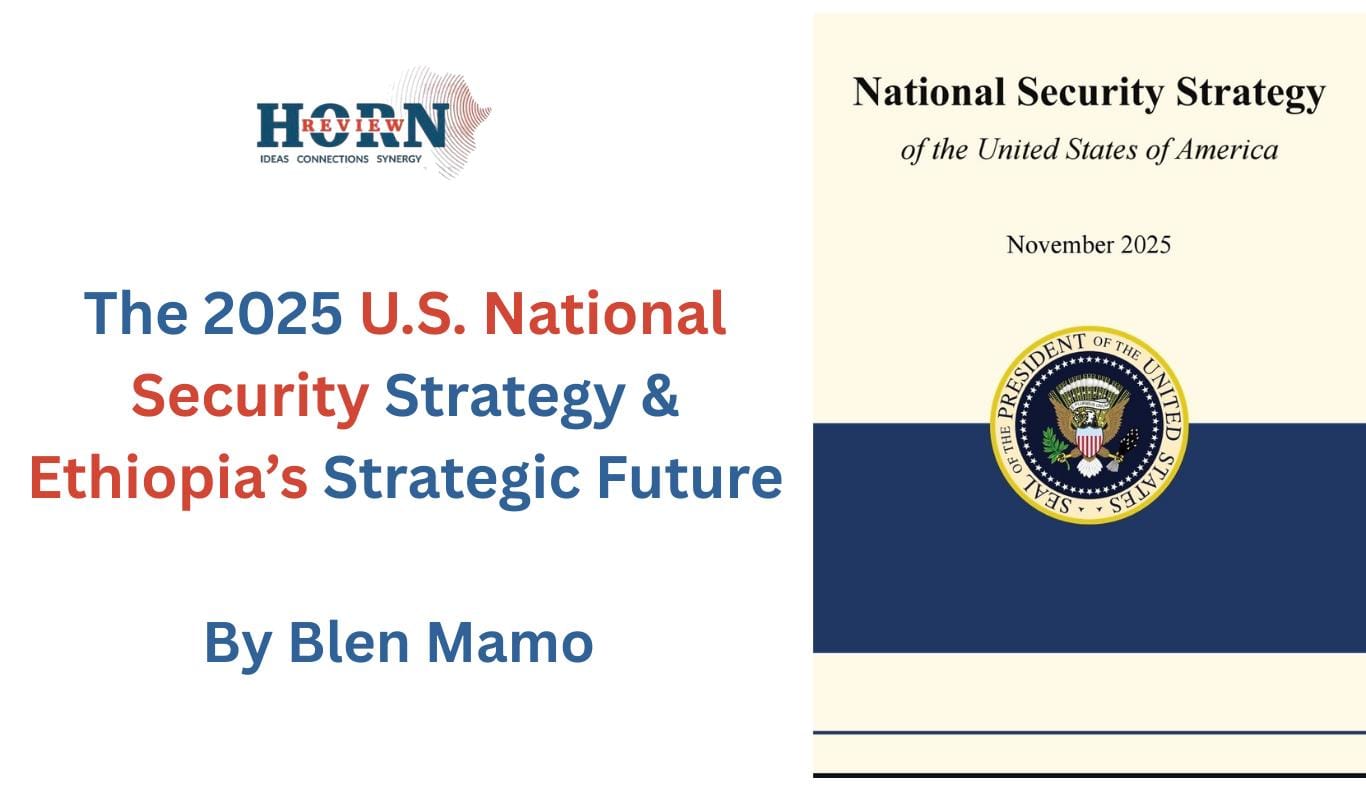
The 2025 U.S. National Security Strategy marks a decisive shift in how Washington approaches Africa, and by extension the Horn of Africa. After decades of weaving development assistance, democratization programs, regional diplomacy, and soft-power influence into an integrated framework, the United States has moved toward a narrower, interest-driven posture. Africa is no longer presented as a space for broad partnership or institution-building, but as a region where the U.S. will engage selectively, commercially, and with limited appetite for large-scale commitments. For a continent where structural fragility and external competition are rising, this reorientation carries deep implications.
Africa enters this moment not as a passive subject of global strategy but as a region in flux. The continent’s demographic rise, natural resource abundance, and growing geopolitical value have made it increasingly contested terrain. Yet many states remain financially constrained, politically brittle, and heavily exposed to global economic shifts. A U.S. strategy that places trade over aid and burden-sharing over long-term stabilization fundamentally alters the landscape. It may unlock investment for countries positioned to absorb it, but it may also deprive fragile states of the external support they once relied on to sustain minimal stability.
Nowhere is this tension sharper than in the Horn of Africa, one of the world’s most strategically contested yet institutionally fragile regions. The Horn lies at the intersection of African and Middle Eastern security systems. It borders the Red Sea, sits across from Yemen – a theatre of Iranian-Gulf rivalry – and remains a critical maritime corridor linking Europe, the Gulf, and Asia. Any shift in U.S. strategy, whether toward or away from the Middle East, reverberates across the Horn. Yet the 2025 NSS treats the Red Sea primarily as an extension of Middle Eastern geopolitics, not as a space with its own African political logic. This framing risks turning the Horn into collateral terrain – an arena shaped by Gulf rivalries, Iranian outreach, Turkish assertiveness, and Russian strategic engagement, rather than by African agency or U.S. diplomatic steadiness.
American policy in the Middle East has also hardened. The 2025 approach is highly transactional, security-centered, and oriented toward deterrence and alliance consolidation rather than regional transformation or conflict resolution. Washington prioritizes strong ties with Israel and key Gulf states, while reducing its involvement in complex political transitions across the region. This shift, when mapped onto the Red Sea arena, amplifies the influence of Gulf actors in Africa. The United Arab Emirates and Saudi Arabia gain greater latitude to pursue their port networks, economic leverage, and political relationships across the Horn – interests that rarely prioritize long-term stability or inclusive governance. The U.S., intentionally or not, becomes a distant power delegating influence to partners whose priorities often diverge from African stability.
Ethiopia sits at the center of this strategic recalibration. As the demographic, geographic, and diplomatic anchor of the Horn, Ethiopia remains too large and too central to be ignored. Its waterways feed a dozen countries; its conflicts spill over borders; its alliances shape regional balances. Yet Ethiopia today is also internally fragile, fiscally strained, and still navigating the political and social aftershocks of conflict. The paradox is that Ethiopia’s strategic weight has never been more important, while its internal resilience has rarely been more uncertain.
At the same time, Ethiopia is undergoing its own foreign-policy transformation: a clear and deliberate shift toward transactional diplomacy. Once heavily reliant on Western development partners, Addis Ababa has diversified its relationships out of necessity. Gulf states provide financial injections and security tools; Turkey supplies drones and military cooperation; China remains essential for infrastructure and loans. Ethiopia now negotiates not as a values-aligned partner of the West but as a state seeking leverage, liquidity, and diplomatic flexibility in a competitive geopolitical marketplace.
This is where the interaction between Ethiopia’s transactional turn and the U.S. 2025 NSS becomes both consequential and delicate. On the surface, the two postures appear compatible. A U.S. foreign policy that rewards strategic utility and clear deliverables can work with an Ethiopia seeking pragmatic arrangements rather than ideological alignment. But beneath this apparent symmetry lies a critical asymmetry. Ethiopia’s transactional diplomacy is born from vulnerability; America’s is born from selectivity. Ethiopia seeks partners because it must. The U.S. chooses partners because it can. This difference matters, because transactional relationships are inherently brittle. They reward strength, predictability, and clear returns. Ethiopia, despite the challenges it faces, is striving to offer such consistency.
If handled wisely, Ethiopia can still leverage its geography and strategic value to shape a more balanced relationship. The U.S. cannot afford a destabilized Horn without undermining its Red Sea posture. A stable Ethiopia, with a sovereign sea presence, is indispensable for maritime security, regional economic integration, and counterterrorism. Ethiopia can leverage this structural indispensability to shape a transactional relationship on its own terms – provided it strengthens internal cohesion and projects a unified diplomatic stance. Where it falls short, Washington’s selective engagement risks leaving Ethiopia without the protective support it once reliably enjoyed.
There is also a broader regional risk. As U.S. attention shifts and Gulf influence deepens, Ethiopia may find its autonomy squeezed. The Gulf states operate through alliance-building, patronage networks, and strategic investments tied to their own regional projects. If American policy continues to treat the Horn as a peripheral extension of Middle Eastern strategy, Ethiopia could be pulled into geopolitical arrangements that limit its flexibility and undermine its long-term regional leadership .
In summary, the 2025 NSS does not fully reconcile the complexities of the continent, especially in light of its adjacent regions. It presents a vision of an America that remains powerful but less patient, influential but less involved, present but more transactional. Africa is expected to shoulder more responsibility at the moment when its vulnerabilities are growing. The Horn, positioned between collapsing internal orders and intensifying external competition, is left to navigate a fragmented international landscape with fewer guarantees and greater risks. Ethiopia, the region’s anchor, faces the difficult task of balancing its immediate development pursuits with its long-term strategic autonomy.
In this emerging world, Ethiopian and Horn stability will not come from whether Washington cares more or less about the region, but from whether Ethiopia and its neighbors can adapt to a world where external powers are transactional, selective, and increasingly unwilling to underwrite regional stability. The challenge is immense, but so is the opportunity for states that can master strategic flexibility, strengthen internal resilience, and negotiate from a position anchored in regional indispensability rather than urgent vulnerability.
Authors Bio
Blen Mamo is Executive Director of Horn Review and a researcher specializing in law, international security, and geopolitics in the Horn of Africa. She holds an LL.B and an M.Sc. in International Security and Global Governance