
3
Dec
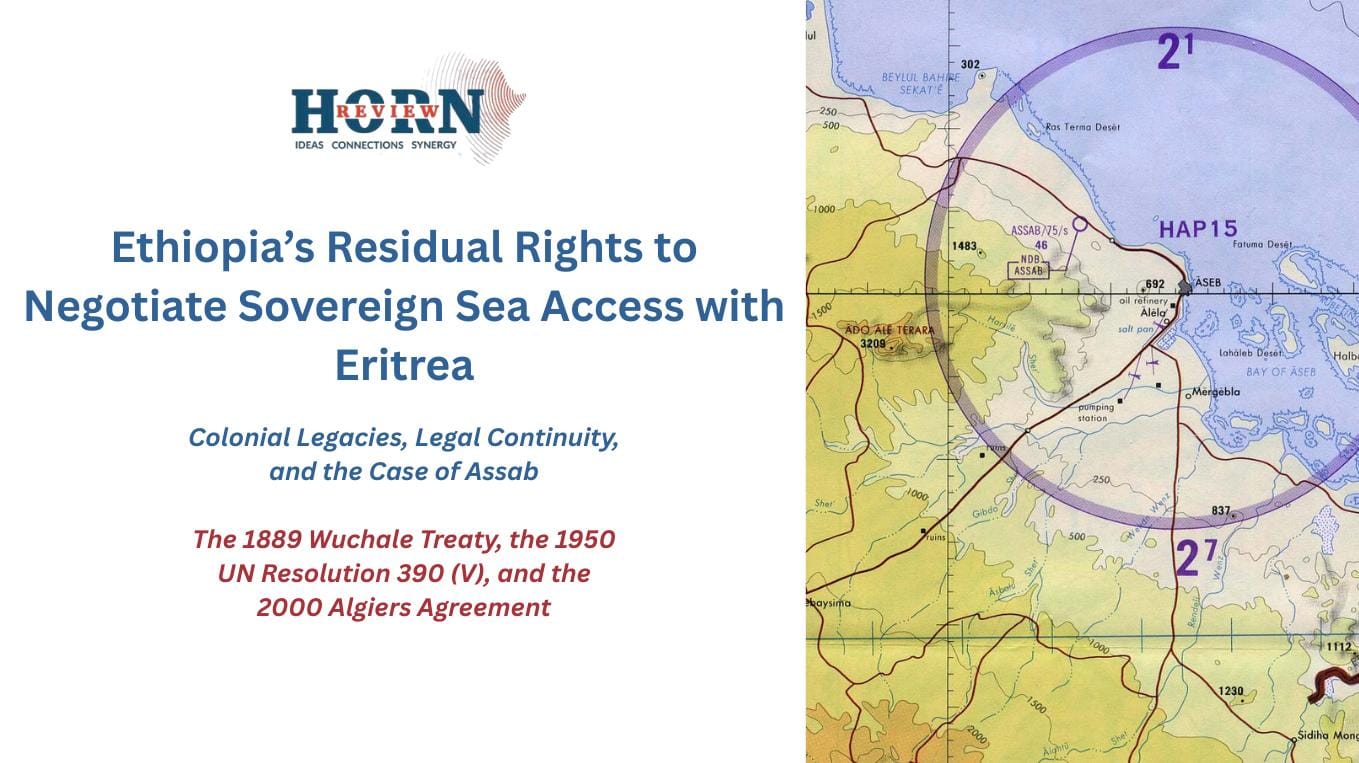
Ethiopia’s Residual Rights to Negotiate Sovereign Sea Access with Eritrea
Colonial Legacies, Legal Continuity, and the Case of Assab
The 1889 Wuchale Treaty, the 1950 UN Resolution 390 (V), and the 2000 Algiers Agreement
By Blen Mamo
Abstract:
Ethiopia’s sovereignty and its historical access to the Red Sea have been shaped by a protracted and intricate trajectory of coerced treaties, colonial opportunism, and post‑colonial subversion. The 1889 Treaty of Wuchale, deliberately reinterpreted by Italy to assert disproportionate control over Ethiopia’s external affairs, inaugurated a recurring pattern of resistance to territorial and maritime encroachments. Italy’s subsequent acquisition of Assab and Massawa, coupled with the imposition of colonial boundary agreements in 1900, 1902, and 1908, entrenched structural vulnerabilities that were subsequently compounded by British administration and the broader geopolitical recalibrations occasioned by the Second World War. In 1950, United Nations General Assembly Resolution 390 (V) endeavored to rectify these historical distortions by federating Eritrea with Ethiopia, thereby reaffirming Ethiopian sovereignty while conferring a measure of administrative autonomy upon Eritrea. Nevertheless, the ensuing decades were marked by recurrent subversion, systemic exploitation, and armed conflict – spanning the dissolution of the federation under Emperor Haile Selassie, the militarized consolidation of the Derg regime, Eritrea’s secession in 1993, and the subsequent Ethiopian–Eritrean War of 1998–2000. Throughout this continuum, Ethiopia’s historical and juridical claims to Assab and adjacent territories remained central to its strategic, economic, and geopolitical calculus. This analysis illuminates the enduring interplay of coercion, opportunism, and contested sovereignty, underscoring that Ethiopia’s maritime struggle is comprehensible only through an integrated consideration of historical precedent, international legal entitlements, and strategic imperatives.
The Wuchale Treaty and Colonial Contestation of Ethiopia’s Coast (1889–1935)
Ethiopia’s sovereignty and access to the Red Sea were profoundly shaped by a protracted sequence of historical developments, beginning with the 1889 Treaty of Wuchale, negotiated under conditions of coercion and profound asymmetry. The treaty existed in dual texts – Amharic and Italian – whose divergences, particularly in Article XVII, produced radically different interpretations. In the Italian text, Ethiopia was obliged to conduct its foreign affairs exclusively through Italy, effectively subordinating Ethiopian sovereignty; in the Amharic text, Ethiopia retained the prerogative to engage foreign powers independently. Upon recognizing this discrepancy, Emperor Menelik II initially rejected Italy’s protectorate claim in 1890 and formally repudiated the treaty in 1893.
The resulting dispute escalated into the First Italo–Ethiopian War, culminating in the Battle of Adwa on 1 March 1896, where Ethiopian forces decisively defeated the Italian invading army, inflicted massive casualties, and captured thousands. This victory compelled Italy to abandon its protectorate ambitions and formally recognize Ethiopian sovereignty through the Treaty of Addis Ababa (1896), establishing a precedent of Ethiopia’s resolute resistance to coerced territorial or maritime subordination.
Italy’s foothold along the Red Sea, however, predated the Wuchale Treaty. The port of Assab was acquired in 1869 by the Italian shipping company Società di Navigazione Rubattino from local Ethiopia’s Afar leaders – a purely commercial transaction involving non-sovereign actors – and transferred to the Italian state in 1882. Massawa was also occupied by Italy in 1885 following the withdrawal of Egyptian forces and the decline of Ottoman authority, exploiting a temporary power vacuum rather than through any legitimate cession by Ethiopia. At the time of the Wuchale Treaty, no political entity known as “Eritrea” existed; Italy unilaterally proclaimed the colony in 1890, several months after the treaty’s signing, without Ethiopian consent. The Wuchale Treaty, while acknowledging Italy’s presence in certain occupied areas under diplomatic pressure, conferred neither sovereignty nor permanence over Ethiopian territory. Italy, however, exploited ambiguities and mistranslations in the treaty to consolidate its holdings and expand beyond them, laying the foundation for the later establishment of Eritrea.
In the ensuing decades, a series of colonial boundary agreements – negotiated in 1900, 1902, and 1908 between Emperor Menelik II and Italy, with Britain participating in the 1902 treaty – purported to formalize the Ethiopia–Eritrea frontier. These arrangements, however, were not genuine renegotiations between equal sovereigns but rather technical refinements imposed upon a structure already shaped by coercion and legal misrepresentation. The demarcations divided the frontier into three sectors: the central sector (1900), following the Mereb, Belesa, and Muna rivers; the western sector (1902), along the Setit (Tekezé) River to its confluence with the Khor Om Hajer; and the eastern sector (1908), extending approximately sixty kilometers inland, roughly parallel to the Red Sea coast from Rendacoma to Mount Mussa Ali. These boundaries were based on imprecise maps, incomplete geographic knowledge, and abstract lines superimposed upon historically interconnected, multi-ethnic territories, leaving substantial latitude for manipulation.
Crucially, none of these treaties represented a clear, voluntary, or explicit cession of Assab, Massawa, or surrounding coastal territories by Ethiopia. They functioned as juridical and cartographic extensions of Italy’s earlier claims derived from the distorted Italian text of the Wuchale Treaty, which Ethiopia had already repudiated. The treaties were therefore anchored to a legally defective foundation, rendering the borders historically and juridically contestable. By never directly, freely, and unequivocally renegotiating the status of these ports, Ethiopia’s maritime rights remained unresolved – suspended, contested, and perpetually vulnerable to political manipulation. Even the 1896 treaty of Addis Ababa abrogated the Wuchale treaty in its entirety, only for the Addis Ababa treaty itself to be null and void upon the 1935 re-invasion of Italy against the Ethiopian Empire.
Viewed in context, these developments reveal a continuous pattern of coercion, opportunism, and legal misrepresentation, whereby early commercial acquisitions and opportunistic occupations were later “regularized” through treaties that reflected power imbalances rather than genuine recognition of Ethiopian sovereignty. The colonial-era cartographic and juridical framework thus left the fate of Assab, Massawa, and adjacent coastal lands suspended, highlighting the enduring tension between historical claims, legal authority, and strategic imperatives in Ethiopia’s maritime history.
UN Resolution 390(V) and the Restoration of Ethiopia’s Maritime Sovereignty (1935–1952)
Following decades of contested sovereignty over Eritrea, the Horn of Africa remained a theater of competing imperial and colonial ambitions. Italy, seeking both revenge for prior defeats and expansion of its East African empire, launched the Second Italo-Ethiopian War (1935–1936), using Eritrea and Italian Somaliland as strategic bases for its invasion. Although Italy temporarily occupied Ethiopia, its control was actively undermined by widespread Ethiopian resistance and coordinated Allied military operations during World War II (1939–1945). Following Italy’s defeat, Eritrea, alongside the Ogaden and Gambella regions, came under British military administration (1941–1950). Britain sought to consolidate control over these territories to secure strategic interests along the Red Sea corridor and to forestall any resurgence of Italian influence. During this period, Emperor Haile Selassie was restored to the Ethiopian throne after years of exile in England, yet Ethiopia’s sovereignty over these regions remained subject to partial external oversight.
Haile Selassie adeptly navigated this geopolitical landscape by cultivating strategic relations with the ascending United States, thereby counterbalancing British ambitions. The United States established Kagnew Station in Asmara, gaining operational leverage over the Red Sea and indirectly safeguarding Ethiopian sovereignty and maritime access until the eventual collapse of the monarchy and the rise of the Derg regime. This engagement ensured that Ethiopia retained meaningful control over its historic maritime corridors, mitigating the risk of permanent external annexation.
Within this context, the 1950 United Nations General Assembly Resolution 390(V) emerged as a post-World War II corrective to colonial-era distortions. The resolution instituted a federation between Ethiopia and Eritrea, explicitly designed to restore Ethiopian rights over Eritrean territory while granting Eritrea internal administrative autonomy.
Crucially, the UN’s framework did not rely upon the coercive colonial treaties or go against the majority will of the Eritrean people – which Ethiopia had consistently repudiated – but instead sought to redress historical inequities engendered by Italian expansionism and strategic appropriation. The resolution reaffirmed sovereignty over Assab, Massawa, and surrounding territories, while establishing institutional safeguards to prevent unilateral annexation or permanent foreign control.
This, however, was preceded by a field study commissioned by a quintet of states – the United States, Britain, Italy, Russia, and France – investigating the aspirations of the Eritrean populace, which indicated that the majority favored reintegration with the Ethiopian Empire. The United Nations, however, was unequivocal: regardless of the Eritrean populace’s choice, Ethiopia’s right to access the sea was to be explicitly preserved. Had Eritrea opted for complete independence, Ethiopia’s coastal territory would have been demarcated to ensure its continued access to the sea. It was, therefore, not the federation with Eritrea that granted Ethiopia a coastline; its access to the sea was guaranteed irrespective of Eritrea’s political status.
The consequences of the UN resolution were, thus, n many respects, salutary for both Ethiopia and Eritrea, formally establishing the federation on September 11, 1952, following the ratification of the Constitution and the Federal Act. It legally restored access to the Red Sea, securing strategic maritime rights that had long been compromised under coercion, occupation, and ambiguous colonial arrangements. Moreover, it offered a structured mechanism for reconciling Eritrean governance with Ethiopian sovereignty, creating the potential for peaceful coexistence within a federated framework. By formally acknowledging Ethiopia’s historical and legal claims while protecting Eritrean internal autonomy, the resolution corrected colonial-era distortions and created a period of relative stability, permitting Ethiopia to rebuild state infrastructure, reassert regional influence, and maintain strategic depth along the Red Sea corridor.
Nonetheless, the long-term efficacy of the federation depended upon the political conduct of Eritrean authorities and Ethiopia’s internal cohesion. Despite these challenges, the 1950 UN resolution remains a landmark legal and diplomatic effort to reaffirm Ethiopia’s sovereignty, restore maritime access, and stabilize a region historically marred by coercion, colonial ambition, and contested territorial claims. Most importantly, any and every controversy surrounding Eritrea thereafter remains Ethiopia’s internal affairs that should be addressed under an internal political and administrative process.
Ending the Federation: Ethiopia’s Legal and Strategic Reassertion over Eritrea (1952–1974)
By the late 1950s and early 1960s, the federal arrangement established under UN Resolution 390(V) was under significant strain. Eritrean local authorities increasingly challenged Ethiopian sovereignty, circumvented federal structures, asserted unilateral control, and refused to comply with obligations mandated by the federation. This pattern of subversion not only contravened the letter of the UN-mandated arrangement but also imperiled Ethiopia’s historical and strategic rights over its historically administered territories, particularly the ports of Assab and Massawa. These actions constituted a continuation of a long-standing historical pattern in which external powers and opportunistic actors sought to undermine its access to the Red Sea and compromise its territorial integrity – a pattern traceable to Italy’s recharacterisation of the Wuchale Treaty and subsequent colonial arrangements.
In response, Emperor Haile Selassie pursued a policy aimed at terminating the federation and fully integrating Eritrea as a province of the Ethiopian Empire, thereby reaffirming the legal and historical principle that Eritrea had long been administered as part of the Ethiopian state. On 14 November 1962, following the formal dissolution of the federated structure, the Ethiopian parliament enacted legislation incorporating Eritrea as the fourteenth province of Ethiopia, effectively ending its autonomous federal status. This act was not arbitrary annexation but a restoration of historical sovereignty, correcting structural vulnerabilities created by coercive treaties, Italian occupation, and the ambiguities inherent in the federal arrangement. It should also be noted that an official request came from representatives from the Eritrean authorities themselves, who were concerned about the growing secessionist tendencies within the Eritrean province.
The incorporation of Eritrea was justified both legally and strategically. Legally, Ethiopia’s historical administration of Eritrean territories – including Assab, Massawa, and the surrounding highlands – predated Italian occupation, colonial boundary treaties, and the federation itself. The Wuchale Treaty and the Addis Ababa agreement of 1896 had long been nullified on grounds of coercion, and the colonial boundary conventions of 1900, 1902, and 1908 had never represented a legitimate cession of Ethiopian sovereignty. Strategically, the union ensured the preservation of Ethiopia’s maritime access to the Red Sea, safeguarding vital trade routes, national security, and regional influence. The loss of Assab or Massawa would have rendered Ethiopia acutely vulnerable to foreign interference, as historical precedent had repeatedly demonstrated under Italian, British, and other external interventions.
Emperor Haile Selassie framed the incorporation as a necessary measure to preserve national unity and safeguard strategic interests while upholding the principle that sovereignty cannot be undermined by local subversion or coercive historical arrangements. By fully integrating Eritrea, Ethiopia sought to establish a coherent administrative, military, and economic structure capable of ensuring long-term stability, enforcing obligations formerly assigned under the federation, and protecting maritime and territorial rights. Hence, the decision to end the federation was both legally defensible and historically grounded. It reaffirmed the principle that Eritrea, historically administered as part of the Ethiopian state, could not unilaterally secede absent legitimate, voluntary negotiation. The incorporation also represented the culmination of a corrective trajectory: rectifying distortions imposed by coercive colonial treaties, Italian occupation, and the ambiguities of federal arrangements, and thereby fully restoring Ethiopian sovereignty over its historic territories.
The Derg Era: Eritrean Insurgency and Ethiopia’s Maritime Vulnerabilities (1974–1991)
The overthrow of Emperor Haile Selassie in 1974 and the ascendancy of the Derg military junta fundamentally reshaped Ethiopia’s governance, regional strategy, and approach to Eritrea. Unlike the imperial administration, which prioritized international legitimacy and careful negotiation, the Derg adopted a centralized, ideologically rigid, and militarized model of rule. Its disproportionate focus on Eritrea proved counterproductive, diverting attention from other strategic priorities, including Ethiopia’s alternative historical maritime options. By prioritizing Eritrea above alternative corridors, the Derg inadvertently allowed potential avenues for maritime reinforcement and trade diversification to remain outside Ethiopian control, thereby compounding longstanding vulnerabilities in its coastal strategy.
During this period, Eritrean political movements intensified their push for secession. The Eritrean People’s Liberation Front (EPLF), among other groups, engaged in prolonged military resistance, sabotage, and political subversion. These activities included attacks on Ethiopian infrastructure, harassment of supply lines, and systematic disruption of port access – particularly at Assab and Massawa – which historically had served as Ethiopia’s vital lifeline to the Red Sea. Eritrean subversion was coordinated, sustained, and strategically executed, drawing upon local grievances and external geopolitical support, while exploiting weaknesses inherent in the federal and imperial-era administrative structures.
Ethiopia’s strategic vulnerabilities were starkly revealed during regional conflicts, most notably the Ogaden War (1977–1978). Reliance on Djibouti for military imports and logistical support proved precarious, as military and other shipments were delayed and withheld, producing acute shortages. Ethiopia’s capacity to sustain defense operations during these crises depended directly on access to Eritrean ports, demonstrating the enduring strategic significance of Assab and Massawa. This period underscored that historical sovereignty over Eritrean maritime territories was not merely symbolic; rather, Ethiopia’s national survival in conflict relied upon it.
The Derg’s mismanagement of Eritrean affairs, coupled with its excessive emphasis on military repression, however, alienated local populations and strengthened separatist movements. Far from securing Ethiopian sovereignty, the regime’s approach often facilitated subversion, as Eritrean actors leveraged Derg authoritarianism to galvanize resistance and attract external support. This pattern echoed historical precedents – from Italian coercion to colonial boundary misrepresentations – underscoring the persistence of structural vulnerabilities in Ethiopia’s maritime governance. By concentrating resources and political energy almost exclusively on Eritrea, the Derg’s fixation, though ostensibly intended to safeguard sovereignty, allowed alternative strategic corridors in the region to slip from Ethiopian influence, thereby reinforcing structural vulnerability and limiting the state’s flexibility in trade and defense while reinforcing dependence on highly contested maritime routes.
Eritrea’s Secession and the Strategic Dispossession of Ethiopia (1991–1993)
By the late 1980s, the Derg regime had become increasingly debilitated by internal dissent, military setbacks, economic collapse, and sustained insurgencies, most notably the protracted struggle in Eritrea. The Eritrean People’s Liberation Front (EPLF) had by this time consolidated control over much of the province, exploiting both the Derg’s repressive measures and systemic deficiencies within Ethiopia’s military and administrative apparatus. The collapse of the Derg in 1991, under combined pressure from the Tigray People’s Liberation Front (TPLF) and other opposition forces, eliminated the centralized Ethiopian authority that had, albeit imperfectly, sought to maintain Eritrea within the Ethiopian state.
The ensuing power vacuum provided both an opportunity and a pretext for Eritrean leaders to pursue full, forceful secession, two years prior to the referendum – most particularly since May 1991. Then the EPLF assumed administrative control over Eritrea, and by 1993, following a UN-supervised referendum, Eritrea formalized its “independence”. This secession, however, remained legally and historically contestable. The 1993 referendum, which formalized Eritrea’s secession, was deeply flawed and remains contestable from Ethiopia’s perspective. The population was presented with an artificial binary- obscuring the complex realities of sovereignty, federal obligations, and strategic interdependence. The remainder of Ethiopia, whose national interests, economic lifelines, and security were directly affected, were actively silenced, suppressed and made to have no substantive role in a decision that deprived the country of its historical Red Sea access and compromised its long-term strategic and economic prospects. This disenfranchisement was reflected in acts of resistance, including the protest by Addis Ababa University students to Boutros Boutros-Ghali’s, an Egyptian diplomat at the helm of the UN, visit to the capital prior to the referendum in January 1993 for Somalia Peace Talks – during which over a hundred of students were tragically shot dead and wounded by government security forces.
Within both Ethiopia and Eritrea, communities most impacted by the loss of Ethiopian administration – particularly the Afar population – were systematically marginalized and denied meaningful participation. Oversight of the referendum was entrusted to the United Nations under the leadership of Boutros Boutros-Ghali, his historical connections with the EPLF raising questions regarding the impartiality and neutrality of the entire process. Critically, the process was authorized and legitimized by a transitional Ethiopian government in which the EPLF – soon to reorganize as the PFDJ – was an active participant, yet this transitional authority lacked a popular mandate or broad-based representation for decisions of such magnitude. The referendum cannot therefore be considered a legitimate exercise of self-determination, as it violated principles of collective sovereignty, disenfranchised affected populations, and was conducted under conditions favoring a single political faction rather than through a fair and representative process.
Strategically, Eritrea’s secession had profound and enduring implications. Ethiopia lost direct access to the Red Sea, becoming reliant on Djibouti for maritime trade and exposing itself to renewed vulnerabilities in logistics and national security. Historical patterns of foreign intervention, local subversion, and contested governance once again constrained Ethiopia’s capacity to exercise authority over its maritime corridors. The secession underscored that maritime access was not merely an economic convenience but a fundamental dimension of national security, intimately tied to Ethiopia’s historical rights and territorial integrity. It did not extinguish Ethiopia’s historical or legal claims to Assab, Massawa, or the highlands; rather, it reflected the failure of post-federation arrangements to withstand systematic obstruction and internal fragmentation.
Post-Secession Exploitation, Border Disputes, and the Road to War (1993–1998)
The period between Eritrea’s secession in 1993 and the outbreak of hostilities in 1998 was marked by a gradual yet persistent escalation of tension, driven not solely by Eritrean secession but by systematic economic exploitation, sabotage, and political subversion directed against Ethiopia. While Eritrea assumed administrative control over Assab and Massawa, it remained heavily reliant on Ethiopia’s economic production, transport networks, and logistical infrastructure, leveraging this dependence to extract revenue and consolidate its nascent state apparatus. Notably, Eritrea engaged in the trafficking and re-export of Ethiopian goods, including coffee – a commodity it had never exported globally – appropriating the proceeds under its own authority. These deliberate acts of economic subversion advantaged Eritrea at Ethiopia’s expense, further intensifying strategic vulnerabilities. Concurrently, unresolved border ambiguities, particularly in areas such as Badme and Tsorona, combined with persistent harassment of Ethiopian interests, rendering the post-secession period a tense and precarious strategic standoff.
By 1998, Eritrea’s leadership assessed that Ethiopia was politically fragile, militarily weakened, and economically exhausted after seventeen years of civil war, with the TPLF-led government lacking broad-based legitimacy. These conditions, compounded by enduring EPLF–TPLF rivalries, fostered the perception in Asmara that Ethiopia could be pressured or fragmented to Eritrea’s strategic advantage. Acting upon this calculation, Eritrea initiated military incursions into disputed territories, emerging as the immediate aggressor in the 1998–2000 conflict. Ethiopia, now landlocked and deprived of its historically administered ports, confronted profound economic and security vulnerabilities, while Eritrea leveraged its post-secession position to assert political and financial control.
Over the five years between 1993-1998, the cumulative pressures of economic sabotages, political subversion, unresolved territorial disputes, and calculated military provocations created conditions conducive to the outbreak of full-scale war. This trajectory demonstrates how historical grievances, unaddressed legal ambiguities, and strategic opportunism can destabilize regional relationships. Both parties continued to rely upon imprecisely defined colonial-era boundaries – principally those delineated in the colonial treaties – which Ethiopia had long rejected as illegitimate. The failure to establish mutually recognized, clearly demarcated post-colonial borders transformed localized disputes into flashpoints for armed conflict. Within this highly charged context – characterized by economic tension, political acrimony, and unresolved sovereignty claims – Eritrea’s military incursion in 1998 escalated a protracted rivalry into a full-scale and catastrophic war.
The Algiers Agreement and Ethiopia’s Preservation of Strategic Claims (2000–2018)
The cessation of hostilities in 2000, formalized under the Algiers Agreement, inaugurated a tense post-war phase, establishing mechanisms intended to secure peace, including the Ethiopia-Eritrea Boundary Commission (EEBC) to arbitrate contested terrestrial borders. Ethiopia, prioritizing international legitimacy and regional stability, accepted arbitration and strategically withdrew from certain areas. Nevertheless, it never relinquished its historical narrative, sovereign prerogatives, or residual rights over disputed territories, including Assab, whose strategic, economic, and maritime significance had been established over more than a century. This continuity links contemporary disputes directly to historical trajectories shaped by the Wuchale Treaty, colonial-era treaties, Italian occupation, post-World War II federation arrangements, and the 1993 Eritrean secession.
It is imperative to recognize the juridical limitations of the EEBC: its mandate was confined strictly to terrestrial boundary delineation, leaving maritime frontiers and port access unresolved. Notably, no demarcation pillars were installed in the Eastern Sector, underscoring that the EEBC’s determinations remain largely declaratory and unenforceable. The claim advanced by Eritrea – that the Algiers Agreement, together with the EEBC’s rulings, confers incontestable sovereignty over Assab – lacks both legal foundation and historical legitimacy. Ethiopia’s position rests on continuous historical administration, residual rights affirmed under United Nations Resolution 390(V), and the absence of any treaty effecting the cession of sovereignty afterwards, thereby distinguishing political recognition of Eritrean secession from the lawful transfer of territory.
Ethiopia has consistently maintained that colonial-era boundaries – freighted with coercion, imprecision, and structural inequity – cannot alone confer legitimate sovereignty. While adhering to formal agreements, Ethiopia asserts that authentic sovereignty derives from historical administration, legal continuity, and principles of recognized international law, rather than from colonial cartography. Maritime access, particularly through Assab, remains inseparable from Ethiopia’s strategic, economic, and national security imperatives, reflecting a continuity of historical rights and obligations dating back to imperial administration and reaffirmed under the UN framework.
Most importantly, all treaties signed with Italy are null and void, as Italy invaded Ethiopia both before and after the Treaty of Wuchale, culminating in the 1935 invasion, which further undermines the validity of all preceding treaties of 1900, 1902, and 1908. Consequently, any agreements, including the Algiers Agreement, that rely on or reference these treaties are themselves null and void. This position finds support in established principles of international law codified in the Vienna Convention on the Law of Treaties: Article 52 provides that a treaty is void if its conclusion was procured by the threat or use of force in violation of international law; Article 53 declares a treaty void if it conflicts with a peremptory norm of general international law (jus cogens); and Article 62, reflecting the doctrine of rebus sic stantibus or fundamental change of circumstances, allows for the termination of a treaty if circumstances essential to the consent of the parties have fundamentally changed. While these provisions provide strong legal support for the nullity of these treaties, it is recognized that practical application, particularly over many decades or in matters concerning boundaries, may face challenges under international law. Therefore, the Algiers Agreement’s reference to the colonial-era treaties is legally untenable, as it attempts to validate an agreement based on instruments that were already void ab initio.
The subsequent two decades of “no peace, no war” exemplify this tension between formal compliance, legal validy and substantive justice. Eritrea’s persistent assertiveness, partial implementation of boundary demarcation, and ongoing economic leverage entrenched Ethiopia’s vulnerabilities. Eritrea has manipulated regional trade, restricted Ethiopian maritime access, and leveraged negotiations to reinforce structural asymmetries rooted in historical grievance, contested treaties, and unresolved post-colonial arrangements. These dynamics have profound regional and international implications, affecting the security and stability of the Red Sea corridor and neighboring states dependent on open maritime trade.
Moreover, the prolonged stalemate continued to affect local communities, particularly populations historically administered by Ethiopia, including the Afar, who experienced marginalization, restricted access to ports, and limited participation in economic and administrative decision-making. The absence of enforcement mechanisms for EEBC rulings further compounded the imbalance, leaving Ethiopia legally compliant yet materially constrained, with sovereignty over its historical maritime outlets formally recognized but practically circumscribed.
Generational Perspective and Post-2018 Initiatives
The 2018 political transition in Ethiopia inaugurated an era of tentative rapprochement with Eritrea, framed within principles of legal legitimacy, historical continuity, and strategic pragmatism. Ethiopia emphasized that its objective was not territorial expansion but the restoration of secure, rule-based maritime access through historically administered ports, notably Assab, reflecting rights affirmed under long-standing international norms. The government’s approach was anchored in a cooperative framework, proposing concrete integration mechanisms for access, including port usage agreements, logistics coordination, and trade facilitation, all designed to reconcile Ethiopia’s historical and strategic claims with Eritrea’s sovereign prerogatives while promoting regional stability.
Despite these overtures, Eritrea’s centralized, militarized, and personality-driven leadership largely misinterpreted Ethiopia’s diplomacy as imperial restoration. Persistent disagreements over its subversive tactics to undermine Ethiopia’s federal government and its destabilizing and disruptive regional strategies – exacerbated by Eritrea’s alignment with regional actors, including Egypt – repeatedly obstructed meaningful progress. This behavior reflects a historical pattern of strategic obstruction, reminiscent of earlier periods in which coercion, political rigidity, and external intervention impeded Ethiopia’s ability to exercise its maritime and territorial rights, from colonial-era treaties to post-secession arbitration under the Algiers Agreement and EEBC framework.
For Ethiopia, the ongoing tension with Eritrea transcends bilateral friction. It underscores the enduring consequences of authoritarianism, ideological dogmatism, historical coercion, structural inequities in colonial-era arrangements, and the fragility of international arbitration divorced from substantive historical justice. Access to Assab remains vital not only for economic trade and logistical networks but also for national security and continuity of state sovereignty. The broader strategic implications extend beyond bilateral relations, encompassing the security of the Red Sea corridor, regional trade, and Ethiopia’s role in Horn of Africa geopolitics. Local communities historically dependent on this port, including the Afar, continue to be affected by restricted maritime access, highlighting the human as well as strategic dimensions of the dispute.
Ethiopian society broadly rejects territorial ambitions over Eritrea, focusing instead on the legitimate exercise of maritime sovereignty. Ethiopia’s enduring objective is rather the attainment of reliable, lawful access to the sea – achievable only through negotiated, rule-based mechanisms that respect Eritrea’s sovereignty, rather than through coercion, unilateral assertion, or military confrontation. The success of such arrangements depends upon reciprocal recognition, juridical clarity, and an acknowledgment of the historical continuum that underpins Ethiopia’s claims, ensuring that past grievances, strategic imperatives, and international legal principles are reconciled to enable sustainable maritime access.
Conclusion
The nullity of the Wuchale Treaty constitutes the foundational principle for understanding Ethiopia’s enduring claims over its historically administered territories, including Assab and the adjacent Red Sea coastline. Subsequent arrangements – from the colonial treaties of 1900, 1902, and 1908, to the ambiguously delineated boundaries established by the Ethiopia-Eritrea Boundary Commission (EEBC), the post-secession Eritrean state, and the Algiers Agreement – rest upon a substratum of coercion, opportunism, and legal uncertainty. Italy’s strategic advantage of Ethiopia’s constrained diplomatic leverage, its acquisition of Assab and Massawa from local actors without regard for Ethiopian sovereignty, and the imposition of colonial-era borders under duress generated enduring structural distortions.
Hence all treaties between Italy and Ethiopia, including the Treaty of Wuchale, the Addis Ababa agreement and subsequent agreements of 1900, 1902, and 1908, are null and void due to Italy’s repeated acts of coercion and aggression, culminating in the 1935 invasion. Principles of international law, including coercion, jus cogens norms, and fundamental change of circumstances (rebus sic stantibus), provide a clear legal basis for this nullity. Consequently, any agreements, such as the Algiers Agreement, that rely on or reference these treaties are legally untenable, as they attempt to validate instruments that were void from the outset.
The 1950 UN Resolution, which sought to restore Ethiopian sovereignty within a federated Eritrea, acknowledged these distortions and invalidity, and attempted to rectify the trajectory of colonial and post-colonial impositions not only upon the request of the Ethiopian empire, but also the explicit political will of the Eritrean people. Yet post-secession Eritrea disregarded these principles, further undermining the legal and historical legitimacy of its territorial claims.
Eritrea’s contemporary territorial assertions are therefore derivative, emerging from coercive colonial arrangements rather than grounded in historical administration, legitimate sovereignty, or consistent legal doctrine. Ethiopia’s pursuit of maritime access is neither expansionist nor capricious; it constitutes a restorative and strategic imperative, anchored in historical rights, operational sovereignty, and regional security exigencies. Crucially, Ethiopia retains residual sovereign rights to negotiate maritime access with Eritrea, a principle grounded in its continuous administration, the juridical nullity of coercive treaties, and the absence of any legitimate cession of Assab or surrounding coastal territories. The port of Assab is indispensable to Ethiopia’s economic, geopolitical, and strategic engagement, enabling the country to participate effectively in regional and global affairs, safeguard transboundary resources, and mitigate vulnerabilities that have accrued over decades of Eritrean obstruction, subversion, and post-secession exploitation. This pursuit is guided by a rule-based, cooperative diplomatic approach, emphasizing negotiation, reciprocity, and adherence to international norms.
The path to resolution is, therefore, evident: Eritrea must engage in reasoned, cooperative negotiations, recognize historical and legal realities, and pursue mutually beneficial solutions. Continued recalcitrance – operating as a state whose primary posture is to rhetorically deny Ethiopia maritime access and constrain its strategic development – undermines both regional stability and Eritrea’s own long-term interests. Assertions of its anti-colonial legitimacy cannot be reconciled with actions characterized by authoritarianism, resource exploitation, and obstruction of a neighboring sovereign state. Ethiopia’s residual rights to renegotiate sovereign access reflect both historical continuity and contemporary strategic necessity.
The broader lesson here is the inextricable link between history, law, and strategy in the Horn of Africa, as is true elsewhere. Ethiopia’s claims are neither nostalgic nor merely political; they represent a concerted effort to assert legitimate sovereignty over its historical coastal territory, secure vital economic lifelines, and participate as a stable, constructive actor in regional security and global affairs. Recognizing this continuum – and approaching the dispute with pragmatism, historical awareness, mutual respect, and acknowledgment of Ethiopia’s residual sovereign rights – remains the only viable path toward sustainable stability, regional integration, and the fulfillment of both nations’ development and security objectives.
References
“Eritrea – Federation with Ethiopia.” Encyclopedia Britannica. Britannica Online. https://www.britannica.com/place/Eritrea/Federation-with-Ethiopia
Clapham, Christopher, ed. Transformation and Continuity in Revolutionary Ethiopia. African Studies Series 61. Cambridge: Cambridge University Press, in collaboration with the African Studies Centre, Cambridge, 1988.
Connell, Dan. 1997. Historical Dictionary of Eritrea. Lanham, MD: Scarecrow Press.
Ellingson, Lloyd. 1977. “The Emergence of Political Parties in Eritrea, 1941–1950.” The Journal of African History 18, no. 2: 261–81. https://doi.org/10.1017/S0021853700015528
Fisseha, Mehari. 2017. The Challenges of the United Nations Effort in the Furtherance of Peace and Security in the Horn of Africa: The Case of the Ethiopian-Eritrea Border Dispute. SSRN Scholarly Paper 2919588, February 17, 2017. https://papers.ssrn.com/sol3/papers.cfm?abstract_id=2919588
Greenspan, Jesse. 2022. “How Ethiopia Beat Back Colonizers in the Battle of Adwa.” HISTORY, November 11. Last updated May 27, 2025. https://www.history.com/articles/battle-adwa-ethiopia-africa-colonization
Hamilton, Kevin. 2000. “Beyond the Border War: The Ethio-Eritrean Conflict and International Mediation Efforts.” Journal of Public and International Affairs.
Hébié, Mamadou, and Alisa Kerschbaum. 2020. “Eritrea-Ethiopia Boundary Commission (EEBC).” Max Planck Encyclopedias of International Law [MPIL]. Max Planck Encyclopedia of International Procedural Law [MPEiPro]. May 2020. https://www.mpeipro.com
Jerven, Morten, Donatella Strangio, and Jacob Weisdorf. 2021. A Case of Its Own? A Review of Italy’s Colonisation of Eritrea, 1890–1941. African Economic History Working Paper Series No. 66/2021. Norwegian University of Life Sciences & Sapienza University of Rome.
Keefer, Edward C. “Great Britain, France, and the Ethiopian Tripartite Treaty of 1906.” Albion: A Quarterly Journal Concerned with British Studies 13, no. 4 (1981): 364–80. https://doi.org/10.2307/4048642
Keller, Edmond J., ed. 1988. Revolutionary Ethiopia: From Empire to People’s Republic. Bloomington: Indiana University Press.
Lata, Leenco. 2003. “The Ethiopia-Eritrea War.” Review of African Political Economy 30, no. 97: 423–436. https://doi.org/10.1080/03056244.2003.9659772
Lyons, Terrence. 2009. “The Ethiopia–Eritrea Conflict and the Search for Peace in the Horn of Africa.” Review of African Political Economy 36, no. 120: 167–180. https://doi.org/10.1080/03056240903068053
Medhanie, Tesfatsion. 2008. Constitution-Making, Legitimacy and Regional Integration: An Approach to Eritrea’s Predicament and Relations with Ethiopia. Aalborg University.
Mohamed Kadamy. “Djibouti: Between War and Peace.” Review of African Political Economy 23, no. 70 (1996): 511–21. http://www.jstor.org/stable/4006341
Negash, Tekeste. 1997. Eritrea and Ethiopia: The Federal Experience. Uppsala: Nordiska Afrikainstitutet
Office of the High Commissioner for Human Rights. 2024. “Human Rights Situation in Eritrea Remains Dire and the Authorities Choose to Maintain Practices Which Perpetuate the Crisis, Special Rapporteur Tells Human Rights Council.” June 20, 2024. https://www.ohchr.org/en/meeting-summaries/2024/06/human-rights-situation-eritrea-remains-dire-and-authorities-choose
Parmelee, Jennifer. 1993. “Eritreans Vote in Plebiscite to Separate from Ethiopia.” The Washington Post, April 27, 1993. https://www.washingtonpost.com/archive/politics/1993/04/28/eritreans-vote-in-plebiscite-to-separate-from-ethiopia/885916ec-716f-49d5-9e74-25c3078a7e3d/
Pool, David. 2001. From Guerrillas to Government: The Eritrean People’s Liberation Front. Eastern African Studies. Athens: Ohio University Press.
Reid, Richard. 2003. “Old Problems in New Conflicts: Some Observations on Eritrea and Its Relations with Tigray, from Liberation Struggle to Inter-State War.” Africa 73, no. 3.
Sarbo, Dima Noggo. 2013. The Eritrea-Ethiopia Conflict: Domestic and Regional Ramifications and the Role of the International Community. GEG Working Paper 2013/79. Oxford: University of Oxford, Global Economic Governance Programme. https://www.geg.ox.ac.uk/sites/default/files/Sarbo_GEG%20WP%202013_79.pdf
Tiruneh, Andargachew. 1980. “Eritrea, Ethiopia and Federation (1941-1952).” Northeast African Studies 2/3, no. 3/1: 99–119. http://www.jstor.org/stable/43660059
Tesfay, Seyoum Yohannes. Year. “Eritrea-Ethiopia Arbitration: A ‘Cure’ Based on Neither Diagnosis Nor Prognosis.” Mizan Law Review 6, no. 2. http://dx.doi.org/10.4314/mlr.v6i2.1
United Nations General Assembly. 1952. Eritrea: Report of the United Nations Commissioner in Eritrea – Resolution adopted on the report of the Ad Hoc Political Committee (Resolution 617 (VII), 17 December 1952). Refworld. https://www.refworld.org/legal/resolution/unga/1952/en/10199
United States Department of State. Papers Relating to the Foreign Relations of the United States, With the Annual Message of the President Transmitted to Congress December 3, 1907, Part I. Washington, DC: Government Printing Office, 1910. Document 460. https://history.state.gov/historicaldocuments/frus1907p1/d460
University of Central Arkansas. 2025 (or latest update). “61. Djibouti (1977‑present).” In Dynamic Analysis of Dispute Management (DADM) Project. Accessed December 3, 2025. https://uca.edu/politicalscience/home/research-projects/dadm-project/sub-saharan-africa-region/djibouti-1977-present/
Vestal, Theodore M. 1986. “Haile Selassie’s War by Anthony Mockler; Ethiopia: Dawn of the Red Star by Madan M. Sauldie; Ethiopia: Politics, Economics and Society by Peter Schwab.” The Journal of Modern African Studies 24, no. 4: 708–710. https://doi.org/10.1017/S0022278X00007369
Zolli, Jakob. Year. Ethiopia, International Law and the First World War: Considerations of Neutrality and Foreign Policy by the European Powers, 1840–1919.
Zondi, Siphamandla, and Emmanuel Réjouis. 2006. “The Ethiopia‑Eritrea Border Conflict and the Role of the International Community.” ACCORD, September 25, 2006. https://www.accord.org.za/ajcr-issues/the-ethiopia-eritrea-border-conflict-and-the-role-of-the-international-community/
Authors Bio
Blen Mamo is Executive Director of Horn Review and a researcher specializing in law, international security, and geopolitics in the Horn of Africa. She holds an LL.B and an M.Sc. in International Security and Global Governance
Disclaimer:
The views, analyses, and conclusions expressed in this article are solely those of the author and do not reflect the positions or policies of Horn Review or any of its partners, affiliates, or associated institutions. Horn Review does not accept any responsibility or liability for the content of this article, including any errors, omissions, or consequences arising from its publication or use. This piece is intended for analytical and informational purposes only.

RELATED
Posts
28
Feb
Restraint vs. Escalatory Provocation: Ethiopia’s Diplomatic Posture in the Face of Eritrean Militarization
Ethiopia, as a pivotal geopolitical anchor state for peace and...

24
Feb
Egypt's Offer to Ethiopia and The Juridical Void with Enforceability Gap
For over a decade the diplomacy of Egypt over the...
24
Feb
Ethiopia's Ascendancy: Inspiring Kenya's Leap Forward While Eritrea Languishes in Stagnation
In a policy address focused on East Africa’s development priorities...
24
Feb
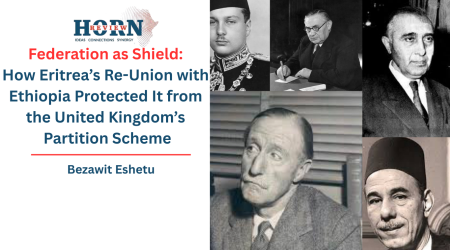
Federation as Shield: How Eritrea’s Re-Union with Ethiopia Protected It from the United Kingdom’s Partition Scheme
In the aftermath of World War II, Eritrea found itself...

21
Feb
Ethiopia’s Modern Diplomacy: Insights in to Its Strategic Engagement in the Middle East and Asia
Over the past eight years, Ethiopia has fundamentally reoriented its...
19
Feb
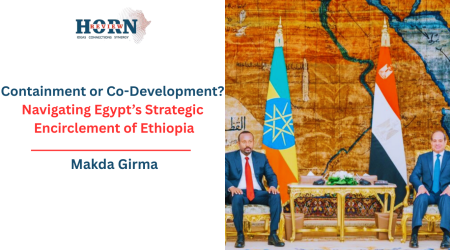
Containment or Co-Development? Navigating Egypt’s Strategic Encirclement of Ethiopia
Egypt is not merely reacting to the GERD. It is...
19
Feb
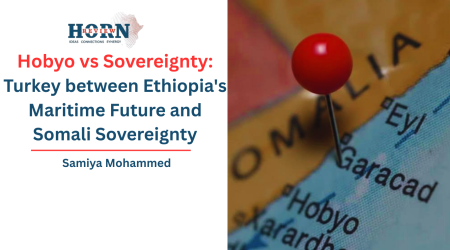
Hobyo vs Sovereignty: Turkey between Ethiopia's Maritime Future and Somali Sovereignty
The Billion Dollar Question, Whose Port, Whose Peace?
The Horn...

18
Feb
Recep Tayyip Erdoğan’s strategic visit to Addis Ababa
President Recep Tayyip Erdoğan’s one-day visit to Addis Ababa on...
18
Feb
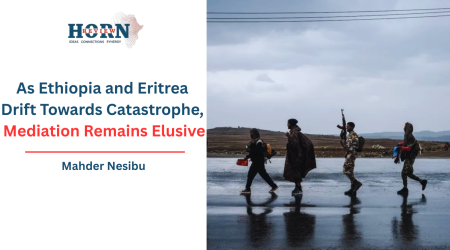
As Ethiopia and Eritrea Drift Towards Catastrophe, Mediation Remains Elusive
The deteriorating relationship between Ethiopia and Eritrea appears to have...