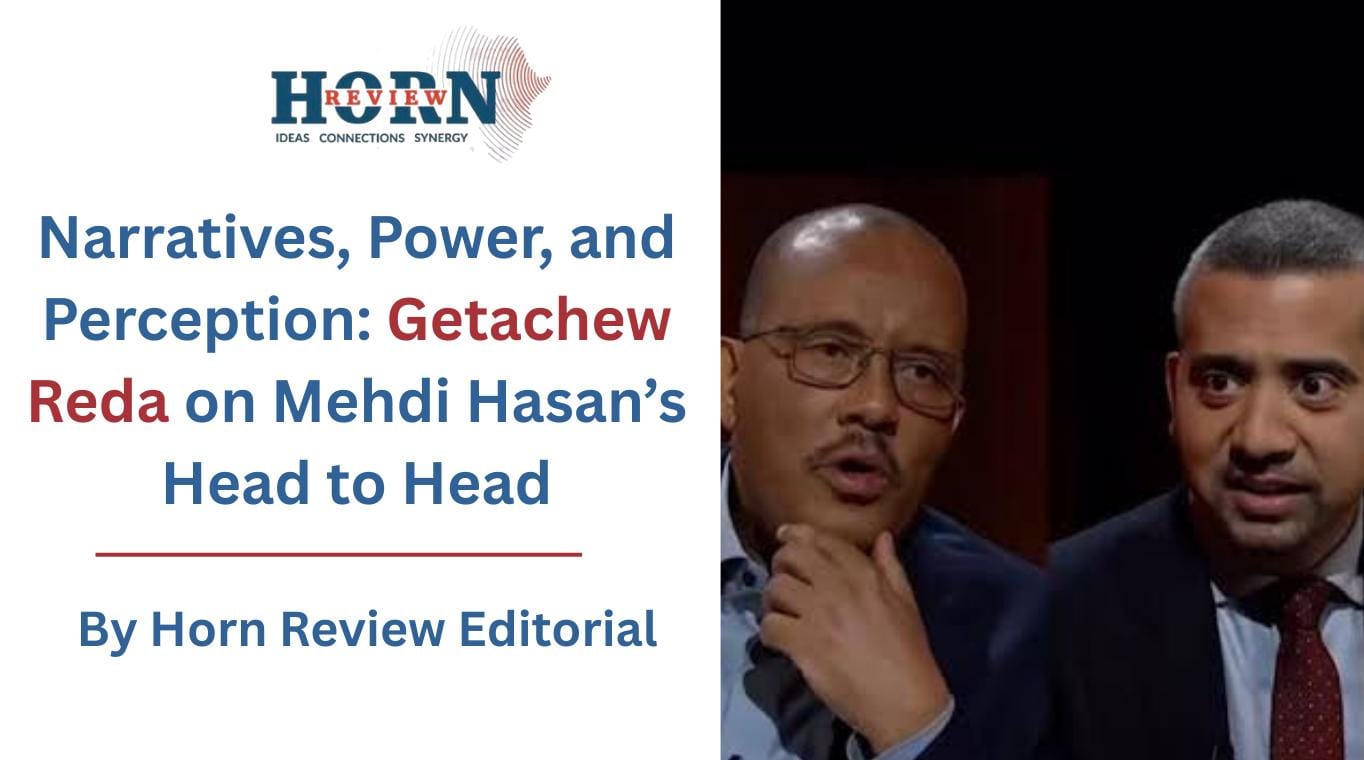
Getachew Reda’s appearance on Al Jazeera’s Head to Head, hosted by Mehdi Hasan, was far more than a conventional interview; it was a carefully choreographed encounter in which media, perception, and political strategy intersected. Within this staged environment, Reda’s political evolution – his engagement with the federal government and distancing from the TPLF’s historical posture – was scrutinized less for its substantive logic than for its symbolic resonance. The episode illustrates the broader dynamics of narrative power in post-conflict Ethiopia, where legitimacy is contested not only on the battlefield but within the architecture of public discourse.
The preparation for the program reflects an acute awareness of these dynamics. Over nearly two months, questions were curated, interlocutors selected, and audience composition strategically planned. The panel comprised figures spanning ideological alignments: Tsedale Lemma, critical of Prime Minister Abiy Ahmed, introduced moral and political tension; Kjetil Tronvoll provided intellectual legitimacy to TPLF-aligned narratives; and Bisrat Lemessa, Aligned with federal perspectives, offered a calibrated counterpoint.
Even the studio audience was deliberately curated to reinforce certain narratives. Advocates like Sarah Van of Edinburgh University and Martin Plaut, a long-standing contributor to pro-TPLF intellectual networks, were present, though Plaut did not pose questions – Sarah posed a curated inquiry targeting Getachew’s position. Vanessa Tsehay, a former long-time anti-PFDJ human rights activist who recently adopted a pro-PFDJ analytical stance amid shifting Western political influences, was also positioned strategically. Their presence, placement and line of questioning created a controlled semiotic environment: every gesture, interruption, and seating arrangement acted as a subtle signal, shaping what could be articulated, how it would be interpreted, and which narratives dominated the discourse.
Moreover, the interview took place in a setting where Ethiopia’s position was insufficiently defended. The substance of the exchange further illustrates the orchestration of perception. Mehdi Hassan, though known for his incisive interviewing style, operated within a predetermined narrative structure that left little room for complexity or contextual nuance, often pursuing contradictions rather than clarity, and confrontation rather than understanding – creating the impression of an event designed for high-impact moments rather than substantive political insight. Each question functioned as a subtle psychological instrument – cornering Reda, magnifying perceived inconsistencies, and reinforcing selective narratives. His line of questioning emphasized sensationalism and moral dichotomies over analytical inquiry, often framing Reda’s political repositioning as a self-contradiction rather than situating it within Ethiopia’s broader post-conflict recalibration.
Genocide allegations were invoked repeatedly without evidentiary scrutiny, establishing a discursive presumption that challenged Reda’s moral authority. Conversely, the TPLF’s wartime actions received no interrogation, revealing an asymmetrical application of accountability. Even the Pretoria Agreement – a cornerstone of Ethiopia’s peace efforts – was treated as a footnote, subordinated to emotive and sensationalist framing. In this sense, the interview functioned as a semiotic arena where symbols and insinuations mattered more than facts, reinforcing selective narratives at the expense of nuanced understanding.
The episode cannot also be divorced from Ethiopia’s broader geopolitical context. Regional actors, particularly Egypt and the TPLF’s longstanding Western allies, have maintained an interest in sustaining narratives that bolster the TPLF while undermining Tigray’s pursuit for peace and progress, and Ethiopia’s broader efforts at federal consolidation. Eritrea, for its part, seeks to alienate Tigray entirely from the federal government, aiming to consolidate what it terms the “Tsimdo alliance” with the TPLF old-guards – its long-time comrades from the TPLF and EPLF’s shared struggle during the war of secession against Ethiopia. This pursuit of alliance emerged after the federal government blocked Eritrea from pursuing its revenge-driven operations in Tigray during the war, which were intended to permanently weaken the Tigray region and render it vulnerable within the Ethiopian state. Even now, Eritrea aims to achieve a similar outcome through the Tsimdo alliance, orchestrating conditions that could lay a foundation for future conflict centered in Tigray rather than Eritrean territory.
Reda’s departure from the radical TPLF old-guards and his realignment with the federal government, therefore, represents a potential disruption of these intensive and extensive investments designed to secure the TPLF’s strategic alignments, complicating entrenched power calculations. Similarly, intellectual and activist networks, historically influential in shaping Western perceptions of the conflict, function as both amplifiers and mediators of narrative, further entangling local, regional, and global dynamics. Hence, the interview was more of a microcosm of competing political and geopolitical agendas, than a media event.
Beyond immediate political calculations, the interview raises profound questions about the ethics of narrative framing in conflict and post-conflict contexts and the risks of allowing unverified claims to circulate without rigorous examination, a practice increasingly common among individuals and groups seeking Western attention through sensationalized terminology. Unsubstantiated claims of atrocities carry real consequences for transitional justice, reconciliation, and national legitimacy. For Ethiopia, where the struggle over political legitimacy is inseparable from the struggle over historical narrative, such framing has long-term consequences for governance, social cohesion, and international reputation.
Ultimately, Getachew Reda’s interview exemplifies the intricate interplay between media, legitimacy, and power in contemporary Ethiopia. It highlights a broader contest over the country’s political future—over who defines legitimacy, who shapes narrative authority, and who influences the nation’s trajectory. The episode demonstrates that control over narrative is itself a central vector of political authority, and that the struggle over perception—who is intelligible, morally credible, and geopolitically consequential—is inseparable from the struggle over Ethiopia’s political direction. It also reinforces a reality long understood in Ethiopian politics: the media is never merely a channel for information. It is an arena in which influence is contested, alliances are recalibrated, and power is negotiated. In this high-stakes environment, interviews like this one are rarely neutral; they function both as instruments and battlegrounds, shaping post-conflict politics, shifting public perception, and altering political balances in ways that extend far beyond the studio.
By Horn Review Editorial