In the political ecosystem of Somalia where consensus is elusive and institutional memory often cautions against repeating past mistakes the federal government’s decision to deny landing clearance to two regional delegations at Mogadishu’s Aden Adde International Airport is not just a security dispute. This incident occurring on the scheduled talks about electoral processes and national unity, serves as a reflection of the contentious governance style of former President Mohamed Abdullahi Farmajo Mohamed whose presidency was suffused by tensions with Federal Member States and repeated delays in electoral timelines. The political drama includes chaotic parliamentary sessions and deepening regional divisions suggests Somalia may be regressing toward a governance model that prioritizes central control over federal consensus potentially endangering the country’s democratic gains and constitutional order.
The recent denial of landing rights to delegations from Puntland and Jubaland coupled with violent discord in the federal parliament are not isolated administrative disputes but rather symptomatic manifestations of a deeper institutional crisis. These events reveal a rupture in the trust required for Somalia’s federal system to function and suggest a strategy to concentrate power within the federal executive. On the eve of crucial talks regarding electoral processes and national unity scheduled to commence on February 1, 2026 the Federal Government of Somalia denied landing clearance at Mogadishu’s Aden Adde International Airport to two aircraft transporting advance security details for the Presidents of Puntland and Jubaland. The FGS justified this action by citing strict violations of previously agreed security protocols for VIP movements into the capital specifically the non submission of passenger manifests and exceeding stipulated numbers of armed guards.
Regional leaders perceived this action quite differently. The Jubaland administration issued a statement strongly regretting the irresponsible decision arguing that their flight had received prior clearance from the Civil Aviation Authority, the conference organizing committee, and federal security agencies. Puntland President Said Abdullahi Deni described the incident as a criminal act and attempted murder. Both regional governments framed the move as a politically motivated tactic designed to undermine their standing ahead of negotiations. This clash over interpretation procedural necessity versus political sabotage reveals the extreme distrust that now characterizes relations between Mogadishu and key federal states.
The timing of this incident is particularly serious as it denotes similar tensions during the Farmajo presidency. In 2021 during another electoral impasse Jubaland and Puntland leaders also arrived in Mogadishu with substantial security details when engaging in consultations. The recurrence of this pattern suggests a structural flaw in Somalia’s federal compact rather than just administrative oversight. Parallel to the airport confrontation Somalia’s bicameral federal parliament descended into chaos during a joint session convened in Mogadishu. The trigger was a contentious set of proposed constitutional amendments that opposition lawmakers argued could effectively extend the current parliament’s mandate which is constitutionally set to expire in April 2026.
The session witnessed physical altercations, shouting matches and scuffles that forced its suspension. Opposition lawmakers accused the Speaker of the House of the People of attempting to railroad through changes without following proper procedure. Lawmaker Abdirahman Abdishakur Warsame, among others condemned restrictions on media access to the parliamentary building calling for journalists to be allowed to report freely. The scene of lawmakers tearing up agenda papers symbolizes the deep divisions surrounding Somalia’s constitutional review process and electoral timeline.
This parliamentary breakdown mirrors a similar constitutional crisis in 2021 under President Farmajo, whose attempt to extend political mandates triggered armed confrontations in Mogadishu and pushed the country to the brink of wider unrest. The fact that this pattern is repeating suggests that Somalia’s political class has not developed adequate mechanisms to resolve constitutional disputes through dialogue rather than confrontation. The cyclical nature of Somalia’s constitutional and electoral crises reveals a persistent institutional weakness.
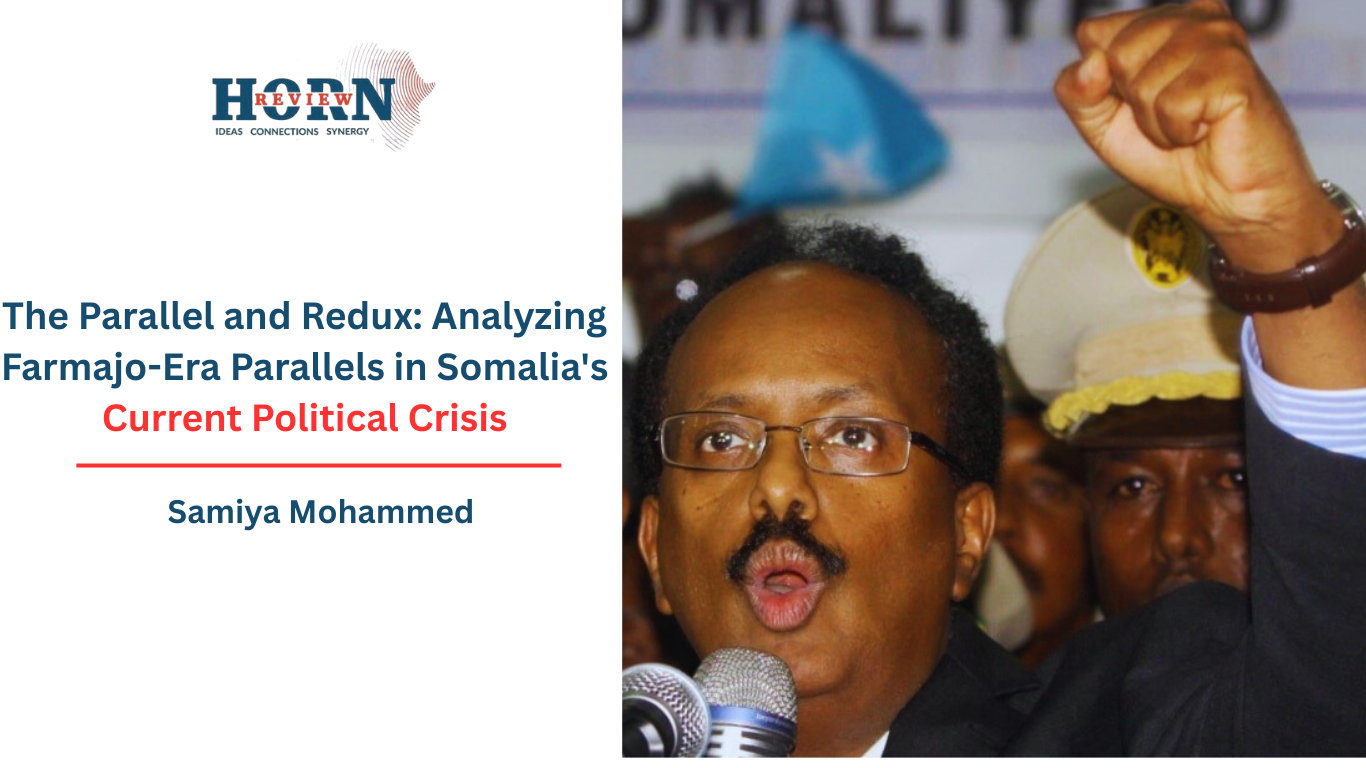
President Mohamed Abdullahi Farmajo Mohamed’s administration was stamped by persistent efforts to consolidate authority in Mogadishu at the expense of federal member states autonomy. This manifested most clearly in disputes over election management. In 2018, Farmajo’s government contested the legitimacy of Jubaland’s presidential election backing a rival candidate against Ahmed Madobe and even deploying federal troops to the region. Similarly, in 2019 tensions with Puntland escalated when the regional government suspended cooperation with Mogadishu accusing Farmajo of violating Somalia’s federal system.
The current administration under President Hassan Sheikh Mohamud appears to be following a similar path. The Federal Government’s assertion of constitutional responsibility to ensure the security and safety of its citizens as justification for the airport denial shows Farmajo’s framing of central authority as paramount. This posture directly contradicts the spirit of Somalia’s federal constitution which envisions power sharing between Mogadishu and the regions rather than unilateral control.The Farmajo presidency became synonymous with electoral delays and constitutional brinkmanship. When his four year mandate expired in February 2021, Farmajo controversially extended his term through parliamentary approval in April of that year triggering deadly gun battles in Mogadishu as opposition groups viewed the move as a flagrant power grab. This extension created a 16 month delay in Somalia’s electoral cycle with parliamentary elections finally completed in April 2022.
The current parliamentary chaos over proposed constitutional amendments that could extend the legislature’s mandate beyond its April 2026 expiration date follows a similar pattern. Opposition lawmakers accusations that the speaker is attempting to ailroad through changes without proper procedure directly parallel opposition allegations during Farmajo’s tenure that he was sowing divisions, disputes, and clan conflict as a tactic to stay in power. This recurrence suggests that institutional safeguards against term extensions remain inadequate.
The airport denial incident and parliamentary chaos of early 2026 are warning signs that Somalia may be reverting to the governance model of the Farmajo presidency. The parallels are too weighty to ignore disputes over security protocols, attempts to manipulate constitutional processes, deepening rifts with key federal states and the prioritization of executive control over federal consensus. What makes this recurrence particularly dangerous is the deteriorating security context. With al-Shabaab controlling more territory than the federal government and advancing toward Mogadishu internal political divisions directly empower the extremist threat. The Somali National Army’s weaknesses are exacerbated when federal and state authorities view each other with suspicion rather than as partners in a common struggle.
By Samiya Mohammed, Researcher, Horn Review