

Teetering on the Precipice: Iran’s Supreme Leader, Regional Instability, and the Geopolitical Dominoes in the Middle East and Beyond
As of early January 2026, a striking and symbolically loaded report has begun circulating through Western and Israeli media ecosystems: Iran’s Supreme Leader, Ayatollah Ali Khamenei, has allegedly prepared a contingency escape plan to flee to Moscow should his regime face imminent collapse. According to a Western intelligence assessment cited by The Times of London, the plan described as a low-probability but high-impact scenario would be activated only if Iran’s security apparatus either fails to contain the expanding unrest or fractures through defection. While there is no indication that Khamenei is preparing to leave Iran imminently, the very existence of such a “Plan B”speaks volumes about the internal condition of the Islamic Republic and the regional shockwaves such a departure would unleash.
At its core, the reported plan is straightforward but politically devastating. Khamenei, now 86, would reportedly flee Iran with his immediate family and roughly 20 close aides, including his son Mojtaba, widely regarded as not his preferred heir. The destination Moscow is neither accidental nor merely symbolic. It reflects both Russia’s role as Iran’s principal great-power ally in recent years and a well-worn precedent in authoritarian survival politics.
Analysts have been quick to draw parallels with the dramatic collapse of Bashar al-Assad’s regime in late 2024, when the former Syrian president reportedly fled Damascus and resurfaced in Moscow as opposition forces entered the capital. That episode marked more than the fall of a client state; it exposed a pattern. Moscow has increasingly functioned as a final sanctuary for embattled leaders whose legitimacy has evaporated but whose strategic value to Russia persists.
For Khamenei, the Assad precedent offers both reassurance and warning. Reassurance, because it suggests that Russia remains willing to provide physical protection to fallen allies. Warning, because Assad’s flight effectively signaled the end of Syrian sovereignty as it had been known reducing the state to a fragmented arena of militias, foreign patrons, and contested authorities. If Khamenei were to follow a similar path, it would likely mark not just the end of his personal rule, but the collapse of the clerical system he has presided over for more than three decades.
The intelligence assessment situates the escape plan against a backdrop of intensifying unrest. Protests have reportedly spread across more than 20 Iranian provinces, driven by a combustible mix of economic hardship, inflation, unemployment, and long-standing political repression. Chants explicitly calling for Khamenei’s death underscore how far public dissent has evolved from reformist demands to outright rejection of the system.
Crucially, the plan’s trigger conditions revolve around the loyalty of the security forces. The Islamic Republic has historically survived crises through a ruthless and cohesive apparatus principally the Islamic Revolutionary Guard Corps (IRGC), the Basij, and internal security services. The fear now appears to be not simply mass protest, but fragmentation: a scenario in which different security units refuse orders, defect, or turn on one another.
President Masoud Pezeshkian’s recent calls for a “kind” approach toward protesters reflect an elite awareness that brute force alone may no longer suffice. Such rhetoric, however, also exposes internal divisions between pragmatists seeking de-escalation and hardliners who view compromise as existential weakness.
Perhaps the most destabilizing aspect of a potential Khamenei exit would be the absence of a credible, unifying successor. Mojtaba Khamenei lacks popular legitimacy and is deeply associated with the regime’s coercive machinery. The clerical establishment itself is fragmented, aging, and increasingly disconnected from society.
In this vacuum, one name has re-emerged with surprising force: Reza Pahlavi, the exiled son of Iran’s last Shah. Protest slogans such as “This is the final battle, Pahlavi will return” and “Reza Shah, God bless your soul” suggest a convergence of generational grievances. Older Iranians associate the Pahlavi era with stability and economic opportunity; younger protesters see Reza Pahlavi less as a monarch-in-waiting than as a symbolic focal point for national unity. Whether he could realistically manage a transition remains uncertain, but his prominence highlights the regime’s ideological exhaustion.
A fleeing Khamenei would reverberate far beyond Iran’s borders. Tehran’s regional proxy network Hezbollah in Lebanon, the Houthis in Yemen, and militias across Iraq and Syria depends on sustained ideological, financial, and logistical backing from the Iranian center. Without it, these actors would face rapid weakening, internal splits, or recalibration toward local agendas.
Such unraveling would benefit Israel, Saudi Arabia, and the United States, all of which have invested heavily in containing Iranian influence. It would also echo the post-Assad Syrian landscape: fragmented authority, militia competition, and foreign intervention.
Ethnic fault lines within Iran further complicate the picture. Kurdish groups in the northwest, Baloch insurgents in the southeast and Azeri communities in the north all of which have experienced repression could push for autonomy or outright separation, risking a Yugoslav-style fragmentation of the Iranian state.
Western capitals would likely interpret Khamenei’s flight as validation of sanctions, covert pressure, and long-term containment strategies. Quiet support for opposition actors would almost certainly intensify. China, as Iran’s largest oil customer, might attempt to play a stabilizing role to protect energy flows, while Turkey and Gulf states would maneuver aggressively to expand influence amid the chaos.
The worst-case scenarios are severe. Iran’s near-threshold nuclear program could fall into the hands of radical factions. Refugee flows could destabilize neighboring states. Proxy escalation particularly a desperate Hezbollah strike on Israel could be used to externalize internal collapse. Any disruption to the Strait of Hormuz would send global oil prices soaring.
What makes this moment uniquely consequential is its intersection with broader geopolitical realignments, including Israel’s expanding footprint in the Horn of Africa. Israel’s recognition of Somaliland and reports of prospective basing arrangements along the Red Sea signal a strategic encirclement of Iran’s remaining maritime and proxy corridors.
An Iranian collapse would weaken the informal alignment between the Houthis and Al-Shabaab, both of which have benefited directly or indirectly from Iranian hostility toward Israel and Gulf states. Israeli presence in the Horn, combined with diminished Iranian capacity, could significantly constrain militant networks operating across the Red Sea basin. In this sense, Khamenei’s hypothetical flight would not merely be an Iranian event, but a catalyst accelerating a regional power shift stretching from the Levant to East Africa.
The provenance of the report itself matters. Attributed to a Western intelligence assessment and amplified rapidly by Israeli outlets, it bears hallmarks of information warfare. Mossad’s deep penetration of Iranian networks, combined with US and UK intelligence monitoring, makes Israeli involvement plausible particularly given Israel’s interest in highlighting regime vulnerability after its 2025 confrontation with Iran. Tehran’s dismissal of the report as “Zionist propaganda” paradoxically reinforces this suspicion.
Whether fully accurate or not, the report functions as strategic signaling: it undermines elite confidence, emboldens protesters, and plants doubt within the security services. In authoritarian systems, perception can be as destabilizing as reality.
Khamenei’s reported Moscow contingency plan may never be activated for now but there is a high chance. Nevertheless, its existence real or perceived marks a turning point. It suggests that the Islamic Republic’s leadership is contemplating scenarios once deemed unthinkable. Should the Supreme Leader flee, Iran would enter a period of profound volatility with consequences that would redraw regional alignments, weaken militant networks, and accelerate Israel’s strategic reach from the Mediterranean to the Horn of Africa. In preparing an exit, the regime may already be conceding that its era is nearing an end.
What deepens the significance of this moment is the renewed posture of the Trump administration, which has framed the Iranian unrest as both a moral indictment of the regime and a vindication of its “maximum pressure” doctrine. President Donald Trump has publicly characterized the protests as a popular uprising against clerical tyranny, and senior administration officials have repeatedly stated that Washington views the unrest as endogenous rather than externally orchestrated. Trump himself has gone further, reviving his long-standing claim that during the six-day regional escalation involving Israel and Iranian proxies in the Horn of Africa and Red Sea Theater, he deliberately refrained from authorizing a strike that would have killed Khamenei. In later remarks, Trump claimed he had “saved the Ayatollah from an ignominious death,” accusing the Iranian leader of ingratitude and warning that restraint should not be mistaken for weakness. These statements, widely circulated inside Iran, have further humiliated the Supreme Leader in the eyes of protesters already chanting “death to the Ayatollah” in the streets.
Iran’s vulnerability is also exposed in Sudan, a theater often overlooked but strategically central to Tehran’s Red Sea ambitions. Over the past two years, Iran has quietly but decisively backed the Sudanese Armed Forces with drones, weapons, and training, seeking to re-establish a foothold on the western shores of the Red Sea after years of isolation. A collapse or paralysis of the Iranian regime would almost certainly sever this support, potentially tipping the balance of Sudan’s civil war in favor of the Rapid Support Forces, which enjoy backing from the United Arab Emirates. Such an outcome would not only reshape Sudan’s internal conflict but effectively end Tehran’s last meaningful Red Sea corridor, compounding the strategic losses already suffered in Syria and Lebanon.
These shifts intersect with intensifying rivalries among Arab states. Saudi Arabia, the UAE, Egypt, and Qatar are already positioning themselves for a post-Iranian vacuum, each with divergent interests. Riyadh would see an opportunity to neutralize the Houthi threat permanently; Abu Dhabi would consolidate its influence from Yemen to Sudan; Cairo would seek to secure the Red Sea against instability; and Qatar would attempt to reinsert itself as a mediator. Turkey, meanwhile, would likely exploit Iranian weakness to expand its influence across Iraq, the Caucasus, and the Horn.
In the Horn of Africa itself, the repercussions could extend to Eritrea. President Isaias Afwerki’s isolationist regime has maintained quiet tactical alignments with Iran at various points, particularly in intelligence and maritime signaling. An Iranian collapse, combined with Israeli expansion and shifting Gulf dynamics, would increase pressure on Asmara, narrowing its already limited strategic options and potentially forcing recalibration.
Taken together, the reported escape plan is less about one man’s survival than about the visible unravelling of an entire geopolitical architecture. From Tehran’s streets to Khartoum’s battlefields, from Yemen’s mountains to the ports of Somaliland, the possibility of Khamenei’s flight exposes how dependent Iran’s regional project has been on centralized authority. If that authority fractures, the aftershocks will not stop at Iran’s borders they will reorder the strategic map of the Middle East and the Horn of Africa for years to come.
By Surafel Tesfaye, Researcher, Horn Review

RELATED
Posts
21
Sep
Saudi Arabia’s Increasing Isolation Against the Houthis
Saudi Arabia’s renewed confrontation with Yemen’s Houthis has exposed how...
21
Sep
Yemen Between Britain and Saudi Arabia
The Houthi advance along Yemen’s Red Sea coast has exposed...
21
Sep
The Cairo-Ankara Rapprochement: A Tactical Mirage of Two Separate Hedges
The recent run of headlines out of Cairo and Ankara,...
20
Sep
The African Union Was Designed to Stand Outside Sudan's War
Every time Sudan's war comes up in public discussion, mentioning...
2
Sep
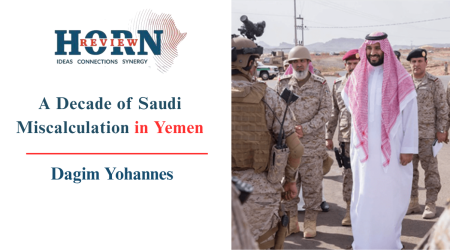
A Decade of Saudi Miscalculation in Yemen
On March 26, 2015, Mohammed bin Salman, then a thirty-year-old...
31
Aug
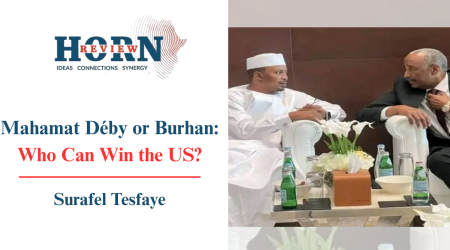
Mahamat Déby or Burhan: Who Can Win the US?
On August 20, 2026, Sudanese warplanes and drones pursued a...
27
Aug
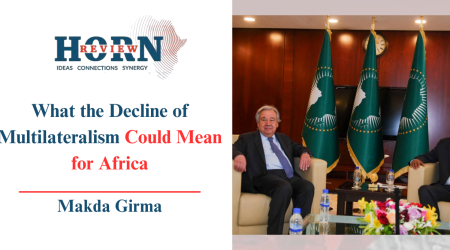
What the Decline of Multilateralism Could Mean for Africa
Multilateralism is weakening just as African states need it most....
19
Aug
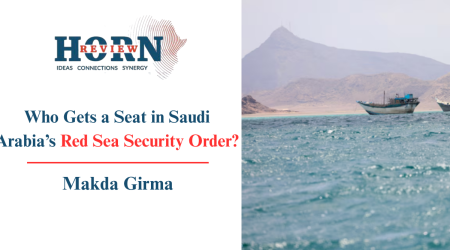
Who Gets a Seat in Saudi Arabia’s Red Sea Security Order?
Saudi Arabia’s new maritime defence architecture exposes a contradiction at...
18
Aug
Asymmetric Attrition in Hormuz: Decoding the Escalation Against State Energy Assets
The attacks on ADNOC vessels in the Strait of Hormuz...
17
Aug
Egypt Skipped the Mecca Pact Because It Lacks the Leverage to Join
Egypt’s continued absence from the Mecca collective-defense pact reflects a...