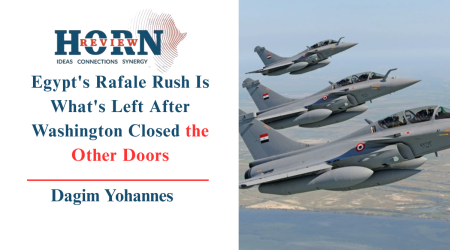
In late 2025, Egypt signed agreements to develop seaports in Eritrea and Djibouti. The terms included upgrading the Red Sea port of Assab and the Gulf of Aden’s Doraleh expanding their capacity to include cot for warships and facilities for elite military contingents. Presented as development partnerships this is interpreted as encirclement aimed at Ethiopia. This development is not just a matter of fact of foreign policy choice however a reflection of Egypt’s obsession with asserting influence over the Red Sea coast where an obsession ineradicable in the colonial era actions of the 19th century. However as then such ambitions to project power into the Horn of Africa collide with the reality of sovereign nations and modern international norms. Egypt’s recent actions mirror a historical arrangement where one written over a century ago during a brief period of imperial overreach and pages have long since yellowed into irrelevance.
The modern realignment within the Red Sea basin operates as a conscious reanimation of a dormant history. Egypt’s arithmetic manifest in its port diplomacy appears to be reactivation of the imperial template established by Khedive Isma’il Pasha which was driven by a vision to forge an African empire stretching from the Mediterranean to the Horn where Khedive Isma’il pursued a policy of aggressive southward expansion from Egypt’s base in Sudan. The coveted prize was control over the Ethiopian highlands and crucially the Red Sea coastline that served as its gateway. Egyptian forces pushed into northern Ethiopian territories annexing the district of Bogos in 1872 and occupying the port of Massawa starting in 1865. This was a classic imperial bet securing coastal to exert pressure on the inland power. Agents like Werner Munzinger Pasha led expeditions aimed at controlling caravan routes, mineral resources and creating buffer zones.
Emperor Yohannes IV of Ethiopia however viewed these incursions as an existential threat to his sovereignty. The conflict escalated into open war. In November 1875 a column of approximately 2,600 Egyptian troops marched from Massawa toward the highlands only to be ambushed and nearly annihilated by Ethiopian forces at the Battle of Gundet. Undeterred, Egypt dispatched a much larger, modernized force of roughly 14,000 men under Ratib Pasha in early 1876. This army equipped with Remington rifles and artillery met an even more decisive fate at the Battle of Gura in March. Emperor Yohannes’s forces leveraging superior knowledge of the terrain, routed the invaders, killing thousands and forcing a humiliating retreat to the coast.
These catastrophic defeats at Gundet and Gura shattered Khedive Isma’il’s dream of an African empire and halted Egypt’s inland advance. However the obsession with the coast persisted. Even in military failure Egypt clung to its coastal enclaves, particularly Massawa maintaining a tenuous and resented presence. This unresolved standoff Ethiopia victorious on the battlefield but denied its own sovereign outlet to the sea, and Egypt defeated but unwilling to fully relinquish its coastal claims—created a volatile frontier that would soon require external mediation. The stage was set for a diplomatic agreement that would become the high water mark of Egypt’s illusory claims.
The diplomatic instrument that encapsulates the fleeting peak and subsequent evaporation of Egypt’s Red Sea ambitions is the Hewett Treaty which signed on June 3, 1884. Negotiated against the secne of the Mahdist uprising in Sudan which threatened to trap Egyptian garrisons, the treaty was brokered by Britain which had occupied Egypt in 1882. Britain’s envoy Rear Admiral Sir William Hewett sought to secure Emperor Yohannes IV’s assistance in evacuating Egyptian troops while stabilizing the region.The treaty’s terms a compromise constituted the fullest formal expression of Egypt’s and by proxy, Britain’s attempt to manage the region through a blend of concession and continued influence. Emperor Yohannes’s core demand was for a seaport. What he received instead in Article I was a guarantee of free transit for all Ethiopian goods, including arms, through the Egyptian-held port of Massawa with Britain acting as protector of this right. In return, Ethiopia agreed to assist the evacuation of Egyptian soldiers and accepted British arbitration in future disputes. Crucially, Article II provided for the return of the occupied district of Bogos to Ethiopian control.
The Hewett Treaty was a masterpiece of imperial ambiguity. It formally acknowledged Ethiopia’s rights and territory yet it kept the prized port of Massawa under Egyptian effectively British administration. For a brief moment, it seemed to crystallize a sphere of influence. However, the illusion was shattered almost immediately. By 1885 with British tacit approval Italy occupied Massawa as Egypt withdrew its forces. Britain, prioritizing its broader imperial interests and relations with other European powers during the Scramble for Africa transferred control without consulting Ethiopia.
This betrayal rendered the Hewett Treaty’s key provisions meaningless. The promised free access to Massawa was denied substituting Egyptian control with Italian colonial ambition and setting the stage for the First Italo-Ethiopian War. The episode served as a lesson like claims to influence based on colonial era agreements are ephemeral dissolving in the face of shifting great power politics and the sovereignty of determined nations. The treaty stands as a historical monument not to enduring power, but to the fragility of influence built on outdated logic. The agreements signed in late 2025 to develop Assab and Doraleh function as a clear mirror, reflecting the strategic patterns of the 19th century with uncanny precision. The actors and specific ports have changed,but the guide remains hauntingly familiar.
In the 19th century, Egypt’s strategy was a direct colonial push like the military occupation of Massawa and northern Eritrean ports, followed by an invasion aimed at the Ethiopian highlands. Today, direct occupation is untenable. The modern equivalent is investment like securing military and logistical facilities in Assab in southern Eritrea and Doraleh in Djibouti to project presence and power into the same Red Sea and Horn of Africa region. Where Khedive Isma’il sought to conquer, today’s Egypt seeks to embed itself through infrastructure, berthing rights for its warships, and the potential to station military contingents.
The underlying objective encirclement and pressure on the Ethiopian highlands from the coast is a direct voice. In the 1870s, Egyptian troops marched inland from Massawa. In 2025, the goal is to position assets that can monitor, pressure, and potentially constrain Ethiopia, which relies heavily on regional ports like Doraleh for over 90% of its trade. The map of influence is being redrawn but the ccartography is centuries old.
This persistent reflex points to a deeper, more enduring mindset. The same conviction that downstream historical rights on the Nile are immutable and must dictate the actions of upstream nations is evident in Egypt’s framing of the Grand Ethiopian Renaissance Dam as an existential threat. It is a logic that privileges historical claims often rooted in colonial-era treaties like those of 1929 and 1959 that Ethiopia rejects over the contemporary rights of sovereign states. The port deals and the dam dispute are twin manifestations of a single philosophy like that geography confers a perpetual hierarchy, and that historic spheres of influence must be defended against the aspirations of rising powers. It is a colonial-era logic struggling to find purchase in a post colonial world.However, the world into which Egypt is projecting this historical strategy is fundamentally different from the one Khedive Isma’il knew. The colonial logic of spheres of influence and imposed hierarchies is obsolete, destined to founder on the rocks of modern sovereignty, international law, and fierce national.
Ethiopia has demonstrated it will not accept a return to vulnerability. The country’s collective memory stretches back to its victories at Gundet and Gura and the betrayal of the Hewett Treaty. This history informs its contemporary resolve. In November 2025, The Ethiopian Foreign Minister explicitly reaffirmed that securing access to the port of Assab remains a national priority, recalling Ethiopia’s historical investments and deep ties to the port. This statement is a declaration that Ethiopia recognizes the game being played and is committed to ensuring its national security and economic independence. Just as it successfully navigated immense pressure to complete the GERD ,Ethiopia’s response to port encirclement will be in a determined defense of its interests.
In an era where nations fiercely exercise their rights over territory and resources, attempts to revive 19th-century patterns of influence are destined to be more symbolic than substantive. They may create friction and tension as seen in the increasingly militarized Red Sea but they cannot recreate the hierarchies of the past. The tools of colonialism are ineffective in a world of sovereign states. Egypt’s recent port agreements in the Horn are not simple foreign policy deals, they are chapters in a much older story. They reflect an enduring fascination with a colonial design written in the 19th century featuring occupation, treaty diplomacy, proxy influence, and strategic encirclement.
The historical mirror shows a consistent pattern from the occupation of Massawa and the Battle of Gura to the promises of the Hewett Treaty, Egypt’s ambitions for Red Sea dominance have repeatedly collided with the realities of Ethiopian sovereignty and the unpredictability of international politics. History’s lesson, however, is that these efforts have ultimately failed. Even at the zenith of the imperial age, they could not be sustained and such endeavours are anachronisms. The Red Sea region’s future will not be determined by the imposition of hierarchies from external powers. Just as the Nile’s waters must be managed through equitable cooperation so too must the Red Sea’s shores be a space for connection, not containment.
By Samiya Mohammed, Researcher, Horn Review