
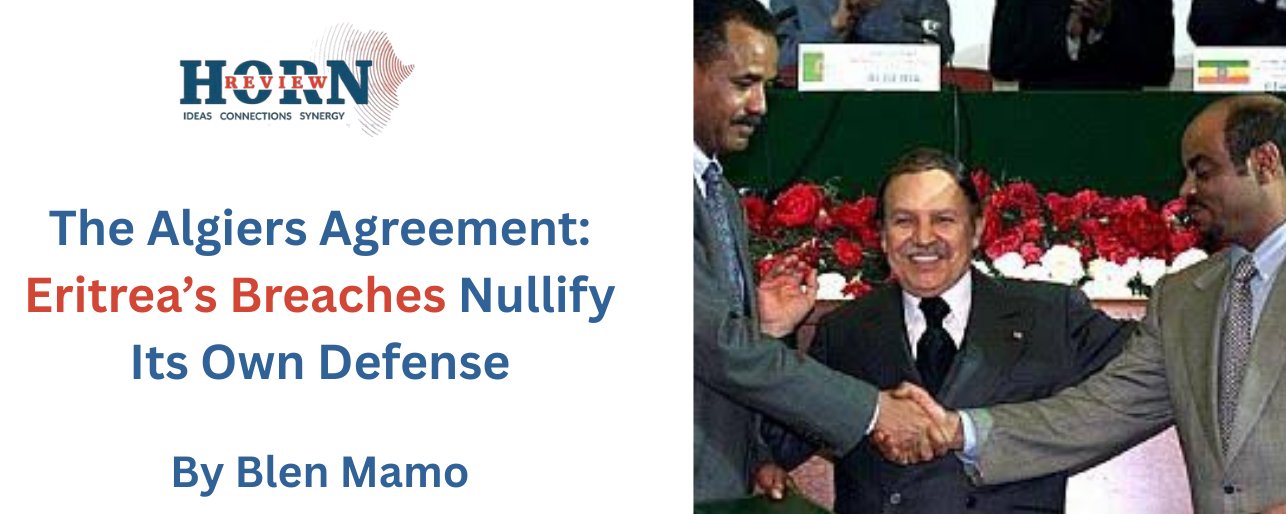
The Algiers Agreement: Eritrea’s Breaches Nullify Its Own Defense
By Blen Mamo
The Ethiopia-Eritrea border dispute, rooted in complex historical, colonial, and post-secession arrangements, remains a critical issue in the Horn of Africa. Its origins trace back to treaties between Ethiopia and Italy from 1889 to 1908, which delineated spheres of influence and established colonial boundaries. These treaties were effectively nullified following Italy’s invasion of Ethiopia in 1896 and 1935, and its subsequent expulsion in 1941, both from the Ethiopian center and periphery, including the Eritrean province. Eritrea was federated with Ethiopia in 1952 under a United Nations mandate and later fully reunited to Ethiopia in 1962, gaining a distinct administrative status but remaining part of the Empire. When Eritrea achieved de jure statehood in 1993 seceding from Ethiopia, the newly formed state encompassed territories previously under Ethiopian sovereignty, creating a situation in which border negotiations involved a former sovereign entity and a state formed from its own territory.
The 1998–2000 Ethiopia-Eritrea war, instigated by the later, arose disputes over these historically and administratively ambiguous boundaries, particularly over the town of Badme. In response, the 2000 Algiers Agreement formally ended hostilities and established two independent commissions. The Eritrea-Ethiopia Boundary Commission (EEBC) was charged with delimiting and demarcating the international boundary based on colonial-era treaties and contemporary international law provisions. Its mandate was exclusively territorial, providing legally binding coordinates and maps to define sovereign control over land.
Complementing this, the Eritrea-Ethiopia Claims Commission (EECC) was tasked with adjudicating claims for violations of international law during the war, including compensation for civilian deaths, injuries, forced labor, sexual violence, looting, destruction of property, and mistreatment of prisoners of war. While the EEBC determined who owns what land, the EECC quantified damages, providing a legally binding framework for accountability.
In its 2002 ruling, the EEBC awarded specific territories as follows: Badme (20 km²) and certain western sector areas, including parts of the Setit–Mareb corridor and sections of northern and western Irob, to Eritrea; Zalambessa (10 km²) in the central sector, Bure in the Afar/Denakil region, and western buffer villages (40 km²) to Ethiopia. The EEBC decision also referenced local administrative labels, such as “Badme sub-district of the North Western Zone” and “former kebele of Dembe Gedamu,” though these references were limited, partial, and complicated by subsequent administrative changes. The award provided limited geographic coordinates and maps at varying scales, and anticipated later fieldwork for physical demarcation. Many small settlements, hamlets, and kebeles were not explicitly named, and shifting administrative boundaries over the decades rendered portions of the award ambiguous in practice.
The EEBC decision also incorporated the principle of effectivités, recognizing the actual administration of contested areas. In regions such as the Endeli projection or Belesa–Muna area near Tserona and Zalambessa, decisions were influenced by de facto control, resulting in differential treatment of settlements. The absence of complete physical demarcation, combined with administrative and effectivité-related uncertainties, meant that much of the de jure boundary remained unenforced, leaving local communities in legal and administrative limbo.
Alongside delimitation, the EECC, later in its Augustt 2009 ruling, awarded Ethiopia around $174 million in compensation for civilian deaths, injuries, forced labor, rape and sexual violence, looting, and POW mistreatment in Irob, Dalul, Elidar, Zalambessa, and more. Besides violations of jus in bello (laws of war), the compensation also covered violations of jus ad vellum (the unlawful resort to force, as the commission found Eritrea was the aggressor. Such ruling, however, unjustly dismissed claims for ports and private business losses on a significant scale. Eritrea received roughly $160 million for comparable claims.
Despite being legally binding, these awards were only partially implemented, leaving many claims unresolved. The EEBC’s reliance on colonial-era maps and limited technological capacity constrained practical implementation. Physical demarcation involving boundary markers was never fully completed, and disputes over effective control persisted, particularly in strategic areas such as Badme, Tsorona, and Zalambessa. Coordinate-based delimitation, rather than reference to contemporary administrative units, left modern woredas and kebeles misaligned with the legal boundary.
Post-2018, Ethiopia took a consequential political step by declaring its readiness to accept the Eritrea–Ethiopia Boundary Commission (EEBC) ruling, including the award of portions of the Badme area to Eritrea. This move was widely understood as a gesture of strategic restraint and a clear signal of Ethiopia’s commitment to durable peace. Ethiopia’s acceptance, however, was accompanied by an expectation of reciprocal engagement – most notably, Eritrea’s willingness to enter negotiations concerning Assab, a strategic Red Sea port whose relevance to Ethiopia’s economic security and regional integration has long been acknowledged.
Despite this opening, Eritrea proceeded in a manner fundamentally inconsistent with both the spirit and obligations of the Algiers Agreement. In the aftermath of the 2020–2022 Tigray conflict and the resulting security vacuum, Eritrean forces entrenched themselves in multiple locations inside internationally recognized Ethiopian territory within northern Tigray region. These include areas in and around Irob, Gulomahda, Adi Quala, Zalambessa, and adjacent border localities long administered by Ethiopia. This continued military presence constitutes Eritrea’s material breach of the Algiers Agreement- whose object and purpose presuppose mutual respect for territorial integrity.
Eritrea’s refusal to withdraw has also compounded humanitarian suffering and insecurity in the Tigray region, deepening displacement, restricting civilian movement, and undermining post-conflict recovery. The situation has been further aggravated by the Tigray People’s Liberation Front’s persistent undermining of the Pretoria Peace Deal and its tactical alignment with its former comrades in the Eritrean regime, signaling a willingness to pursue renewed confrontation in defiance of the Post-conflict peace and recovery framework. This stands in stark contrast to the continued position of the Ethiopian federal government, which has consistently called for the full implementation of the Pretoria Agreement, respect for Ethiopia’s sovereignty, and the unconditional withdrawal of Eritrean forces from its territory. It has to be noted, while Eritrea was not a party to the November 2022 Pretoria Agreement, its continued military presence on Ethiopian territory directly undermines the implementation of that agreement and perpetuates the very conditions of instability the Algiers framework was designed to resolve. Such conduct constitutes a material breach of the Algiers Agreement’s core premise: the normalization of relations through respect for sovereignty, territorial integrity, and good faith compliance.
In summary, Eritrea systematically subverted the post-2018 rapprochement framework, exploiting political and security vacuums during early years of political transition in Ethiopia. It reneged on agreed arrangements, fostered proxy insurgencies, and cultivated tripartite alliances – including with Somalia and Egypt – to prevent Ethiopia’s maritime access under the Ethiopia-Somaliland MoU. Eritrea also selectively ignores the EECC ruling and invokes the EEBC ruling to dismiss Ethiopia’s constructive gesture to negotiate maritime rights over its former coastal territories, despite Ethiopia never formalizing a position on Assab. This demonstrates Eritrea’s misuse of the EEBC award, extending beyond its intended territorial scope.
That said, the decisive issue now is Eritrea’s sustained and deliberate violation of the Algiers Agreement in the present. For more than three years, Eritrean forces have remained entrenched inside internationally recognized Ethiopian territory, occupying areas in northern Tigray despite Ethiopia’s repeated calls for de-escalation, normalization, and peaceful coexistence. Throughout this period, Ethiopia has exercised exceptional restraint – eschewing retaliatory measures, reaffirming its commitment to peace, and continuing to reference the Algiers framework as the appropriate legal basis for resolving disputes. Eritrea’s conduct stands in stark contrast. Its continued occupation of Ethiopian territory, coupled with its refusal to normalize relations in practice, directly defeats Algiers Agreement as its defense.
Therefore, Eritrea, or whoever for that matter, can no longer credibly invoke the Algiers Agreement either as a shield or as a source of unilateral obligations for Ethiopia only. Under Article 60(3)(b) of the Vienna Convention on the Law of Treaties, a material breach occurs when a party violates a provision essential to the accomplishment of a treaty’s object and purpose. Eritrea’s ongoing military presence on Ethiopian soil – long after the cessation of active hostilities and in the face of Ethiopia’s demonstrable restraint – meets this threshold. Moreover, Article 62 of the Convention permits termination or suspension of a treaty where a fundamental change of circumstances, unforeseen at the time of conclusion, radically transforms the extent of obligations still to be performed. Eritrea’s transformation from a party to a peace agreement into a de facto occupying force constitutes precisely such a change. International law does not permit a state to continue invoking a treaty’s protections while systematically hollowing out its substantive obligations through coercive conduct and simultaneously eroding the peace frameworks that give those outcomes meaning. A treaty persistently undermined in practice cannot be selectively resurrected as a source of entitlement.
Eritrea’s consistent strategy of invoking international law only when it serves coercive objectives, while rejecting its reciprocal obligations has made it forfeit any claim to legal good faith. In doing so, its elite’s continued reliance on the Algiers Agreement has lost its legal and moral force. They cannot cloak themselves in the authority of Algiers while operating in open defiance of its foundational commitments. While Ethiopia’s position remains grounded in treaty law, state practice, and the principle of good faith – the collapse of the Algiers pretense is the inevitable legal consequence of Eritrea’s own conduct.
References
African Union, Peace & Security Dept. “Decision of the Eritrea‑Ethiopia Boundary Commission (EEBC) Regarding the Delimitation of the Border between the State of Eritrea and the Federal Democratic Republic of Ethiopia.” PeaceAU, last updated October 8, 2012. https://www.peaceau.org/en/article/decision-of-the-eritrea-ethiopia-boundary-commission-eebc-regarding-the-delimitation-of-the-border-between-the-state-of-eritrea-and-the-federal-democratic-of-ethiopia.
Blen Mamo. “Ethiopia’s Residual Rights to Negotiate Sovereign Sea Access with Eritrea.” Horn Review, December 3, 2025. https://hornreview.org/2025/12/03/ethiopias-residual-rights-to-negotiate-sovereign-sea-access-with-eritrea/.
Daily News Egypt. “Ethiopia Accuses Eritrea of Violating Its Territorial Integrity.” DNE Africa, November 2025. https://africa.dailynewsegypt.com/ethiopia-accuses-eritrea-of-violating-its-territorial-integrity/.
Ehl, David. “A Look at Eritrea’s Role as New Tigray War Looms in Ethiopia.” DW, July 16, 2025. https://www.dw.com/en/a-look-at-eritreas-role-as-new-tigray-war-looms-in-ethiopia/a-73283778
Eritrea‑Ethiopia Claims Commission. Final Award – Eritrea’s Damages Claims, 17 August 2009, in Reports of International Arbitral Awards Vol. XXVI (United Nations, 2009), pp. 505–630. https://legal.un.org/riaa/cases/vol_XXVI/505-630.pdf
Eritrea‑Ethiopia Claims Commission (EECC). In Max Planck Encyclopedia of Public International Law, edited by Rüdiger Wolfrum. Oxford: Oxford University Press, [year]. https://doi.org/10.1093/law:epil/9780199231690/law-9780199231690-e1774
FRANCE 24. “Two Years After Ethiopia’s Tigray War, Eritrean Forces Still Occupy Border Regions.” FRANCE 24, November 14, 2024. https://www.france24.com/en/tv-shows/focus/20241114-two-years-after-ethiopia-s-tigray-war-eritrean-forces-still-occupy-border-regions
Human Rights Watch (HRW). “Eritrean, Tigray Forces Committed ‘War Crimes’: Rights Watchdog.” DW, September 16, 2021. https://www.dw.com/en/eritrean-tigray-forces-committed-war-crimes-rights-watchdog/a-59197012
Kibreab, Gaim. “Sexual Violence in the Eritrean National Service.” African Studies Review 60, no. 1 (2017): 123–43. https://www.jstor.org/stable/26410204
Odello, Marco. The Eritrea-Ethiopia Boundary Commission: The Aftermath. 2021. https://doi.org/10.1007/978-94-6265-439-6_11
Permanent Court of Arbitration. “Case 71 – Eritrea‑Ethiopia Claims Commission.” https://pca-cpa.org/en/cases/71
Permanent Court of Arbitration. “Eritrea‑Ethiopia Boundary Commission (Case 99).” PCA-CPA, accessed December 5, 2025. https://pca-cpa.org/en/cases/99
Shaw, Malcolm N. “Title, Control, and Closure? The Experience of the Eritrea–Ethiopia Boundary Commission.” International and Comparative Law Quarterly 56, no. 4 (2007): 755–96. https://doi.org/10.1093/iclq/lei201
The America Team for Displaced Eritreans. “The Repression Avalanches.”EritreanRefugees.org Accessed December 5, 2025. https://eritreanrefugees.org/the-repression-avalanches/.
The Reporter Ethiopia. “Eritrea Admits Military Presence In Badme And Disputed Territories, Denies Occupation.” The Reporter Ethiopia, March 2, 2024.https://www.thereporterethiopia.com/39015/.
Tesfay, Seyoum Yohannes. “Eritrea‑Ethiopia Arbitration: A ‘Cure’ Based on Neither Diagnosis nor Prognosis.” Mizan Law Review 6, no. 2 (2013): 163–199. https://doi.org/10.4314/mlr.v6i2.1
United Nations. “Decision Regarding Delimitation of the Border Between Eritrea and Ethiopia, 13 April 2002,” Reports of International Arbitral Awards Vol. XXV (2002): 83–195. https://legal.un.org/riaa/cases/vol_xxv/83-195.pdf
United Nations. Vienna Convention on the Law of Treaties (23 May 1969). United Nations Treaty Series, vol. 1155, p. 331. https://legal.un.org/ilc/texts/instruments/english/conventions/1_1_1969.pdf
Ethiopia and Eritrea. Agreement between the Government of the State of Eritrea and the Government of the Federal Democratic Republic of Ethiopia. Algiers, 12 December 2000. UN Peacemaker. Accessed December 5, 2025. https://peacemaker.un.org/en/node/9574
Authors Bio
Blen Mamo is Executive Director of Horn Review and a researcher specializing in law, international security, and geopolitics in the Horn of Africa. She holds an LL.B and an M.Sc. in International Security and Global Governance.
.

RELATED
Posts
16
Sep
Why Eritrea Turned from Engaging Somaliland in 2019 to Opposing It Today
In March 2019 Eritrean Foreign Minister Osman Saleh accompanied by...
16
Sep
Ethiopia and the U.S. After the War on Terror: Within a New Arc of Terrorism
The War on Terror began as a direct response to...
16
Sep
Why the Abraham Accords Will Not Expand Yet
The claim that Israel is unlikely to find an...
16
Sep
The Real Houthi Weapon Was Mobilization, Not Missiles
Fatima Abo Alasrar frames the Houthi ground strategy as...
16
Sep
The Houthis Reached Zuqar Island: Can Eritrea Be a Neutral Observer?
The island of Zuqar sits in the southern Red Sea,...
15
Sep
What the UN’s Darfur Sanctions Rollover Reveals About the Next Phase of Sudan’s War
On paper, Resolution 2828 is a housekeeping measure. It...
14
Sep
Eritrea Can’t Secure the Red Sea. Here Is Why
When Saudi Arabia formed a coalition of states in...
14
Sep
Shadow Competition in the Horn, Saudi Training and Emirati Surveillance
The Horn is experiencing a shift in the character of...
14
Sep
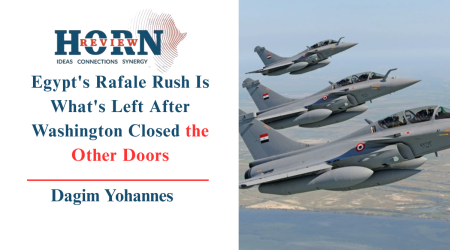
Egypt's Rafale Rush Is What's Left After Washington Closed the Other Doors
Egypt is nearing a new deal with French company...
14
Sep
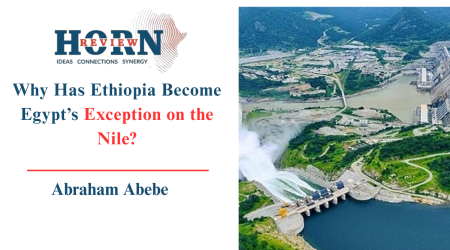
Why Has Ethiopia Become Egypt’s Exception on the Nile?
Egyptian officials have repeatedly made a revealing distinction about the...