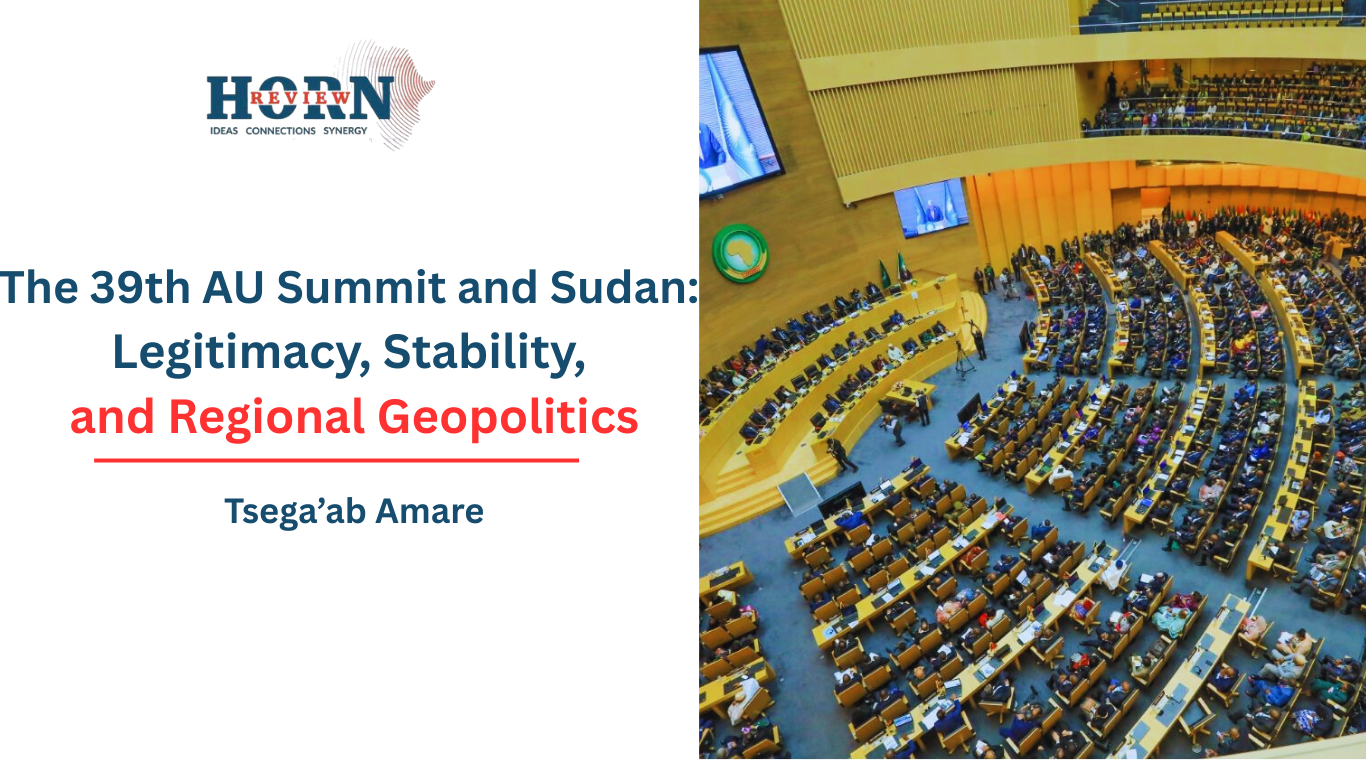
The 39th African Union Summit took place at a critical time for the Horn of Africa, with the continental body seeking to address the complex issues resulting from the prevailing conflict in Sudan. The main point of tension between member states was Egypt’s efforts, while presiding over the Peace and Security Council (PSC), to ensure that Sudan rejoins the African Union (AU). It is important to note that Sudan was suspended by the AU on October 25, 2021, following a coup d’etat that took place on that day, a move that was consistent with AU norms on unconstitutional changes of government.
The proceedings at the summit, therefore, underscore a longstanding tension between strict adherence to democratic values and a pragmatic approach that was considered essential at a time of crisis.
The strategic context was also defined by a PSC meeting convened by Egypt on February 12, 2026, which was attended by foreign ministers only a few days after Cairo took over the presidency of the PSC. The meeting was intended to underscore Cairo’s determination to ensure that the Sudanese Armed Forces (SAF), under General Burhan, rejoined the continental fold. This was underscored by a decision by Sudan to re-engage with the IGAD, a move that was seen by regional leaders as a sign that Khartoum was willing to re-engage with its regional peers. The AU Commission, under Mahmoud Ali Youssouf, was also under pressure from civilians, with former Prime Minister Abdalla Hamdok and his Somoud coalition arriving in Ethiopia ahead of the AU Summit to express opposition to any premature re-admission that could legitimize military rule without a credible transition to civilian governance.
For Ethiopia, therefore, the stakes in Sudan’s crisis will continue to be pressing and deeply local. As host of the AU and a primary neighbor to the conflict, Ethiopia will view stability in Sudan through the twin lenses of national security and regional containment. Ethiopia’s interest is not merely in a unified Sudan, but in a unity anchored in a credible political transition. Stability secured solely through military consolidation would be brittle, risk cross-border spillovers into Amhara and Benishangul-Gumuz, and ultimately feed Ethiopia’s own internal fault lines.
The geopolitical aspects of the conflict also involve the complex dynamics of the Nile Basin countries. Egypt’s strong support for the SAF is seen not only as a desire to ensure stability in the region but also to enhance a relationship that can significantly impact future negotiations regarding the Grand Ethiopian Renaissance Dam (GERD). Recent negotiations between Cairo and Khartoum regarding mediating water issues between Ethiopia, South Sudan, and Sudan indicate that Sudan’s readmission into the AU can significantly impact the dynamics within the deliberative bodies of the organization. While Ethiopia is committed to a cooperative approach to the Nile Basin, the emergence of a strengthened relationship between Egypt and Sudan calls for a sophisticated approach to ensure that all Nile Basin countries are taken into account in future negotiations.
The normative aspects of the conflict, from the AU perspective, represent a test of the founding principles of the organization. While the organization maintains a zero-tolerance policy regarding coups, the protracted nature of the conflict in Sudan has led to calls from member countries that the suspension of Sudan is not only counterproductive but also represents a desire to isolate a key player in future negotiations regarding conflict resolution in the region.
Ethiopia, traditionally a guardian of continental norms, remains positioned to advance a principled yet pragmatic approach: engagement with authorities in Port Sudan for humanitarian and security purposes, while conditioning full readmission on verifiable benchmarks, including a comprehensive ceasefire and the meaningful inclusion of civilian forces such as the Somoud coalition.
Sudan’s return to IGAD has opened a door for the AU. With IGAD on board, engagement in the region can shift from talk to action on border security and trade. The summit has reinforced the need for follow-through, with planning for assessment missions and the reopening of an AU Liaison Office in Sudan, signposting a step-by-step approach to normalization in the region. Rather than a dramatic return that signals a step back from the Lomé Declaration, a step-by-step approach that allows for participation in technical committees of the AU tied to progress in the political transition in Sudan maintains AU pressure while also acknowledging the country’s strategic position in the region.
Egypt’s objective has been to prevent a complete collapse in Sudan while protecting its interests in the Red Sea region. At the same time, there has also been engagement from the Sudanese side, with diplomats such as Ambassador Elzein Ibrahim Hussein remaining active in the region, even during the suspension. The PSC will need to balance this engagement with the need for a democratic transition, rather than a premature readmission that could create divisions within the country, suggesting that the military can return to continental favor without having to make concessions to the pro-democracy movement.
The summit concluded with a step-by-step approach rather than full readmission. There has been no breakthrough on a ceasefire agreement brokered by the AU and IGAD, but a reaffirmation of calls for a ceasefire, plans for field assessments, and the continued suspension, suggesting a careful approach. External actors, such as the US, Saudi Arabia, and the UAE, remain key players, running parallel mediation processes that do not always align with continental processes. Ethiopia, as a key player in the region, is in a strong position to broker a resolution that ties together the different strands of diplomatic engagement, from informal meetings with military leaders and civilian politicians such as Abdalla Hamdok.
To strengthen its diplomatic leverage, Ethiopia should work to create a joint technical committee with the AU and IGAD that focuses on the political transition in Sudan. This will oversee humanitarian ceasefires and keep the voices of civilians at the center of a new road map for the country. At the same time, Ethiopia should quietly open a dialogue with Egypt to discuss areas of common interest, such as counterterrorism operations and preventing spillovers, while at the same time protecting its vital national security interests in the Nile River Basin. This balanced approach will allow Ethiopia to play a guiding role in a new continental response to the crisis while still protecting its vital security interests.
Ultimately, the way that the crisis in Sudan has been managed at the 39th African Union Summit speaks to the relevance of the organization for the next decade. By opting for a more conditional approach rather than a bold, sudden response, the AU has signaled a commitment to aligning the realities of geopolitics with the need for democratic legitimacy. Ethiopia, with its unique position as a neighbor to Sudan and a hub for multilateral organizations, is in a strong position to make sure that the return of Sudan to the AU is more than a mere formality, but rather a new era of stability, cooperation, and civilian leadership.
By Tsega’ab Amare, Researcher, Horn Review