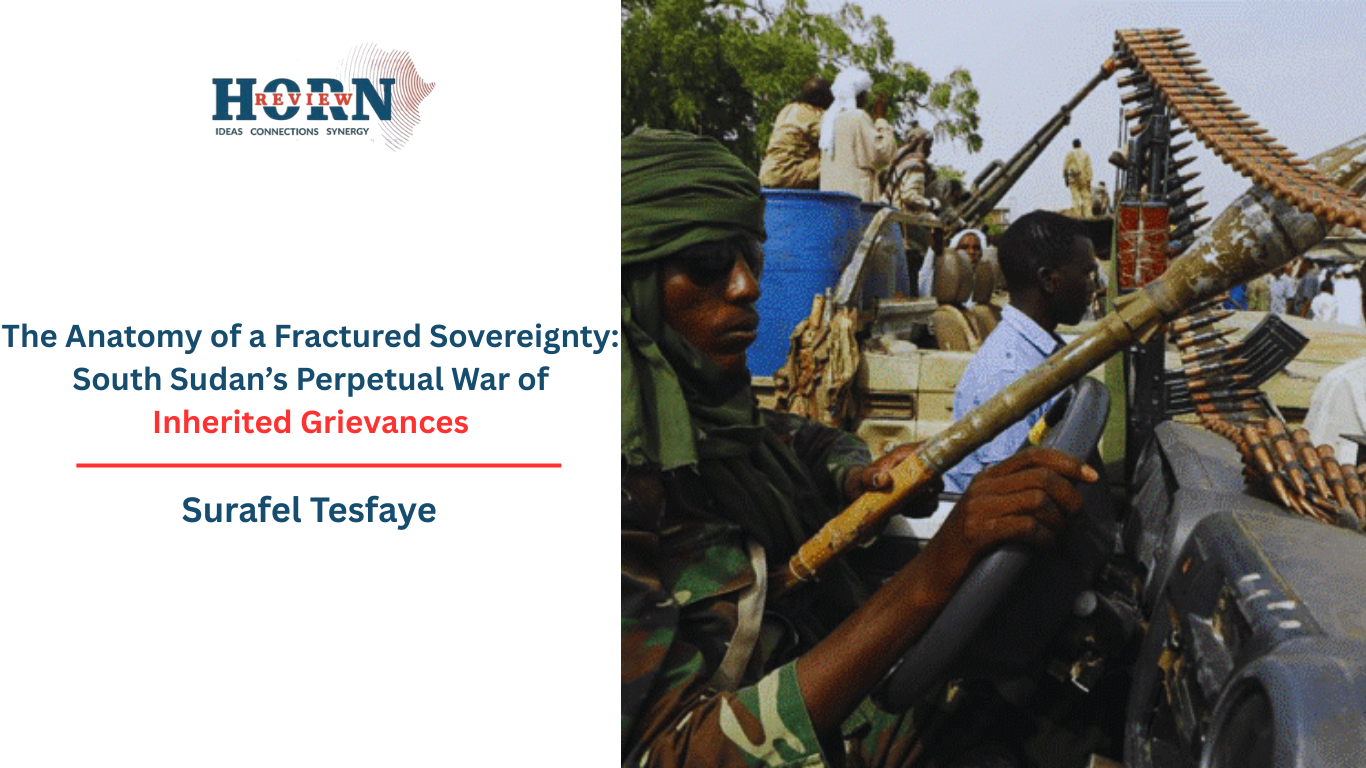
South Sudan emerged as the world’s youngest sovereign entity amidst a climate of profound optimism, yet it almost immediately regressed into a tragically familiar pattern of internal fragmentation. Since the achievement of independence, the republic has spent nearly half of its brief existence consumed by open civil war. What renders this tragedy more profound is the historical reality that this violence did not spontaneously ignite in 2013, or even in 2011; rather, Southerners have repeatedly engaged in internecine warfare with a ferocity that often eclipsed their resistance against the North. In this sense, South Sudan is not a nation that merely “returned” to a state of war; it is a state that has never maintained stability long enough to function as a cohesive institutional body.
Long before the realization of independence, the architecture of Southern resistance was already critically fractured. Even during the protracted liberation struggle against Khartoum, the South was convulsed by repeated episodes of what is best described as “South-on-South” internal warfare. These conflicts were neither marginal nor accidental; in many instances, they resulted in higher Southern casualty rates than direct engagements with Northern forces. The historical pattern remained consistent: unity was a fleeting tactical necessity, while mistrust remained a permanent strategic reality, and violence between Southern factions was treated as a legitimate instrument of political competition.
This systemic fragmentation was not a random evolution but was rooted in the very colonial construction of Sudan itself. The primary political rupture occurred during the 1947 Juba Conference, where British administrators abruptly abandoned their “Southern Policy” and coerced the South into a unified Sudanese state dominated by Northern hegemony. Southern leaders accurately warned that they would be politically and economically “swallowed,” yet their legitimate objections were dismissed. This decision effectively marooned the South within a state apparatus it neither trusted nor controlled, planting the seeds of an existential grievance that would eventually explode into open rebellion.
The military manifestation of this grievance followed in August 1955 with the Torit Mutiny, where Southern soldiers fearing a purge by Northern officers chose insurrection over integration. Even before Sudan achieved official independence, the precedent for armed resistance as the primary language of Southern politics had been solidified. While the mutiny failed to achieve its immediate military objectives, it established a lasting norm: the surviving mutineers fled into the bush, existing as a decentralized constellation of fugitives across Equatoria and Upper Nile. For several years from 1955 until the early 1960s there was no unified rebel command, only fragmented armed groups surviving on the periphery of the state.
From this disorganized vacuum emerged the Anyanya, a name signifying “snake venom” in the Madi language, reflecting both its lethal intent and its decentralized guerrilla nature. While this movement represented the first organized Southern rebellion, it was perpetually undermined by leadership rivalries, ethnic polarization, and regional mistrust. In 1971, Joseph Lagu staged a successful internal coup against Gordon Muortat Mayen, unifying rival factions under the Southern Sudan Liberation Movement. This consolidation was heavily influenced by external geopolitical currents: weaponry flowed from the Congo Crisis, and Israel provided strategic support under its “Periphery Doctrine,” aimed at distracting the Sudanese government (an ally of Egypt).
When President Jaafar Nimeiry signed the 1972 Addis Ababa Agreement, granting the South a degree of autonomy, Khartoum effectively acknowledged that a total military victory was unattainable. However, the agreement did not resolve the South’s internal contradictions; it merely suspended them. This autonomy functioned as a temporary veneer over deep political and ethnic fractures without addressing their root causes. When that autonomy was unilaterally dismantled in 1983 through the imposition of Sharia law and the re-division of the South the conflict resumed with an even more virulent ideological and ethnic intensity than before.
The Second Civil War exposed these internal fault lines with brutal transparency. The confrontation between Anyanya II and John Garang’s SPLA in the 1980s marked the advent of large-scale “brother-to-brother” warfare. Anyanya II, drawing heavily on Nuer support, advocated for total independence, while Garang’s SPLA widely perceived as Dinka-dominated fought for a unified, secular “New Sudan.“ These were not merely academic disagreements; they were competing visions for power, identity, and survival.
Regional and Cold War geopolitics intensified this divide. Ethiopia, under Mengistu Haile Mariam, backed Garang not because it supported Southern self-determination, but because Garang promised a unified Sudan one that could help Ethiopia counter what Mengistu believed was a coordinated effort by the United States, Egypt, and pro-Western Arab states to destabilize his Marxist regime. During the Derg period, Sudan hosted Ethiopian opposition and secessionist movements, while Cairo and Khartoum were suspected of supporting insurgencies inside Ethiopia. Supporting Garang became a strategic counter-move.
Khartoum, meanwhile, strategically armed Anyanya II. This alliance was not ideological but purely tactical; Anyanya II accepted Northern support as a survival strategy to avoid being crushed by the SPLA a classic “enemy of my enemy” calculation. Khartoum exploited this by transforming Southern factions into proxy militias, entrenching a culture of ethnic militarization that would later devastate Jonglei and Upper Nile. Simultaneously, the SPLM/A itself received arms not only from Ethiopia but also from Uganda, Eritrea, Kenya, Zimbabwe, Namibia, Israel, the United States, and Great Britain. Southern fragmentation was thus reinforced by international sponsorship on all sides.
The 1991 Nasir faction split led by Riek Machar and Lam Akol represented the most devastating internal collapse prior to independence. It marked the point at which Southern violence fully turned inward. The resulting Bor Massacre was not a collateral byproduct of war, but a deliberate deployment of ethnic mobilization as a political weapon. This moment shattered the illusion that Southern unity would naturally materialize upon independence; the trauma was never reconciled or resolved, but instead hardened into a collective political memory.
Garang eventually consolidated the remaining Anyanya fighters into the SPLM/A, demanding an end to religious hegemony while refusing to abandon his vision of a unified Sudan. Following the 2005 Comprehensive Peace Agreement, he briefly served as Sudan’s Vice President before his untimely death. Salva Kiir Mayardit, a former Anyanya II major, succeeded him and prioritized independence over unity. The 2006 Juba Declaration subsequently absorbed the South Sudan Defense Forces into the SPLA, creating a hollow illusion of unity while embedding former enemies within a single military structure.
This is precisely why South Sudan’s post-independence conflicts were not an anomaly but a structural inevitability. Even before the 2018 revitalized agreement, the nation had already spent nearly six years in a state of civil war. Independence did not represent a break with history; it was an extension of it. The rivalry between Salva Kiir and Riek Machar was not merely personal, but structural a continuation of earlier power struggles. When tensions escalated in 2013, communities mobilized immediately, driven by decades of historical experience rather than sudden panic.
The deeper problem remains the institutionalization of governance by the gun. The SPLM was forged as a military movement rather than a democratic one, and independence failed to transform military commanders into civilian statesmen. Political disagreement remains synonymous with betrayal, and elections are viewed as existential threats rather than mechanisms for accountability. In this dysfunctional system, armored vehicles replace ballots, and ethnic militias serve as substitutes for national institutions.
Local grievances were never effectively reconciled. Communities across Equatoria, Jonglei, and Pibor felt marginalized throughout the liberation struggle, with some aligning with Khartoum for protection rather than loyalty. The collapse of the national army in 2013 merely exposed the fundamental truth: it was never a cohesive national institution, but rather a temporary coalition of armed rivals.
By 2026, the political narrative has come full circle. Juba is increasingly viewed as the “New Khartoum,” with a narrow elite accused of reproducing the same exclusionary systems that Southerners once fought against the northerners. Federalism has returned to the discourse not as an administrative theory, but as a strategy for survival, while disarmament is viewed as a precursor to ethnic domination. History has conditioned fear into the very fabric of political behavior.
The tragedy is not simply that South Sudan is a young nation; it is that from 1955 to the present day, war has remained the default language of political engagement. Independence did not interrupt this cycle; it inherited it. In 2026, the central question remains identical to the one posed in 1947: can diverse communities coexist under a central authority they fundamentally do not trust? Until that question is addressed through political reform rather than military force, South Sudan’s internal conflict will not end; it will only pause to prepare for the next round of attrition.
By Surafel Tesfaye, Researcher, Horn Review