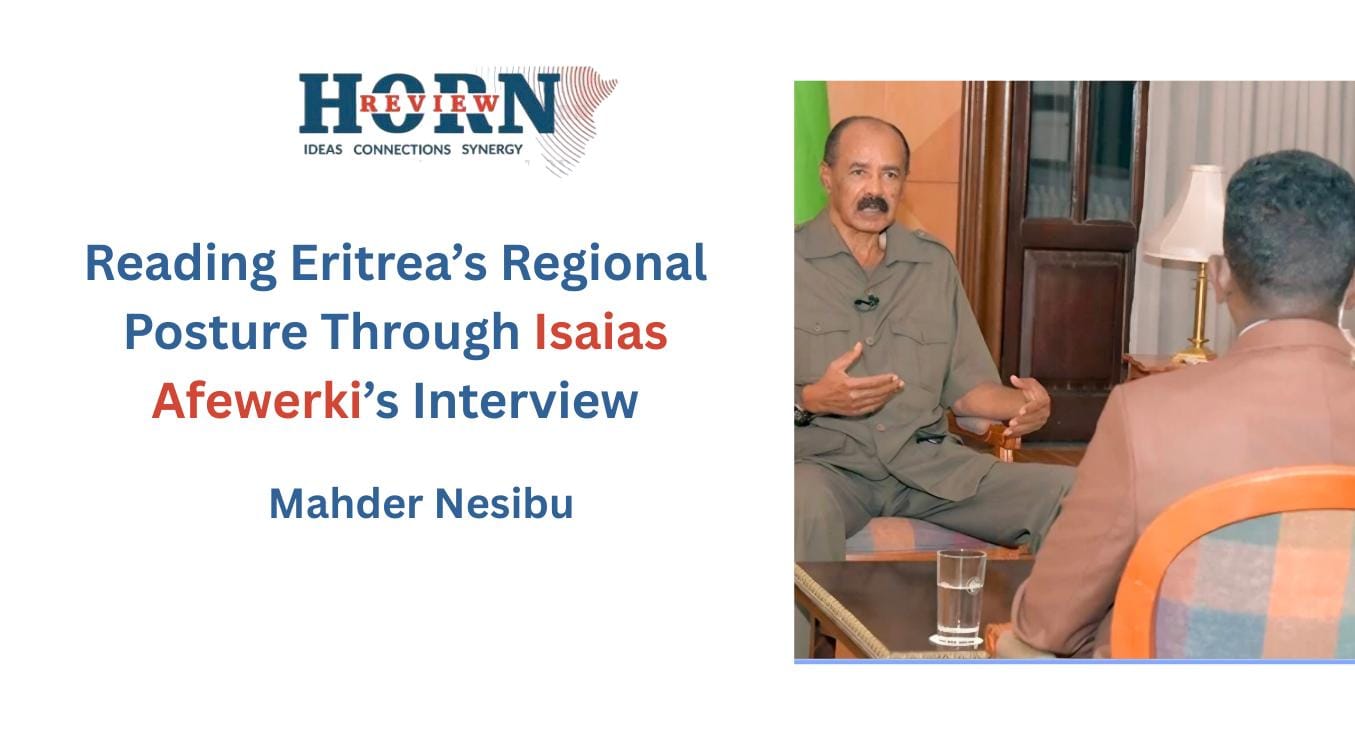
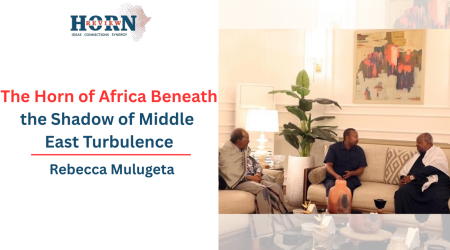
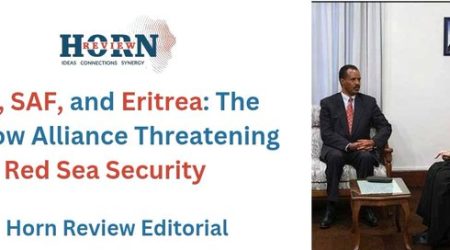
On January 12, Isaias Afewerki gave an interview to state media addressing a range of international and regional issues. Beyond his customary reflections on the global order and United States foreign policy, the interview offers a clearer indication of Asmara’s current priorities and its self-perceived geopolitical standing. For a leadership that has steadily re-entered regional diplomacy since Eritrea’s emergence from prolonged isolation after 2018, developments in the immediate neighbourhood and the broader Middle Eastern–Horn of Africa interface appear more central than ever. As is typical of such interventions, the interview devotes little attention to domestic governance, socio-economic conditions, or issues directly affecting Eritrean society. Instead, it triangulates Eritrea’s outlook around Sudan, Ethiopia, and shifting power dynamics in the Middle East, situating Asmara as an active and regional actor.
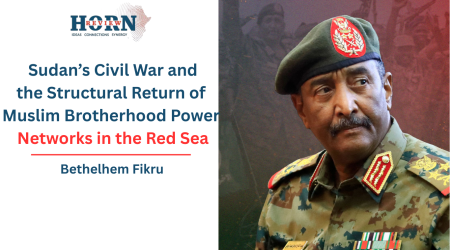
Sudan occupies a particularly prominent place in the ’s remarks. This emphasis is consistent with a pattern evident across recent interviews given to Sudanese, and Egyptian media, in which Sudan is framed as both a historical issue and a contemporary strategic priority. Isaias situates the Sudanese crisis within a longue durée narrative extending back to independence in 1956, arguing that decades of misrule under the National Congress Party produced structural instability with repercussions beyond Sudan’s borders. The popular uprising that removed Omar al-Bashir is portrayed as a corrective moment, followed by a necessary, though temporary, custodial role for the military through the Sovereign Council. Eritrea’s stated support for a transitional arrangement leading to civilian rule is presented as principled and consistent, reinforced by references to documents allegedly submitted to Sudanese authorities in 2022 outlining a time-bound transfer of power.
Yet this account also serves a political function. By framing the conflict as neither a civil war nor a personal rivalry between generals, Isaias seeks to legitimize the Sudanese Armed Forces as transient custodians of the state, while delegitimizing alternative interpretations advanced by international actors. External interference, rather than internal political contestation, is identified as the primary driver of Sudan’s collapse, with the United Arab Emirates singled out as the principal destabilizing force. This narrative aligns closely with Eritrea’s current regional posture. Asmara is no longer hedging its position but stands firmly aligned with the SAF in a conflict that has become deeply internationalized and increasingly destructive of Sudanese state structures.
Eritrea’s involvement in Sudan is neither new nor incidental. Relations between the two countries have been conflict-prone for decades, with patterns of interference, proxy engagement, and cross-border influence predating Eritrean secession. The current war has offered Asmara an opportunity to reassert and expand this role under the cover of regional stabilization discourse. Isaias’s focus on Sudan appears less concerned with bilateral relations alone than with the wider geopolitical possibilities created by the conflict. By embedding itself within the SAF’s external support network, Eritrea gains access to a regional arena where Egypt, Saudi Arabia, and other actors are already deeply invested. Sudan thus becomes a staging ground for Eritrea’s attempt to enhance its geopolitical relevance beyond what its material capabilities would otherwise allow.
This positioning also explains the sharp rhetorical turn against the UAE. Once a pragmatic partner, Abu Dhabi is now cast as the central spoiler in Sudan and, by extension, the wider region. Eritrea’s antagonism toward the UAE mirrors broader tensions in Middle Eastern geopolitics, particularly as Sudan exposes divergent Gulf interests. The RSF is widely perceived as enjoying Emirati backing, while the SAF draws support from Egypt, Saudi Arabia, and Turkey. Following its fallout with Abu Dhabi, Asmara has sought to realign itself within this constellation, using the Sudan file to cultivate closer ties with actors positioned against Emirati influence. Isaias’s repeated denunciations of the UAE should thus be read less as moral condemnation than as a strategic recalibration within an increasingly polarized regional environment.
Saudi Arabia occupies a central place in this recalibration. In the interview and related statements, Isaias speaks positively of Riyadh’s regional role, explicitly calling for Saudi leadership in promoting stability across the Red Sea and Horn of Africa. This reflects an attempt to situate Eritrea as a constructive partner to the Kingdom at a time when Saudi–Emirati relations show signs of strain, particularly in Sudan and Yemen. Eritrea’s emphasis on Red Sea security, cooperation among littoral states, and resistance to “extraneous forces” echoes Saudi sensitivities while offering Asmara a platform to present itself as an indispensable security interlocutor. Engagement with Egypt is framed in similar terms, drawing on a narrative of historical alliance and shared regional concerns.
Egypt’s presence in the interview is closely tied to Eritrea’s posture toward Ethiopia. Cairo’s rivalry with Addis Ababa, particularly over Nile waters and Ethiopia’s broader regional ambitions, has long provided the basis for an enduring, if asymmetric, relationship between Egypt and Eritrea. Isaias’s remarks reinforce this alignment, portraying Egypt as a constructive actor whose involvement is necessary for stability in Sudan and the wider region. For Cairo, Eritrea’s antagonism toward Ethiopia represents a useful pressure point; for Asmara, Egypt offers diplomatic backing and regional visibility.
It is in his discussion of Ethiopia that Isaias’s rhetoric becomes most openly confrontational. The language employed reflects a hardening stance that goes beyond diplomatic disagreement. It aligns with Eritrea’s broader militarized approach toward Ethiopia, which has increasingly relied on propaganda, delegitimization, and the exploitation of internal security challenges.
Isaias appears deeply invested in regional manoeuvring, intent on leveraging Sudan’s war, Gulf rivalries, and tensions with Ethiopia to enhance Eritrea’s geopolitical standing. Stability, cooperation, and development are invoked rhetorically, yet the underlying approach remains rooted in confrontation, alignment through conflict, and opportunistic engagement with regional crises. The interview thus provides insight into how Isaias understands the current moment: a period of fluidity and contestation in which Eritrea seeks relevance and leverage by embedding itself within the region’s most volatile fault lines.
By Mahder Nesibu, Researcher, Horn Review