As Sudan’s civil war passes its one-thousandth day, the conflict has moved decisively beyond its domestic origins. What began in April 2023 as a power struggle between rival military elites has evolved into a central arena of regional realignment across the Middle East and the Red Sea basin. Sudan is no longer simply a site of internal collapse. It has become a strategic theater in which competing models of regional order are tested through arms finance, logistics control, mercenary mobilization, and proxy management.
At the center of this shift is the widely reported finalization of a 1.5-billion-dollar defense agreement between Pakistan and the Sudanese Armed Forces, facilitated politically and potentially financed by Saudi Arabia.
When viewed alongside the erosion of Emirati-backed proxy influence in Yemen and the consolidation of a Saudi-led Red Sea security alignment, the deal represents more than a mere transactional arms transfer; it signifies a decisive shift in the diplomatic and military calculus of Riyadh, marking the end of the era of cooperative hegemony with the United Arab Emirates (UAE) and the emergence of a more assertive, state-centric Saudi foreign policy designed to insulate the Red Sea from the destabilizing effects of sub-state fragmentation.
The Sudanese war cannot be understood solely as a proxy contest. Its roots lie in the collapse of Sudan’s political marketplace, a system in which authority was maintained through the transactional distribution of land, gold, and coercive power. When fiscal exhaustion and elite fragmentation rendered this system unsustainable, violence replaced bargaining.
The war now reflects a widening rift between Saudi Arabia and the United Arab Emirates over the nature of the regional order. Riyadh views the collapse of central state authority as a direct threat, fearing that the fragmentation of states like Sudan or Yemen will create enduring zones of chaos on its borders. Consequently, Saudi policy favors established, state-centric orders and the restoration of centralized military authority in neighboring countries.
By contrast, the UAE has pursued a risk-acceptant strategy centered on cultivating non-state or quasi-state actors dependent on Emirati patronage. This approach enables rapid influence projection but carries high long-term costs. In Sudan, the divergence is acute, with mounting evidence that the RSF functions as both a military proxy and an economic node embedded in transnational gold and logistics networks linked to the Gulf.
Sudan has thus become a focal point where competing visions of sovereignty and fragmentation collide, deepening intra-Arab tensions and reshaping alliance structures.
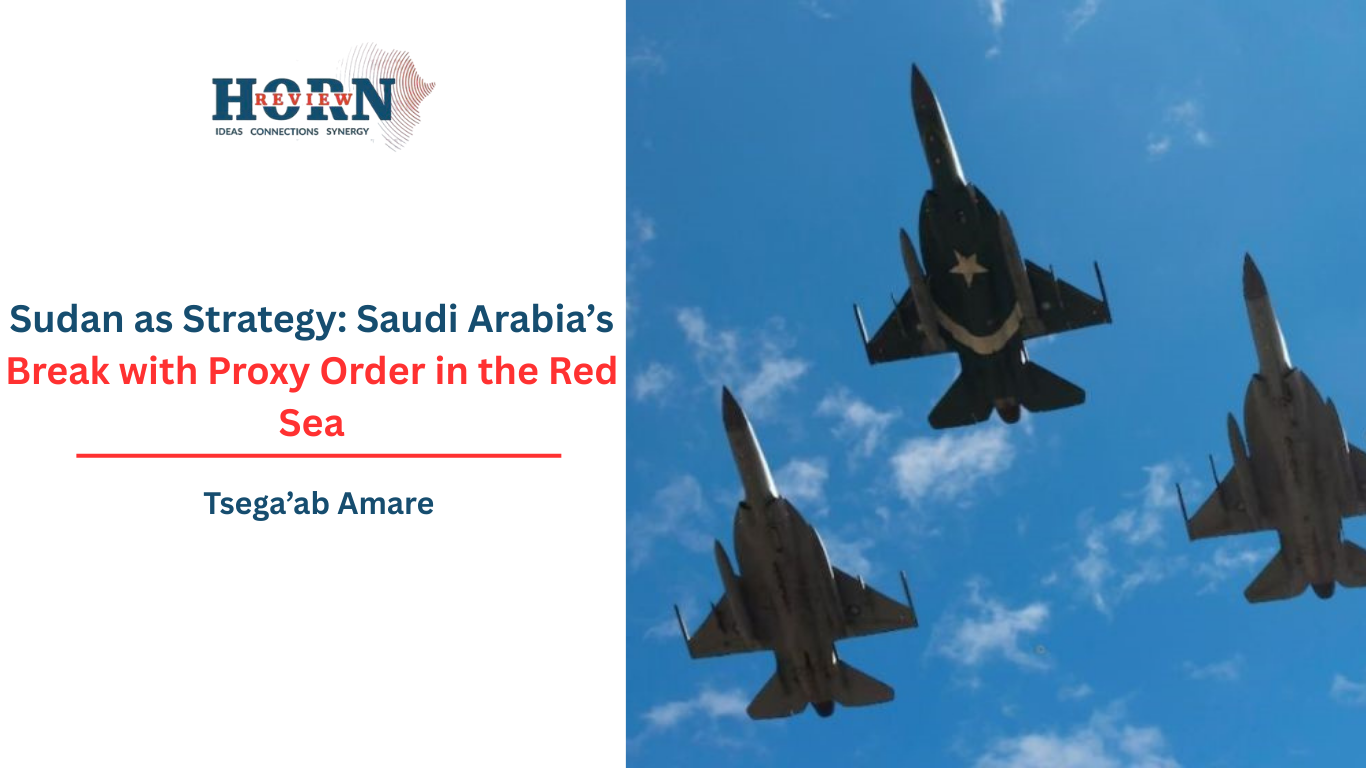
The reported Pakistan–Sudan defense package represents a qualitative shift in the war. According to regional sources, the deal includes K-8 light attack aircraft, Super Mushshak trainers, reconnaissance drones, loitering munitions, and potentially JF-17 Thunder multirole fighters. If realized, this package would significantly enhance the SAF’s air and reconnaissance capabilities, addressing one of its most persistent operational weaknesses.
Saudi Arabia’s role is central. Reports indicate that Riyadh brokered the agreement, with the Pakistani Air Force chief visiting the Kingdom to discuss defense cooperation and the regional security environment shortly before the deal’s announcement.
At the same time, Saudi Arabia has allegedly acted to disrupt RSF supply chains by closing its airspace to UAE aircraft bound for the Kufrah airbase in southern Libya. Kufrah has long been identified as a logistical hub for funneling weapons, equipment, and personnel into western Sudan. Denying overflight access will impose a significant operational constraint on Emirati-linked airlift routes, forcing longer and more exposed alternatives and increasing reliance on third-country permissions.
Complementing this, the termination of the UAE’s presence in Somaliaeffectively closes the eastern flank of the Emirati logistical network. Following allegations that ports like Bosaso and Berbera were being used as “backdoors” to funnel equipment to the RSF, Mogadishu’s revocation of all security and maritime agreements and the subsequent enforcement of a strict flight ban completes a strategic encirclement. These moves signal a shift from mediation toward strategic containment and highlight airspace control as a coercive instrument of statecraft.
This decision forms part of a broader pattern. Egypt has escalated its intervention by directly striking RSF-linked supply lines along its border. Days before a high-level visit to Cairo by Saddam Haftar, the Egyptian Air Force reportedly bombed a military convoy entering Sudan from southeastern Libya. This strike targeted a critical logistical artery frequently used to funnel Emirati-supplied weapons and fuel through the Kufrah-Darfur corridor. Meanwhile, Türkiye has deepened quiet coordination with Khartoum in support of the SAF.
Together, these measures point to the emergence of a loosely coordinated Red Sea alignment aimed at curbing the proliferation of armed non-state actors along critical maritime and trade corridors.
The Sudanese conflict has become a laboratory for modern coercive statecraft. Regional powers are shaping outcomes through arms finance, airspace denial, logistics interdiction, and economic pressure rather than direct force deployment. The SAF’s expanding drone capabilities, combined with new aircraft and external intelligence support, reflect this evolving model of warfare.
The RSF will seek to compensate through professionalization, including the recruitment of foreign fighters and technical specialists. These efforts are costly and increasingly vulnerable to supply chain disruption.
The Pakistan–Sudan arms deal offers the SAF a pathway to survival and possible territorial consolidation, but it also entrenches a militarized exit from political collapse. For the Horn of Africa, the greater danger lies in the normalization of externally managed fragmentation. If Sudan’s de facto partition hardens under competing patronage systems, it may become a template for future conflicts.
The priority for regional institutions must therefore be the consolidation of collective bargaining power. Without coordinated engagement through mechanisms such as the African Union and IGAD, Sudan risks becoming the first durable case of a new disorder in which sovereignty is selectively preserved or dismantled by external actors.
Sudan today is not merely a battlefield; it is a warning signal for a regional order increasingly shaped by selective sovereignty and managed fragmentation.
By Tsega’ab Amare, Researcher, Horn Review