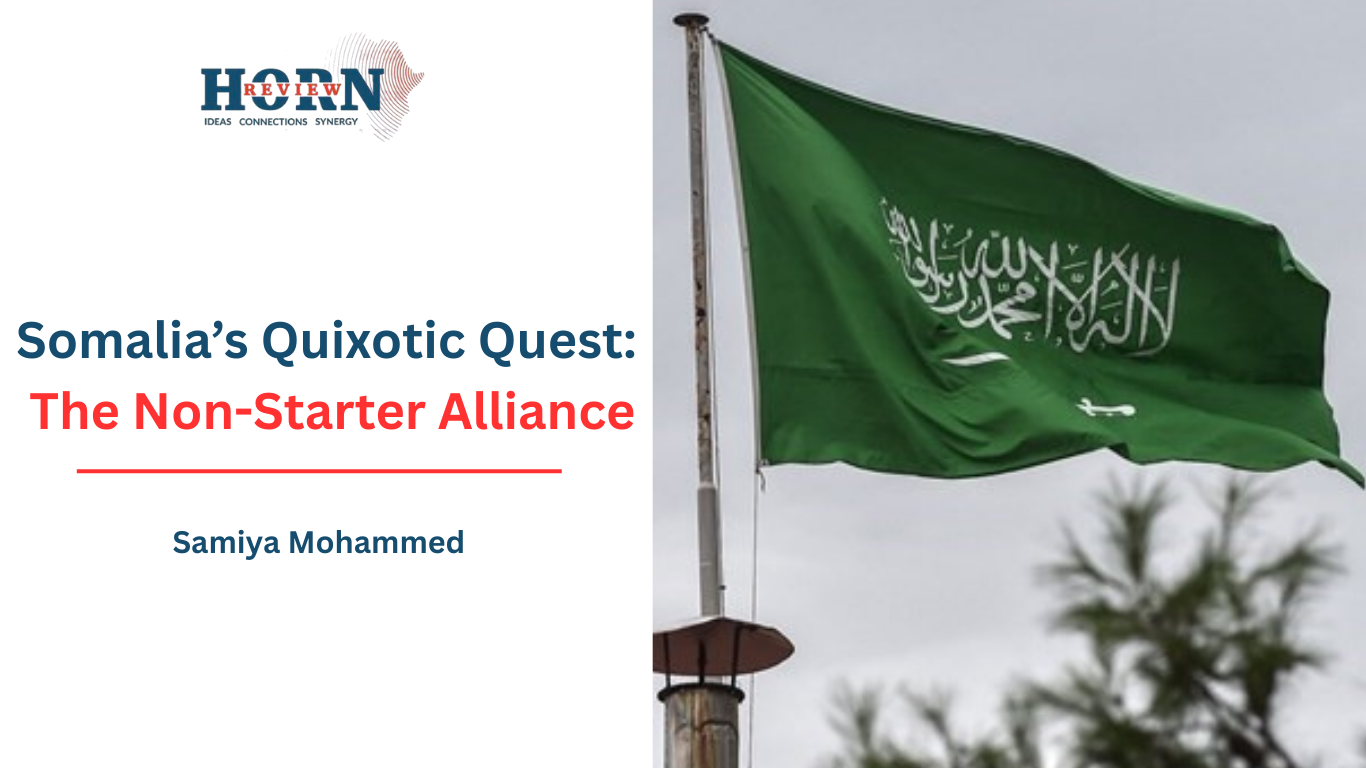
In a recent appeal for intervention against Somaliland, Somali Defense Minister Ahmed Moalim Fiqi referenced Saudi Arabia’s previous campaign against Yemen’s Southern Transitional Council positioning the appeal as a logical progression of Riyadh’s security priorities within the Red Sea. This overture stems from a critical misinterpretation of the distinct geopolitical circumstances of each nation. While both countries border the Red Sea and adhere to Sunni Islam, their core objectives and political dynamics are so dissimilar that any collaborative military action against Somaliland is considered diplomatically unviable.
The prevailing assessment among regional diplomatic circles is that Saudi Arabia lacks both the political will and a substantive rationale to endorse Mogadishu’s request. The divergent priorities of Riyadh and Mogadishu define a relationship that operates on fundamentally separate trajectories with minimal likelihood of alignment. Saudi Arabia formulates its external engagements based on immediate imperatives of national security and the equilibrium of regional influence rather than on the generalized preservation of sovereignty for nations.
Somalia’s appeal is predicated upon three core assumptions each of which falters under closer examination. Saudi Arabia interprets Somaliland’s de facto independence and any subsequent recognition by Israel as a direct strategic threat analogous to that posed by Yemen’s Southern Transitional Council and the other being that Riyadh considers the preservation of Somalia’s territorial integrity a main strategic interest justifying potential military commitment. Third that Saudi Arabia retains both the operational capacity and the political will to initiate a new military engagement while still navigating the aftermath of its prolonged campaign in Yemen.
A sober assessment however systematically undermines these premises. Unlike the STC, which effectively controlled territories proximate to Saudi Arabia’s southern border and posed a risk to critical energy infrastructure, Somaliland represents no comparable security challenge.
Its governance has historically been inwardly focused prioritizing internal stability and organic state building over external ambitions or cross red sea power projection. While a formal Israeli diplomatic presence in the Horn would undoubtedly discomfit Riyadh on a strategic level it does not in itself constitute an imminent threat necessitating a military riposte. Saudi security doctrine remains principally oriented toward countering Iranian-aligned proxies and intercepting missile and drone threats not contesting diplomatic recognitions in a geographically and politically distinct.
The Red Sea serves as a lens through which the strategic priorities of Saudi Arabia and Somalia diverge fundamentally. For Riyadh, these waters are a vital commercial conduit demanding a security posture centered on safeguarding navigation and countering specific maritime disruptions. The coastline of Somaliland enters this equation only as a possible location for logistical assets obtainable through negotiation rather than force. From Mogadishu’s perspective, the same sea represents a source of potential political currency based on the aspiration that Saudi Arabia will view the Somaliland coast with the same operational urgency as it did Yemen’s. This analogy, however, overlooks a critical distinction unlike the instability in Yemen, Somaliland’s prevailing order does not imperil Saudi interests and may even offer cooperative potential.
The evolving framework for Red Sea governance further discourages unilateral action. Saudi engagement in various multilateral forums emphasizes collective and cooperative security measures. A military intervention would fracture these diplomatic understandings, potentially realigning other states against such precedent. Moreover, Somalia’s effort to cast developments in Somaliland as a broader Arab concern encounters the nuanced reality of regional diplomacy. While opposed to normalization processes that marginalize Palestinian interests Saudi Arabia maintains its own calibrated dialogue with Israel prioritizing pragmatic management of shared regional challenges over symbolic confrontations.
Far of diplomacy tangible constraints of capacity and priority render intervention improbable. The Saudi military despite its modernization remains engaged in managing enduring regional commitments. Active security challenges elsewhere command immediate attention and resources, whereas the Somaliland question presents no comparable exigency. Financial prudence, informed by the substantial costs of past engagements, reinforces this restraint. Investment is directed toward domestic transformation and stabilizing immediate neighbours, not toward territorial reconsolidation projects in distant fractured states.
Saudi Arabia is far more likely to employ discreet, non-military instruments to address its interests. This includes diplomatic dialogue within collective Arab institutions quiet engagement with influential actors in the Horn and the use of economic and developmental tools to encourage stability. Supporting regional mediation efforts between Mogadishu and Hargeisa represents a logical extension of this preference for indirect, cost-effective statecraft aimed at conflict management rather than escalation. In essence, the relationship is defined by asymmetry. Saudi Arabia’s actions are guided by a of risk management and economic continuity within a regional system. Somalia’s appeal, rooted in its internal territorial dispute, fails to align with that calculus because it addresses a challenge that Saudi Arabia does not perceive as direct, urgent, or soluble through military means. The two nations view the same stretch of water through fundamentally different strategic lenses.
By Samiya Mohammed, Researcher, Horn Review