In the early phase of Sudan’s civil war, Eritrea’s posture was marked by deliberate ambiguity. A series of meetings between Mohamed Hamdan Dagalo (Hemeti), commander of the Rapid Support Forces (RSF), and Eritrean President Isaias Afewerki prompted speculation over Asmara’s intended role in Sudan’s post-Bashir political reconfiguration. Concurrently, Ethiopia under Prime Minister Abiy Ahmed sought to sustain a position of stabilizing regional actor, engaging directly in mediation efforts between Hemeti and Sudanese Armed Forces (SAF) commander Abdel Fattah al-Burhan. For Addis Ababa, already weakened diplomatically by the erosion of its pre-2020 regional strategy following the outbreak of the Tigray conflict, averting the consolidation of a prolonged instability along its western frontier was a strategic imperative.
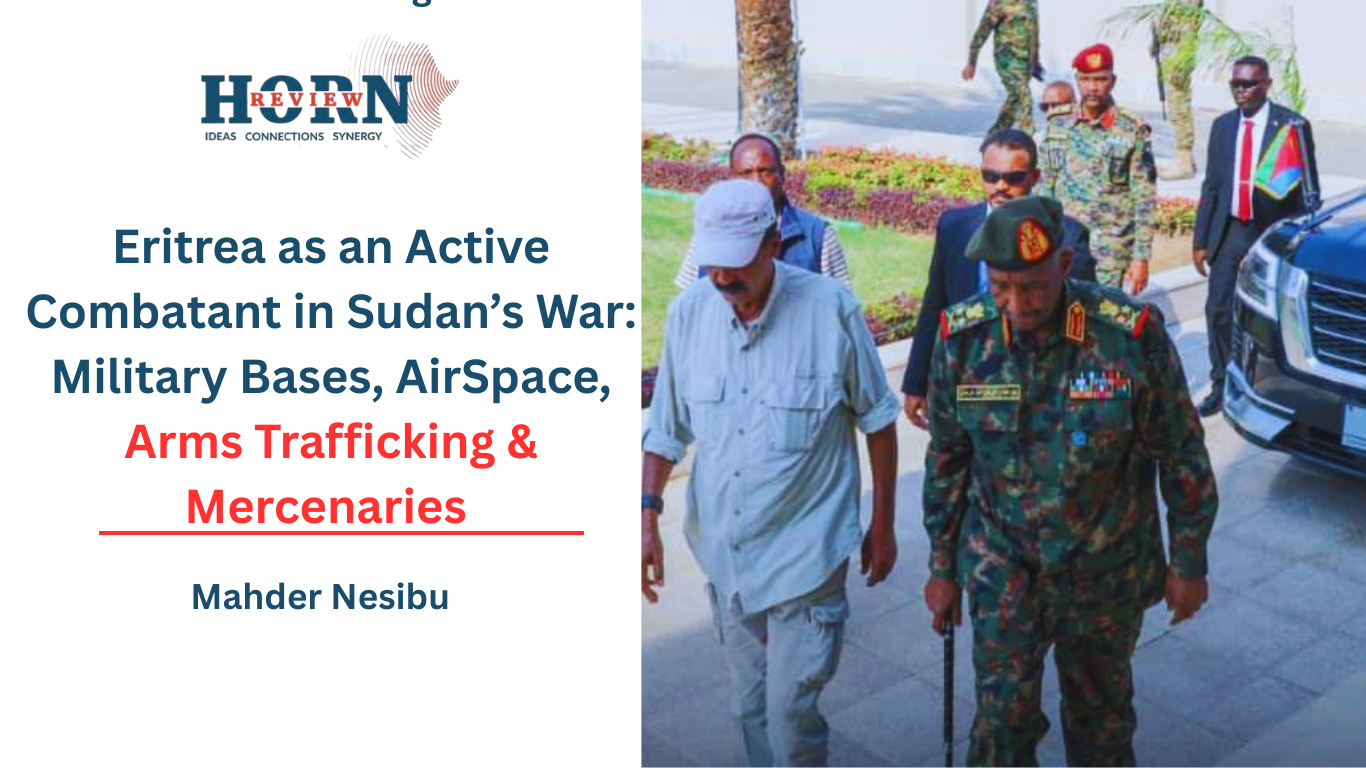
Two years later, that diplomatic configuration has disintegrated. Sudan’s war persists without meaningful attenuation, Ethiopia has largely withdrawn from the mediation track, and Eritrea has emerged as one of SAF’s most consequential external backers. Relations between Port Sudan and Addis Ababa have deteriorated sharply, with SAF officials now accusing Ethiopia of supporting the RSF and issuing threats of armed confrontation along their shared border. While the trajectory of deterioration was visible earlier through Ethiopia’s gradual marginalization from mediation efforts, the expansion of Asmara’s operational footprint in the conflict has pushed the rupture into a more acute and potentially destabilizing phase. Isaias Afewerki, by consolidating alignment with the SAF, has not merely exploited the rift between Ethiopia and Port Sudan but has become instrumental in entrenching it.
Understanding this configuration requires revisiting Ethiopia’s regional posture prior to the Tigray conflict. Before 2020, Addis Ababa pursued a strategy grounded in the assumption that instability in the Horn of Africa was systemic rather than compartmentalized. The response was not the construction of rival blocs, but an effort to embed regional actors within interlocking frameworks of cooperation designed to reduce the salience of bilateral disputes. Regional integration, rather than competitive alignment, constituted the organizing logic of this approach.
The 2018 rapprochement with Eritrea was the most visible manifestation of this strategy, but it was never intended to function as a standalone pillar. Ethiopia simultaneously deepened engagement with Somalia, sought to stabilize its western frontier through improved relations with Sudan, and attempted to manage tensions with Egypt by situating the GERD dispute within a broader regional context. Prime Minister Abiy Ahmed’s outreach to President Abdel Fattah al-Sisi reflected this logic. The objective was not to impose a decisive Ethiopian position on Nile politics, but to reduce the dispute’s strategic centrality constrain escalation.
Within this framework, Sudan occupied a structurally pivotal position. Its geography rendered it central to Ethiopia’s western security calculations, while its political orientation could either reinforce or dilute Egyptian leverage over Nile negotiations. Developments in Khartoum therefore carried implications extending well beyond the bilateral relationship.
The removal of Omar al-Bashir in 2019 appeared to open space for recalibrating this dynamic. Relations between Addis Ababa and Khartoum improved rapidly amid optimism surrounding Sudan’s civilian-led transition under Prime Minister Abdalla Hamdok. From Ethiopia’s perspective, a post-Bashir Sudan offered interlinked strategic advantages: enhanced stability along the western frontier, the prospect of partnership rather than rivalry, and the possibility of encouraging a more autonomous Sudanese position on Nile politics that would complicate Cairo’s influence. This optimism was restrained. Egypt’s institutional penetration of Sudan’s military remained deep, and the civilian transition was inherently fragile. Nonetheless, Addis Ababa treated Khartoum as a strategic partner in formation and committed diplomatic capital accordingly. That assumption collapsed with the onset of the Tigray conflict.
When armed confrontation erupted between Ethiopia’s federal government and the TPLF in November 2020, the country’s regional strategy unravelled. Diplomatic capacity contracted sharply, military focus turned inward, and Ethiopia’s vulnerability reshaped regional risk assessments. The integrative logic that had underpinned Addis Ababa’s posture was displaced by short-term crisis management.
Sudan was among the earliest actors to recalibrate. As Ethiopia became absorbed by its northern front, the Sudanese Armed Forces adopted a more assertive stance. The occupation of al-Fashaga, a long-contested border area, was widely interpreted in Addis Ababa as opportunistic, undertaken under conditions of Ethiopian constraint. Simultaneously, political and operational alignment between the SAF and the TPLF began to crystallize. Sudanese territory reportedly served as a rear base and transit corridor for TPLF forces. Ethiopian officials stated to have intercepted aircraft originating from Sudan and transporting arms into Tigray. The International Crisis Group observed that SAF–TPLF cooperation drew upon long-standing linkages predating the change in administration in Addis Ababa in 2018.
By the end of the conflict’s most intense phase, Ethiopia–Sudan relations had effectively ruptured. Sudan’s role as a prospective western stabilizer was replaced by a posture characterized by suspicion and antagonism. Eritrea’s trajectory over the same period unfolded along a parallel but opposing axis. Asmara entered the Tigray conflict as a direct belligerent, and for Isaias Afewerki the conflict carried existential significance. The TPLF was perceived as the principal architect of Eritrea’s prolonged isolation. Eritrea’s objective was unequivocal: the elimination of the TPLF as a political and military force.
This objective placed Eritrea and Port Sudan on opposing sides during the conflict. SAF facilitation of TPLF operations directly undermined Eritrea’s campaign, leaving Asmara with little incentive to cultivate relations with Khartoum. The regional balance shifted again following Sudan’s October 2021 coup, which terminated the civilian transition and consolidated power in the hands of the SAF, with RSF on its side. For Ethiopia, the coup eliminated its primary civilian interlocutor and produced a Sudanese military increasingly dependent on Egypt for diplomatic and material support. Khartoum’s posture toward Addis Ababa hardened further, but the decisive rupture followed the Pretoria Agreement in late 2022.
While Pretoria ended active hostilities in Tigray, it also dissolved the Eritrea–Ethiopia strategic alignment. From Asmara’s perspective, the agreement constituted a strategic reversal: the TPLF survived politically, Eritrea’s core war objective remained unrealized, and Ethiopia normalized relations with the very force Eritrea had sought to destroy. Bilateral relations deteriorated rapidly in the aftermath. Concurrently, Eritrea’s external options narrowed. New leverage points became necessary. Therefore, Sudan’s internal war offered such an opportunity.
When fighting erupted between the SAF and the RSF in April 2023, Ethiopia attempted to position itself as a mediator, seeking to limit spill over and preserve relevance in the Sudan file. These efforts failed. SAF hostility toward Ethiopia intensified, accusations escalated, and Addis Ababa’s influence diminished steadily. As Ethiopia receded, Eritrea recalibrated. Initial hedging through contacts with Hemeti gave way to a clearer alignment with Port Sudan. For Isaias Afewerki, Sudan’s war offered leverage against Ethiopia, convergence with Egypt, and an avenue for reasserting Eritrea’s relevance as a security actor. Port Sudan, under pressure, required precisely such partnerships.
This alignment clarifies the SAF’s increasingly adversarial posture toward Ethiopia. Egypt and Eritrea now constitute the SAF’s most consequential external supporters, each driven by distinct but converging strategic calculations. A deeper layer involves the Tsimdo arrangement linking Eritrea, elements of the Sudanese military, and TPLF remnants operating under the designation “Army 70.” Through this configuration, Eritrea functions as a critical connective node between Port Sudan and forces hostile to Ethiopia.
A new regional configuration has thus taken shape, one that positions Ethiopia increasingly outside the axis shaping Sudan’s war.
Sudan continues to contend with a deeply fractured political order shaped by decades of unresolved centre–periphery tensions and now expressed through protracted civil conflict. Its relations with neighbouring states, particularly Ethiopia and Eritrea, are structured by short-term tactical adjustments than by enduring political trajectories. The regional arrangement that followed the Tigray conflict has alienated Sudan from Ethiopia while drawing it more firmly into axis politics, with Asmara’s strategic calculations at the core. The al-Burhan–Isaias alignment continues to consolidate, reshaping Sudan’s external orientation. Ethiopia, having been side-lined after repeated failures at mediation, now faces the prospect of being drawn into the conflict’s expanding regional orbit—not through deliberate choice, but through the strategic decisions of others.
By Mahder Nesibu, Researcher, Horn Review