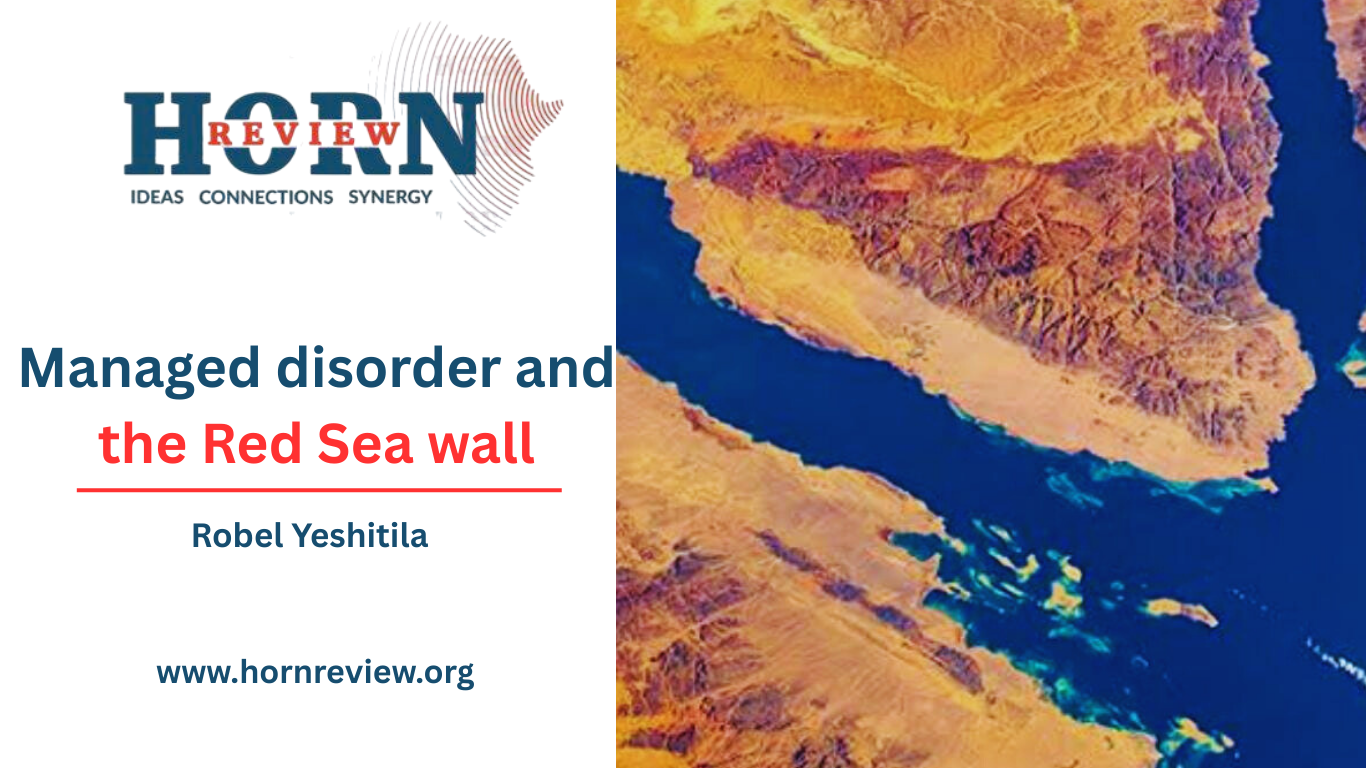
The Red Sea corridor despite being one of the most critical maritime arteries on Earth has remained lawless, weakly governed and chronically exploitable for decades. Rather than collective security or coherent stewardship, the region has been left to decay under proxy warfare, denial and selective enforcement. It evolved into a gray zone where no single actor is fully responsible and every actor continued externalizing the cost. Global commerce depended on its openness, yet no regional or international framework emerged to secure it as a shared strategic common.
The Horn of Africa was the first and remains the primary victim of this vacuum. Long before disruptions in the Bab el-Mandeb or attacks on commercial shipping reached global headlines, societies in the Horn lived with the consequences of this fragmentation and external manipulation. What the world now experiences as episodic crisis has been, for the Horn, a permanent condition.
Egypt’s strategic posture toward the Red Sea has been consistent: maintain dominance, preserve monopoly over regional chokepoints and, above all, constrain Ethiopia. Stability was never the objective but managed disorder was. A genuinely secure Red Sea would require new actors, new balances and new rules particularly, acknowledging Ethiopia’s demographic, economic and strategic weight. That outcome threatens Egypt’s long-standing leverage. Disorder, by contrast, freezes the hierarchy in place, delays reconfiguration and masks declining influence behind procedural control.
To sustain this arrangement, Egypt leveraged its influence within the Arab League. Saudi Arabia, Turkey and other Arab bloc states tolerated so long as the configuration kept Israel at arm’s length and Ethiopia strategically boxed in, a convergence of strategic interests.
No actor assumed responsibility for regional order; each accepted a system where instability was preferable to redistribution of power. Control was exercised indirectly, through proxies, exclusions and selective engagement rather than through shared security commitments.
Iran exploited the same decay from a different angle by embedding weapons, logistics and influence networks along the Eritrean and Somalia coasts and linking them to the Houthis in Yemen. This was structural opportunism exploiting weak coastal sovereignty, porous maritime space and deniable transit routes that turned the Red Sea into an ideal theater for asymmetric warfare.
Where states could not enforce authority, non-state actors gained strategic depth. Somali piracy emerged and sustained because coastal states lacked naval capacity and legal control, turning a major shipping lane into an ungoverned space.
The same governance failure drove mass migration, terrorism, human trafficking and illicit weapons flows. Ungoverned coastlines and porous borders turned the Red Sea into a logistics corridor for traffickers moving migrants toward the Gulf and Europe and weapons toward militias and insurgents across the Horn and Yemen. These networks were enabled by state collapse, tolerated by regional powers and ignored as long as the human and security costs were primarily Africans.
The overall outcome is a chain of fragmented coastal states of Eritrea, Djibouti, Somalia and Yemen incapable of securing their coastal borders let alone the world’s most important maritime line. These states function within a proxy configuration, with Egypt at its strategic center. Eritrea, Djibouti and Somalia in particular have sustained parasitic political economies that survives on Tolls, destabilization and external patronage rather than productive integration that can uplift their decaying economy. Their political survival is tied less to development than to Ethiopia remaining constrained and appease their underwriter in Cairo.
This Arab-centric geopolitical architecture has imposed costs far exceeding any perceived benefits. It has prevented cooperation among resource-poor but strategically vital states, leaving behind failed state of Somalia and fracture of Sudan currently. Egypt accelerated on its strategic missteps that has prioritized aligned military governance over transition to civilian democracy in Sudan, even northwards in Libya.
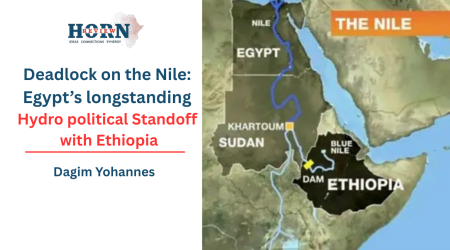
Similarly, Egypt continues to issue threats and draw one red line after another, refusing to accept the shift in the geopolitics of the Nile River. It remains anchored to colonial arrangements it exploited for decades to block upstream development and preserve monopoly and control. That reality no longer holds. The colonial, Nile river legacy framework wall has fallen.
Egypt refuses to accept that the Nile Basin has entered a new status quo in which upstream African states have signed a cooperative framework to move beyond outdated colonial impositions. This transition is irreversible. GERD is no longer theoretical that requires further debate. It is a pragmatic reality that has delivered electricity to millions and strengthened regional energy security. The facts on the ground have overtaken the old threat-based order. Now, the managed disorder in the Red Sea and exclusionary Arab-centered wall has to fall.
By Robel Yeshitila, Researcher, Horn Review