By Blen Mamo
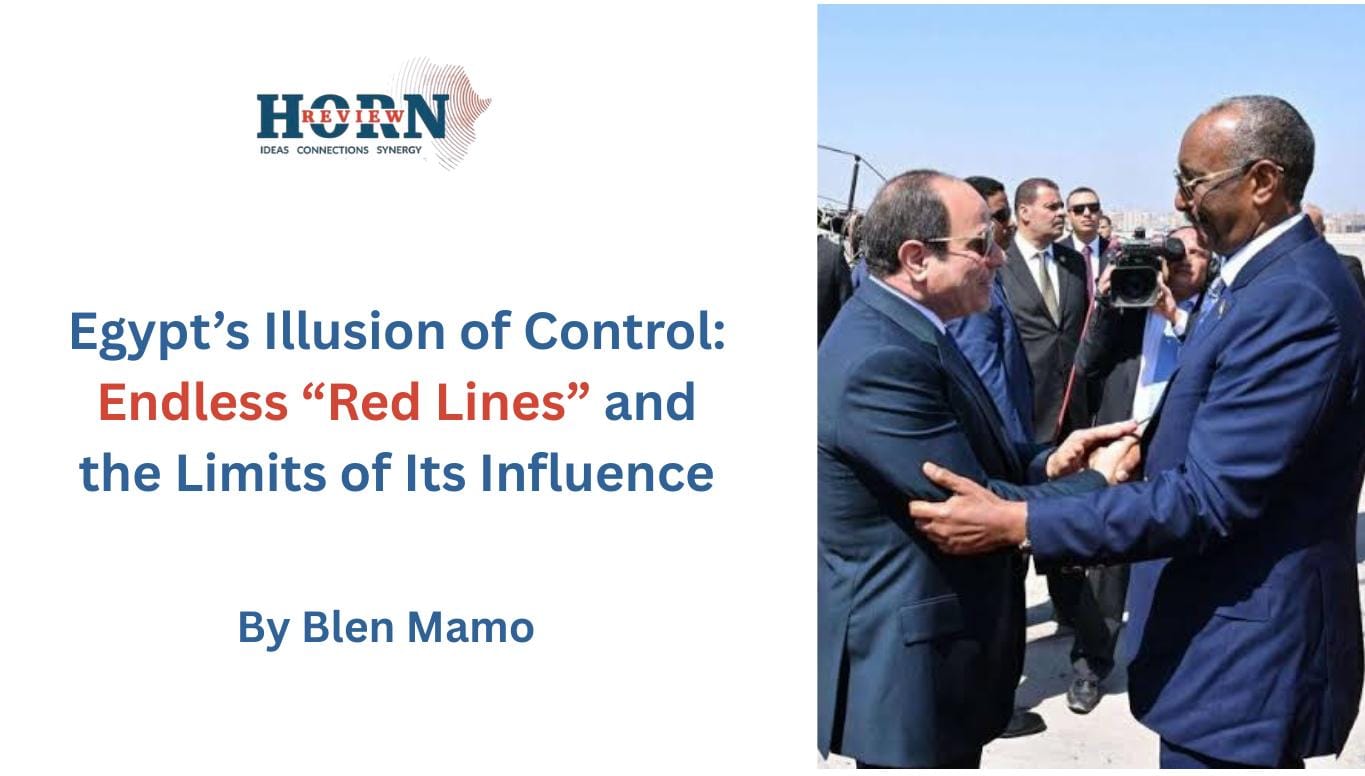
Egypt’s recent declaration on Sudan – invoking inviolable “red lines,” reaffirming Sudan’s territorial unity, and signaling readiness to act within bilateral and international defense frameworks – has been presented as Cairo’s most assertive posture since the outbreak of the Sudanese conflict. At face value, it appears to reflect a principled commitment to regional stability and the protection of civilian populations. Yet a closer and more rigorous examination reveals that this position is less an expression of guardianship toward Sudan than a function of Egypt’s deep-seated strategic anxieties and geopolitical self-preservation. Sudan has increasingly become an arena through which Cairo negotiates its rivalries – with Ethiopia over the Nile and regional leadership, with Gulf powers over influence in the Horn of Africa, and with Israel over security architecture in Gaza and the broader Red Sea region. In this context, Sudanese suffering becomes marginal to a broader performance of power, where rhetoric eclipses responsibility.
Egypt’s orientation toward Sudan cannot be divorced from a much longer historical trajectory. From 1899 to 1956, Sudan existed under the Anglo-Egyptian Condominium – nominally a joint administration but substantively a British colonial enterprise. This arrangement followed Egypt’s earlier conquest in the 1820s and the subsequent intervention of Britain after the Mahdist Revolt, anchoring Sudan within overlapping hierarchies of external domination. Independence in 1956 may have formally ended colonial rule, but the strategic imagination that positioned Sudan within Egypt’s orbit remained intact. Post-colonial engagement was therefore less about partnership than about shaping Sudan’s political direction in ways that preserved Egyptian influence and contained Ethiopian ambitions.
This historical disposition carried forward into the modern era. Egypt consistently worked to ensure that Sudan’s political leadership remained aligned with Cairo rather than Addis Ababa. More recently, Cairo’s position has been unmistakably aligned with the Sudanese Armed Forces (SAF), not only during the current conflict but in undermining Sudan’s fragile transition to civilian governance in 2019. Egypt’s support for the military establishment during the 2021 coup that dismantled Prime Minister Abdalla Hamdok’s civilian-led administration helped entrench authoritarian continuity and contributed materially to the crisis trajectory culminating in the present war. In choosing regime stability over democratic transition, Cairo privileged its own security calculations over the democratic aspirations of Sudanese society.
Yet Egypt’s capacity to control its preferred partner has proven limited. Reports suggest that Cairo and Riyadh have both grown increasingly frustrated with Abdel Fattah al-Burhan’s inconsistency, wavering commitments, and inability to impose decisive control as RSF advances reshape the balance of power. Egypt’s inability to decisively direct SAF reveals a structural constraint: Sudan is no longer a pliable periphery but a contested arena where multiple external actors – most notably Gulf states – now wield significant influence. Egypt’s “red lines” thus operate in a crowded geopolitical marketplace, diminishing their deterrent effect.
The Sudan crisis must also be viewed through the prism of Egypt’s unresolved confrontation with Ethiopia. The Grand Ethiopian Renaissance Dam (GERD) has reshaped Egypt’s historical dominance over Nile waters. Despite years of stern unilateral warnings, unnecessary diplomatic escalation, and repeatedly declared “red lines,” Ethiopia advanced with the project largely unimpeded – while still keeping negotiations on the table. This strategic failure left a deep imprint on Cairo’s security psyche. Sudan therefore represents more than a neighbor in turmoil; it constitutes an alternative site through which Egypt seeks to reassert relevance and proximity to Ethiopian vulnerabilities, complementing – rather than replacing – its longstanding calculations in Eritrea. Sudan also joins a lineage of attempted Egyptian projections into Somalia, Djibouti, and other East African countries who are rather cautiously trading with the Egyptians – efforts designed to reanchor geopolitical leverage where direct coercion had failed. What we see in Sudan today is not a sudden pivot, but the extension of a historical continuum that threads together colonial precedent, post-colonial political management, and present-day insecurity.
These dynamics are compounded by Gulf competition. Saudi Arabia and the UAE have invested in Sudan’s war economy, political elite, and emergent power hierarchies. Cairo’s emphatic commitment to Sudanese territorial unity and sovereignty therefore serves a strategic function: it seeks to prevent Sudan from consolidating within a Gulf-dominant security order that marginalizes Egyptian influence and potentially strengthens Ethiopia’s regional position. Egypt presents its stance as normative, but it is strategically defensive – a contest over who structures Sudan’s post-war political settlement.
However, Egypt’s performance of power is constrained by domestic realities. Severe economic strain, acute debt, inflationary pressures, and political sensitivities limit the willingness of the Egyptian state to assume the material risks of direct intervention. The military establishment remains cautious of becoming entangled in a prolonged, uncertain cross-border conflict. Consequently, Cairo defaults to declaratory deterrence – issuing emphatic warnings, invoking legal frameworks, and gesturing toward intervention – without committing to the costly actions such rhetoric implies. Thus, rhetoric becomes a substitute for strategy.
Diplomatically, Egypt has also positioned itself in uneasy tension with African-led mechanisms. The African Union and IGAD have pursued mediation in Sudan, yet Cairo remains uncomfortable with Ethiopia’s institutional weight within these frameworks. Instead, Egypt has often preferred Arab-centric or bilateral diplomatic channels in which it believes it retains superior leverage. This reflects not neutrality but preference: Cairo seeks processes it can shape rather than collective mechanisms that might dilute its influence.
The Gaza dimension further illuminates Egypt’s dilemma. Cairo frames its engagement in Gaza in humanitarian, security, and regional stabilizing terms, repeatedly declaring “red lines” against displacement and uncontrolled escalation. Yet Egypt’s capacity to shape outcomes has been limited. Parallel discussions – including U.S. considerations of involving Ethiopia in potential peacekeeping roles in Gaza, alongside India’s strengthening security collaboration with Ethiopia, including assistance in peacekeeping training – signal the erosion of Egypt’s exclusivist claim to regional stewardship. Simultaneously, Egypt sustains extensive natural gas cooperation with Israel, including major commercial agreements, even amid political tensions over Gaza. This juxtaposition underscores a broader pattern: assertive rhetoric overlaid upon pragmatic, interest-driven policy, revealing the distance between declaratory posture and strategic influence.
The cumulative effect of these contradictions is rhetorical inflation. Across Sudan, Ethiopia, Libya, and Gaza, Egypt repeatedly announces red lines it does not enforce. Over time, these declarations cease to deter and instead signal a diminishing capacity to translate intent into consequence. Nowhere is this more devastating than in Sudan, where continuing war produces famine, displacement, institutional collapse, and societal fragmentation. Egypt claims regional guardianship while contributing, through selective backing and geopolitical maneuvering, to the prolongation rather than resolution of conflict. Sudan’s tragedy becomes a variable in Egypt’s strategic equation rather than a humanitarian crisis demanding principled stewardship that Ethiopia has been pursuing since the start of the Sudanese Civil War in 2023.
Egypt’s Sudan policy is, thus, not a narrative of principled leadership or humanitarian obligation. It is the manifestation of a state grappling with its waning regional primacy, entrenched insecurities, and constrained leverage. Sudan is treated as a strategic extension rather than a sovereign partner; Gaza is filtered through calculations of prestige; Ethiopia remains the unresolved locus of existential competition. Now therefore, Egypt’s incessant invocation of “red lines,” decoupled from meaningful enforcement exposes the illusion embedded in its strategy: an outward projection of authority masking a narrowing field of effective power. Its “Red lines” remain emblematic not of strength, but of a regional power confronting the limits of its influence, while others bear the catastrophic cost of a geopolitical performance that privileges posture over peace.
Authors Bio
Blen Mamo is Executive Director of Horn Review and a researcher specializing in law, international security, and geopolitics in the Horn of Africa. She holds an LL.B and an M.Sc. in International Security and Global Governance.