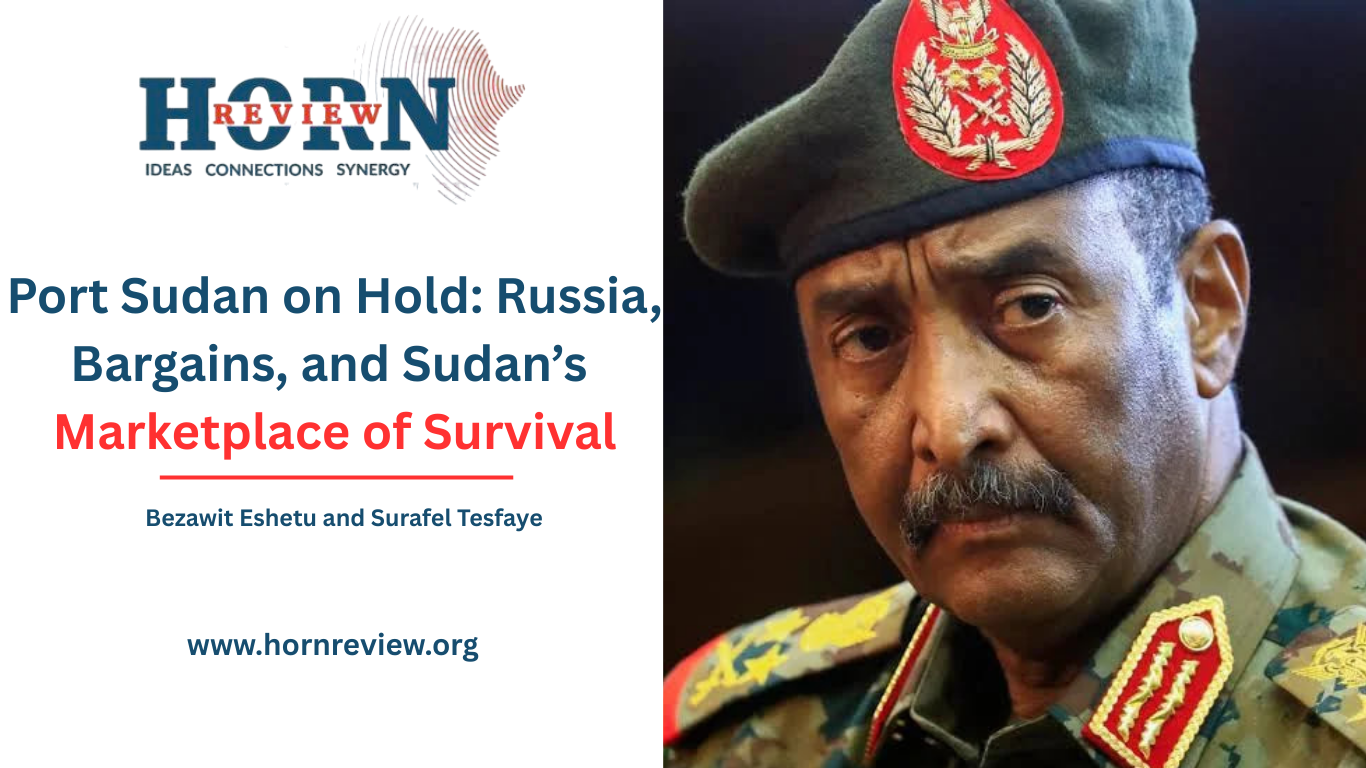
The Sudanese decision in early December 2025 to pause moves toward hosting a Russian naval presence at Port Sudan is best read as a calibrated act of strategic hedging rather than a definitive pivot in the country’s foreign alignment. The announcement was framed as a suspension of procedures rather than an outright rejection, which preserved the immediate material advantages that ties to Moscow could deliver while avoiding an irreversible legal and infrastructural commitment. That posture makes sense when one recognizes that control of materiel, control of territory, and access to patronage networks are existential to the survival of ruling coalitions in wartime Sudan. By keeping the possibility of a base alive but not formalizing it, Khartoum converted geography into leverage, signaling to multiple external actors that it could be courted and rewarded for restraint without locking itself into a decades-long dependency.
The proposals under consideration clarify the rationale behind this balanced approach. Reports from December indicated a draft agreement that would have allowed Russia sustained access to a Red Sea facility within a 25-year framework, associated with commercial concessions and military arrangements. The draft terms reported by multiple outlets included capacity for a few hundred personnel and for several surface combatants to berth at once, and they were explicitly tied to expedited supplies of air defense systems and munitions that would be immediately useful to the Sudanese Armed Forces. These inducements are not abstract concessions; they are battlefield inputs and revenue levers that can decisively shift the operational balance between SAF and RSF. Pausing the deal therefore preserved the flow of bargaining power without ceding the strategic infrastructure that would enshrine a single patron’s presence.
To understand the pause fully, it is necessary to situate the basing offer within Sudan’s dire domestic economy and the tactical realities of the April 2023 conflict. The war has inflicted extensive human and economic damage, destroying infrastructure, dislocating millions, and disrupting formal revenue systems. International institution assessments and humanitarian reporting document severe contractions in output, hyperinflationary pressures, and the near collapse of state capacity that together narrow policy choices for the ruling elite. Under such conditions, foreign policy becomes battlefield logistics and economic triage at the same time. Offers of weapons, fuel, and lines of credit matter not only for external alignment but for immediate regime survival and patronage obligations at home. Leaders who face the choice between short-term survival and long-term strategic autonomy will often prefer an intermediate option that buys time while preserving optionality.
External politics amplified Khartoum’s ability to convert restraint into returns. The United States publicly reframed Africa as a theater of strategic competition in its December 2025 National Security Strategy, signaling greater willingness to mobilize diplomatic, economic, and security tools to deny strategic access to rival powers. That repositioning by Washington, coupled with active engagement by Gulf partners and regional capitals, created a multilateral marketplace in which restraint could be monetized. In that environment, pausing a basing deal has instrumental value: it invites renewed attention from Western and regional actors, creates the prospect of sanctions relief or targeted incentives, and amplifies the bargaining power of a government that can plausibly say it is not yet committed to a single external patron. This is not merely posturing; it is a means of converting a concession that would otherwise be permanent into a negotiable asset.
Domestic factions and illicit economies shape how those external variables translate into decisions on the ground. The RSF’s control of lucrative extraction points and international recruitment networks has sustained its operational autonomy, while the SAF has become dependent on external suppliers to sustain its campaigns and patronage networks. The interaction between battlefield control, resource extraction, and patronage has made ceasefires and humanitarian pauses part of transactional politics rather than neutral pauses in fighting. The RSF’s unilateral three-month humanitarian truce announced in late November 2025 illustrates how declared pauses can be instruments of territorial consolidation, reorganization of extraction, and leverage over aid flows. Such maneuvers alter local balances of power and change what foreign supplies can accomplish at any given moment, reinforcing the logic of hedging rather than prematurely locking-in long-term strategic arrangements.
The humanitarian dimension imposes its own constraints on how external patrons can convert diplomatic signals into durable bargains. Sudan is now the scene of one of the world’s most acute crises, with widespread food insecurity and severe limitations on humanitarian access. Aid that stabilizes civilian life can be appropriated by predatory actors, while withholding assistance for leverage risks catastrophic outcomes that would be politically and morally costly for external backers. Any basing arrangement that visibly deepened the military government’s dependence on a single patron risked alienating donors and humanitarian agencies whose cooperation remains essential to preventing mass starvation and to preserving whatever legitimacy external sponsors seek. The pause reduces the risk that a formalized base would make external actors complicit in arrangements that exacerbate civilian suffering or close off channels for humanitarian support.
Comparative history makes the present pattern intelligible rather than anomalous. Sudanese rulers have long practiced elastic alignments where partnerships with external powers are treated as contingent instruments of regime survival. Jaafar Nimeiri pivoted from Soviet patronage toward Western and Gulf patrons in the 1970s in pursuit of debt relief, security support, and domestic consolidation, with consequential domestic tradeoffs. Omar al Bashir’s post 1989 rule similarly balanced diverse external ties, deepening relations with Russia and other patrons when useful and reorienting where necessary to secure resources and legitimacy. Abdel Fattah al Burhan’s approach fits this lineage: the basing proposal with Russia functions as both lure and leash, attracting material support from Moscow while preserving access to alternative patrons. The pause therefore looks like a historically consistent tactic of elastic alignment where rulers treat strategic geography as a negotiable asset rather than a point of irreversible strategic capture. The historical continuity linking Nimeiri, al Bashir, and al Burhan reveals a recurring logic in Sudanese statecraft where short-term survival choices often trump long term strategic autonomy.
Reading individual motives into the pause is necessary but must be cautious. One plausible additional motive is that al Burhan sought to give Washington another chance at engagement. Public diplomacy around early December and diplomatic contacts in Riyadh in mid-December 2025, including meetings between Burhan and US envoys and advisers, are consistent with a strategy that uses restraint toward Moscow to re attract US mediation, legitimacy, and potential sanctions relief. This inference is supported by observable signaling and meetings, though it is inferential rather than dispositive. It is therefore sound to present this motive as a plausible driver that complements the instrumental calculus of materiel needs, domestic politics, and humanitarian constraints.
The strategic consequences of this tactical interlude are twofold. In the short term, the pause preserves Khartoum’s ability to extract immediate material benefits while avoiding a binding strategic settlement that would reduce its bargaining power. In the medium term, it forces external actors to compete in ways that align resources to both humanitarian stabilization and immediate military needs, complicating the calculus for any patron that seeks a durable foothold. That competition can produce short term relief for Khartoum and for civilians but also risks entrenching dependencies if external supplies are not conditioned on political change. For policymakers, the more important lesson is structural: when state capacity is degraded and external patronage has direct battlefield effects, foreign policy behaves like a tool of domestic survival. The December 2025 pause is a clear instance of that dynamic rather than a dramatic realignment in the long term.
This episode will not by itself determine Sudan’s strategic trajectory. The country’s future alignment will depend on the interaction among battlefield dynamics, the flows of weapons and money, the depth of humanitarian catastrophe, and the willingness of external powers to condition aid on political outcomes. The pause on a Russian foothold is therefore best read as a tactical interlude that preserves optionality and buys time for further bargaining. It keeps the shore as currency in a marketplace of survival and reminds observers that in states with weak institutions and intense external competition, allegiance is seldom absolute and is often exchanged to survive another day.
By Bezawit Eshetu and Surafel Tesfaye, Researcher, Horn Review