
15
Dec
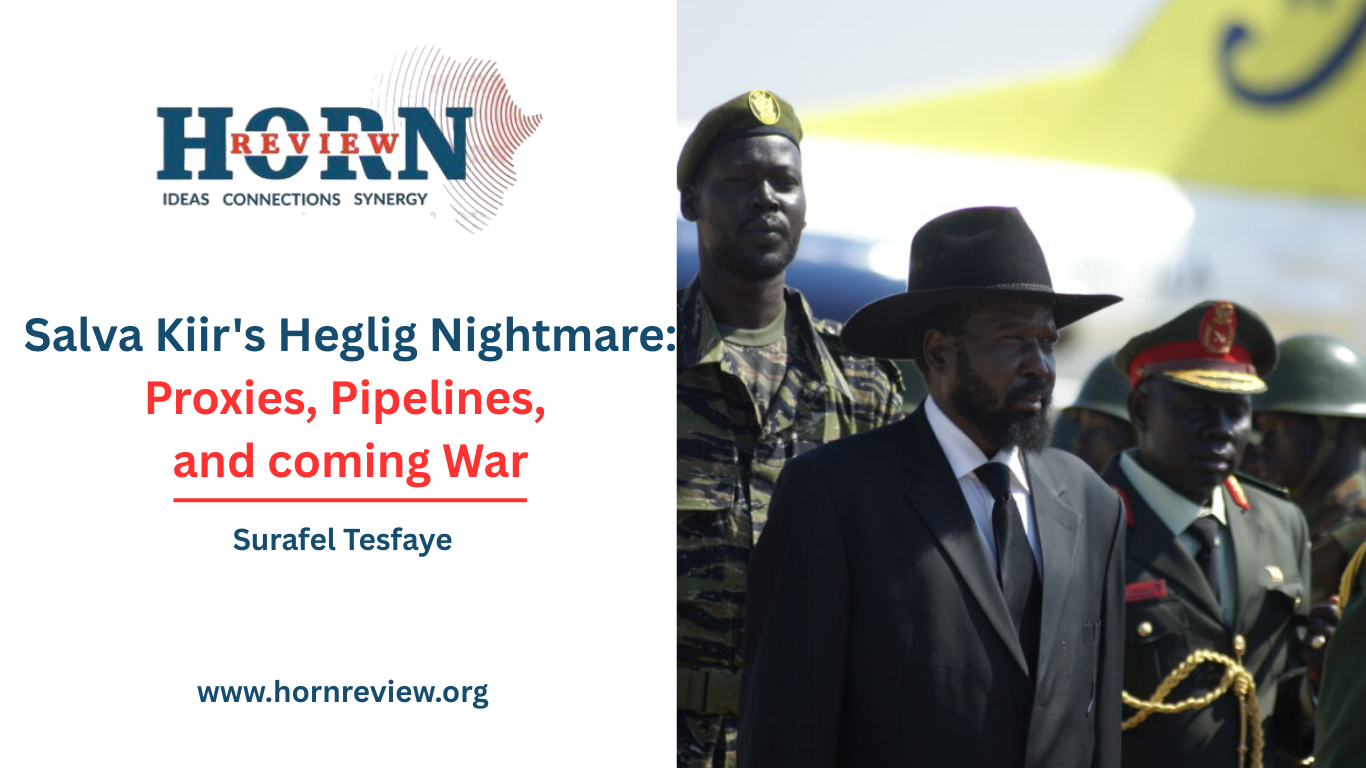
Salva Kiir’s Heglig Nightmare: Proxies, Pipelines, and coming War
The civil war in Sudan, which began in April 2023, has continued without pause as of the end of 2025. It is now entering its third year. What started as a power struggle between two generals in Khartoum has turned into total destruction for the Sudanese state: political turmoil, economic collapse, one of the worst humanitarian crises on earth, and countless other tragedies.
This war is rooted in the long-standing history of Sudan a war that came with the baggage of history. It is the explosion of deep historical grievances, decades of political marginalization, competing interests, ideological clashes, repeated coups, and the systematic exclusion of peripheries that have marked Sudan since independence. All these tensions finally tore the country in two in 2011 with the birth of South Sudan. Nevertheless, the political divorce was never complete. Shared identities, intertwined histories, and above all, oil pipelines and undemarcated borders mean that whatever happens in the north always bleeds into the south and vice versa.
By late 2024 and early 2025, the war has physically arrived at the most dangerous fault line: the oil-rich Heglig area (called Panthou or Aliiny in South Sudan). The Rapid Support Forces (RSF) under Mohamed Hamdan Dagalo “Hemedti” have seized the last major functioning oilfield and the central processing facility that handles almost all of South Sudan’s crude. The parallels with the 2012 Heglig Crisis are uncanny, except for one terrifying difference: the two forces that fought together in 2012 to drive South Sudan out of Heglig the Sudanese Armed Forces (SAF) and the Janjaweed (predecessor of today’s RSF) are now fighting each other over the same piece of land. In addition, whoever wins will decide whether South Sudan’s oil flows or stops.
Why Heglig Is More than Just an Oilfield
Heglig is the strategic location on the entire Sudan–South Sudan border. It is not only rich in oil; it contains the main processing plant and pumping stations through which South Sudan’s oil must pass before reaching Port Sudan on the Red Sea. Whoever controls Heglig controls South Sudan’s economic oxygen.
The RSF’s capture of the area (confirmed between December 2024 and January 2025 after the fall of al-Fashir, Singa, and large parts of South Kordofan) has turned a northern civil war into South Sudan’s direct concern. The border is unmarked in many places, tribal and rebel networks cross it freely, and both the SAF and RSF have expansionist ambitions. Most probably, the RSF will not be allowed to hold Heglig for long without a major counter-offensive. When that counter-offensive comes, the fighting will almost certainly spill southwards and potentially even into neighboring countries like Ethiopia and others.
The Ghost of 2012 Returns, But the Actors Have Swapped Uniforms
The Heglig Crisis of March–September 2012 broke out less than a year after South Sudan’s independence in July 2011. At that time, South Sudan’s army (SPLA) occupied the oilfield for ten days. The war pitted the SPLA (supported by Sudanese rebels like JEM) against the Sudanese Armed Forces (SAF) and pro-government Janjaweed militias fighting under Omar al-Bashir’s command.
The RSF as an official paramilitary force did not yet exist in 2012 it was formally created only in 2013. However, its fighters were already active as Janjaweed (“devils on horseback” in Sudanese Arabic), the same Arab militias used in the Darfur genocide. They fought alongside the regular army exactly as they had done in Darfur.
Various generals and units under Bashir’s ultimate command executed the military operations during the crisis. However, one cannot overlook the roles of the two generals who are actively participating in the current Sudan civil war: al-Burhan and Dagalo. While neither Hemedti nor al-Burhan was the Commander-in-Chief during the 2012 Heglig Crisis (that was President Omar al-Bashir), they did have their own distinct roles within the Sudanese security apparatus at the time.
Two names from 2012 are critical because they are the same two men tearing Sudan apart today:
- General Abdel Fattah al-Burhan was a senior SAF field commander in 2012 and played a direct role in the conventional military operation that recaptured Heglig from the SPLA. Al-Burhan, a career military officer within the formal Sudanese Armed Forces (SAF), was an active field commander as part of the formal SAF operations. Reports indicate he held a senior position, possibly coordinating ground forces, during the time the Sudanese army successfully retook Heglig from the SPLA in April 2012. He was an integral part of the mainstream military operation, unlike Hemedti’s parallel militia structure.
- Mohamed Hamdan Dagalo “Hemedti” was already one of the most ruthless Janjaweed commanders in Darfur. His men operated as auxiliary forces loyal to Khartoum. Mohamed Hamdan Dagalo, known as “Hemedti”, was a prominent Janjaweed militia commander in 2012. The Janjaweed were Arab militias used by the government as a counter-insurgency force, primarily in the Darfur region. Hemedti had risen to a senior position among the various Janjaweed warlords, earning a reputation as a ruthless commander who was loyal to Bashir.
In 2012, al-Burhan and Hemedti were on the same side, under the same president, against the same enemy South Sudan. Today, they are trying to kill each other over the same oilfield.
From Brothers-in-Arms to Mortal Enemies
Both men rose under Omar al-Bashir’s system, but through different paths: al-Burhan is a career officer who climbed the regular army hierarchy. He commanded ground forces, border guards, and eventually became Commander-in-Chief of the SAF.
Hemedti started as a tribal rebel, became a feared Janjaweed warlord, and was gradually brought into the state structure. His militias were first rebranded as Border Guards, and then formalized as the Rapid Support Forces in 2013, nominally under the army but in practice semi-autonomous, funded by gold mines and foreign contracts.
On paper, the RSF always fell under the SAF’s chain of command, which meant al-Burhan was technically Hemedti’s superior. In reality, Hemedti built a parallel empire. The spark that ignited the current war in April 2023 was exactly this unresolved hierarchy: al-Burhan demanded full integration of the RSF into the regular army and direct control over Hemedti. Hemedti refused. The result is the bloodiest war Sudan has seen since independence.
A Century of Contention: The Deep History of Heglig/Panthou
The dispute over Heglig is not new. It predates oil, predates independence, and even predates the Anglo-Egyptian Condominium in some forms. During colonial rule, the Ruweng Dinka and Ngok Dinka were repeatedly transferred between provinces (Kordofan, Bahr el-Ghazal, Upper Nile) through a series of administrative decisions in the 1920s and 1930s.
When Sudan became independent in 1956, the border was supposed to follow the provincial boundaries as of 1 January 1956 but oil had not yet been discovered, so no one cared much. Everything changed in the late 1970s when Chevron found oil. Suddenly, the exact location of the boundary mattered.
What exacerbated the situation was in 1980, when the national parliament attempted to redraw the boundaries of Upper Nile Province with the passage of legislation establishing new regional governments in northern Sudan. The then-President Jaafar Nimeiri tried to annex the oilfields to the north (Kordofan) by redrawing internal boundaries a move that southern leaders saw as theft. The plan was to ensure that its valuable oil resources remained under northern control rather than being part of the autonomous Southern Region, because of his aim to consolidate economic and political power in the North.
Nimeiri planned the “redivision” of the Southern Region from one autonomous body into three smaller and weaker states. He created a new state around Bentiu (which is near Heglig/Panthou) to administratively “prise it” from the South. He decreed that an oil refinery was to be built at Kosti, in the north, instead of Bentiu, in the South, to ensure the economic benefits flowed north. Nimeiri’s actions along with his abrogation of the 1972 Addis Ababa Agreement and the imposition of Sharia law nationwide were among the main triggers of the second Sudanese civil war (1983–2005), one of the longest civil wars in the history of Africa.
The civil war brought an end to oil exploitation inside Upper Nile until the 1990s. However, during the civil war, the Khartoum government and its militias (including the Janjaweed) ethnically cleansed huge areas around Heglig to secure the oil industry a move accomplished through massive demographic displacement of indigenous inhabitants, especially along the old provincial borderline. The territory of Panaru, in particular, was cleansed of its occupants to make way for the development and expansion of the oil industry.
After the 2005 Comprehensive Peace Agreement, the border remained undemarcated in several places. The 2009 Permanent Court of Arbitration ruling on Abyei explicitly placed Heglig outside the Abyei box and inside South Kordofan, but it did not settle the international border with the soon-to-be-independent South Sudan. Juba continued to claim the area until the 2012 crisis, as seen during the 10-day war. Due to international pressure, South Sudan quietly dropped the claim and withdrew its troops, but the emotional and tribal connections remain.
South Sudan’s President Can No Longer Hide
President Salva Kiir Mayardit has spent two and a half years trying to stay neutral. He maintains communication with both al-Burhan and Hemedti due to his oil dependency. He positions himself as a mediator. However, geography and economics have caught up with him.
- The RSF now controls the oilfields and the central processing facility inside Sudan.
- The SAF still controls the pipeline endpoint and the export terminal at Port Sudan.
- Either side can choke South Sudan’s oil revenue at any moment.
Even though the RSF has publicly promised to protect the facilities and staff and to guarantee the flow of South Sudanese oil, everyone knows promises mean little in war. The SAF, meanwhile, can (and has threatened to) shut the export valve or encourage its allies inside South Sudan to sabotage the pipeline. Kiir’s room for maneuver is shrinking fast. He cannot stay outside the conflict forever, and his unofficial stance might be revealed. The unfinished business of 2011 undemarcated borders, shared oil infrastructure, and intertwined rebel movements is forcing him to choose.
The Proxy Networks That Will Drag Everyone
In Both Sudanese, factions have allies inside South Sudan and the Two Areas:
- The SPLM-N faction led by Abdel Aziz al-Hilu (Nuba Mountains) has ideological and historical sympathy with the RSF.
- The SPLM-N faction led by Malik Agar (Blue Nile, and now Vice-President under al-Burhan) is aligned with the SAF.
- Darfuri rebel groups (JEM, SLA-Minni, and SLA-Abdul Wahid) are split, some fighting alongside the RSF, others against.
If Kiir leans even slightly toward the RSF (the pragmatic choice, given proximity), the SAF can activate Malik Agar’s forces or others to cut the pipeline. If Kiir supports the SAF, al-Hilu’s fighters can open a new front in South Kordofan that directly helps the RSF. In other words, whichever side Kiir chooses or is forced to choose the other side has ready-made proxies to punish him.
The Economic Weapon No One Can Ignore
Oil is 90–95% of South Sudan’s budget. Sudan (whichever faction controls the pipeline) earns transit fees worth hundreds of millions of dollars a year. For the SAF, losing Heglig means losing one of the last reliable revenue streams to pay soldiers and buy weapons.
For Hemedti, holding Heglig gives him something more valuable than gold or petrol: direct leverage over Salva Kiir or a chance of negotiation power over Kiir, because Hemedti now controls the most important functioning oil facility in Sudan and the vital processing plant for South Sudan’s oil exports. He can now threaten to turn the tap on or off at will.
This is new. In 2012, the enemy was clear: north vs south. In 2025, the enemy is internal to Sudan, but the weapon is the same South Sudan’s economic lifeline.
The Coming Battle and the Risk of Regional War
From the situation, we can believe the SAF, possibly with Egyptian and Eritrean support, will launch a major counter-offensive to retake Heglig in 2026. When that happens, the fighting will not respect the unmarked border. South Sudan will either have to intervene to secure its interests or watch its economy collapse. Ethiopia, already overwhelmed with refugees, will face another wave of instability on its western flank.
Conclusion: The Divorce That Never Ended
The separation of Sudan and South Sudan in 2011 was supposed to end the north-south war. It did not. Oil pipelines, unclear borders, shared tribes, and rebel movements guaranteed that the two countries would remain chained together.
The RSF seizure of Heglig has turned that chain into a noose around Salva Kiir’s neck. He can no longer pretend to be a mediator. He cannot stay neutral when his neighbor’s civil war is being fought over his only source of income.
The ghosts of 2012 have returned to Heglig, but this time they are wearing Sudanese uniforms on both sides, and South Sudan is no longer a bystander. The next few months will decide whether the Horn of Africa faces a new interstate war, a collapsed South Sudanese state, or both.
By Surafel Tesfaye, Researcher, Horn Review

RELATED
Posts
26
Mar
Sudan’s Shadow Alignment: Military Dependence and Diplomatic Denial Amid a Middle East War
The geopolitical orientation of the Sudanese Armed Forces (SAF), under...
23
Mar
Africa in Iran’s Broader Geopolitical Strategy
The eruption of the 2026 military conflict between Iran and...
23
Mar
The Ultimatum as Narrative: How it is Reframing Escalation and Reimagining the Horn of Africa’s Place in a Changing Regional Order
The escalating tensions between the United States and Iran are...
17
Mar
Reassessing Egypt’s Myth of Regional Leadership
In the unstable landscape of the Middle East and North...
17
Mar
The Profits of Collapse: Sudan’s Civil War and the Rise of an Industrial Narco-Economy
This analysis examines how the ongoing conflict in Sudan is...
16
Mar
The Radicalization Arcade: The Brotherhood at the Border
Why the Muslim Brotherhood's Control of Sudan's Military Is...
16
Mar
The Profits of Collapse: Sudan’s Civil War and the Rise of an Industrial Narco- Economy
This analysis is based on the landmark report released by...
13
Mar
The Horn of Africa Beneath the Shadow of Middle East Turbulence
The Horn of Africa has officially evolved from a silent...
13
Mar
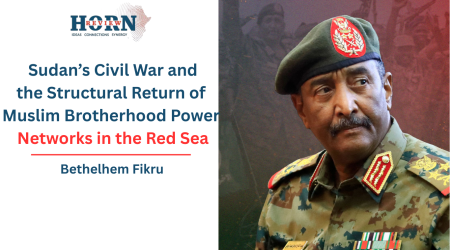
Sudan’s Civil War and the Structural Return of Muslim Brotherhood Power Networks in the Red Sea
Sudan’s current foreign alignment reflects the structural imperatives imposed by...
13
Mar
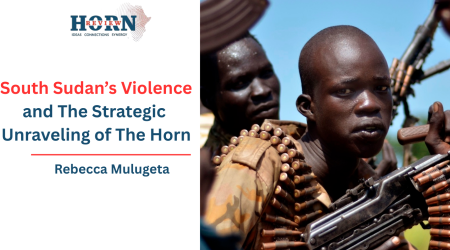
South Sudan’s Violence and The Strategic Unraveling of The Horn
For decades, the Horn of Africa has been defined as...