I. Executive Summary
The Nile Basin is entering a new chapter shaped by climate change, evolving water management and long-term shifts in sediment flow. Scientific studies show that the Nile Delta, once renewed each year by fertile Ethiopian silt, is now increasingly vulnerable because that natural sediment no longer reaches it. As a result, the Delta faces soil decline, land subsidence and growing saltwater intrusion.
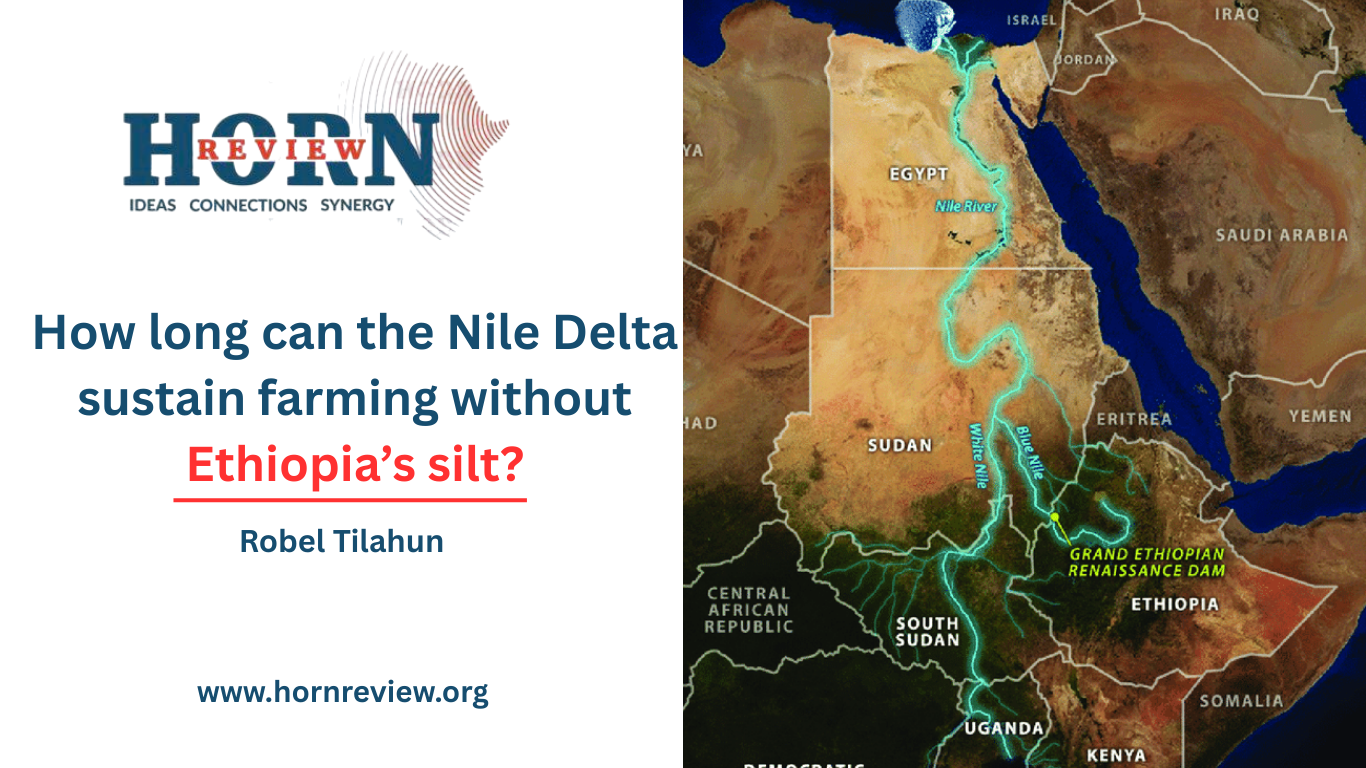
In a system shaped by a cascade of upstream reservoirs beginning with GERD in Ethiopia, followed by Sudan’s Roseires, Sennar and Merowe dams, and ending with the Aswan High Dam in Egypt, the natural flow of Ethiopian silt is intercepted at every stage of the river. The Nile now arrives at the Delta as clear water carrying almost no sediment, eliminating the soil-building process that sustained the Delta for millennia.
Under this modern configuration, where all major sediment sources are trapped upstream, the Nile Delta becomes increasingly difficult to maintain and increasingly dependent on costly engineering, land reclamation and climate adaptation measures.
This brief outlines a positive and forward-looking approach through which Egypt, Ethiopia and the wider region can strengthen their shared future by investing in ecological restoration, climate adaptation and agriculture investment partnerships.
II. Key Scientific and Structural Realities
The Nile Basin is undergoing a long-term environmental shift shaped by changes in sediment flow, land elevation and climate variability. These developments are gradual rather than sudden, yet they fundamentally reshape how the river system behaves. Understanding these realities provides the foundation for effective and future-oriented policy.
One of the clearest scientific findings is that the sediment which once sustained the Nile Delta no longer reaches it. For thousands of years, the Ethiopian Highlands supplied the Delta with nutrient-rich silt that renewed soils, counteracted natural land sinking and reinforced the coastline. Modern dams have disrupted this cycle. The Aswan High Dam traps nearly all sediment before it can travel downstream, and reservoirs in Sudan and Ethiopia, including GERD, reinforce this pattern. As a result, the Delta now receives water without the soil-building material that historically protected its fertility and elevation.
This matters because the Nile Delta is naturally prone to subsidence, the slow sinking of land caused by geological compaction and groundwater extraction. In the past, annual silt deposits offset this sinking. Today, satellite measurements show that parts of the Delta are subsiding by several millimeters per year at the same time global sea levels are rising. Together, these forces produce one of the highest rates of relative sea level rise in the world. The Delta is not collapsing, but it is under growing environmental pressure. Saltwater is intruding into coastal groundwater, soils are becoming more saline, drainage systems must work harder and maintaining productivity increasingly requires costly engineered interventions.
Egyptian agriculture remains strong and resilient, but it operates in a system that demands more inputs and more careful management than before. Without natural silt renewal, farmers rely on fertilizers, modern irrigation and extensive pumping systems to sustain production. These measures are effective, but they highlight that the environmental foundation beneath Egyptian agriculture has changed. Soil fertility, land elevation and salinity control now depend on human effort rather than natural processes. Long-term agricultural sustainability is therefore sensitive to environmental trends and economic pressures.
Overall, the scientific picture is not one of crisis but of structural transition. The Nile Delta remains productive, but its long-term resilience depends on smarter management, climate adaptation and ecological stability upstream.
III. Strategic Implications for Egypt
The evolving environmental realities of the Nile Basin create an opportunity for Egypt to reassess its long-term strategy in a constructive and forward-looking manner. Egypt has built one of the most advanced water management systems in the world, maintaining high agricultural productivity even after natural flood cycles ended. Yet science now makes clear that the main pressures on Egypt’s water and agricultural systems stem not from upstream water use but from ecological changes within the Delta itself. Land elevation, soil quality and coastal stability are shaped more by the absence of natural sediment renewal, continuing subsidence and the rising Mediterranean than by upstream withdrawals. These structural realities cannot be reversed through diplomatic pressure or geopolitical maneuvering. They call for a modern approach that aligns Egypt’s national interests with basin-wide ecological resilience.
Recognizing the shift from water quantity concerns to environmental realities opens a new strategic horizon. The long-term health of the Ethiopian Highlands, where most of the Nile’s water and historical sediment originate, is too significant to ignore and too important to treat as a secondary issue. Supporting upstream ecological restoration is not charity. It is a practical investment in Egypt’s own water and food security. This represents a strategic shift from trying to control events to shaping the environmental conditions that underpin regional stability.
This reframing enables Egypt to move from a defensive posture rooted in outdated assumptions to a proactive strategy grounded in scientific realities. By embracing ecological cooperation and climate-aligned investment, Egypt can position itself at the forefront of global discussions on sustainable water management, resilience and regional development. Such a strategy strengthens national security, supports long-term agricultural productivity and builds partnerships that can endure in an era of climate uncertainty. In this context, Egypt’s future water stability is best served not by constraining upstream development but by helping to strengthen the environmental foundations of the Nile system.
IV. Strategic Implications for Ethiopia
For Ethiopia, the emerging scientific realities of the Nile Basin offer an important opportunity to anchor national security strategy in ecological strength and long-term resilience. The Ethiopian Highlands are the hydrological engine of the Nile system, supplying the overwhelming majority of its water and nearly all the sediment that historically sustained downstream agriculture. As the basin undergoes structural change driven by dams, climate variability and increasing water demand, Ethiopia’s upstream position provides both responsibility and advantage.
Ethiopia’s environmental stewardship is no longer simply a national priority. It is increasingly recognized as central to the long-term stability and sustainability of the entire basin. This moment allows Ethiopia to define its leadership through restoration, resilience and a cooperative ecological diplomacy that strengthens both national interests and regional trust.
Ethiopia’s most strategic and least contentious instrument of influence is the restoration of its own landscapes, demonstrated in the Green Legacy Initiative. Reforestation, soil conservation and watershed rehabilitation are not just environmental programs. They are tools of national security and long-term state resilience. Healthy highlands reduce soil erosion. Ecological restoration becomes a form of soft power that enhances Ethiopia’s importance without confrontation.
Ethiopia’s restoration agenda aligns closely with African Union climate priorities, global environmental goals and major international funding windows. By placing restoration at the center of its foreign policy, Ethiopia positions itself as a provider of ecological stability and climate security for the region. This reframing transforms Ethiopia from a perceived competitor in Nile politics into a pivotal partner whose environmental investments generate shared benefits across the basin. It strengthens Ethiopia’s diplomatic standing and expands opportunities for climate finance and development partnerships.
Conclusion
Taken together, the scientific evidence shows that a Nile Delta without Ethiopian silt is a structurally unsustainable agricultural system over the medium and long term. No confrontation or political campaign will bring back the natural sediment that once sustained the Delta, nor will hostility help either country navigate the climate challenges ahead. For Egypt, the rational path is not to destabilize Ethiopia or engage in subversive activities, but to build partnerships that support Ethiopia’s agricultural expansion, because Ethiopia has the land, water and human capital necessary to sustain regional food security. A stable and productive Ethiopia strengthens the entire region and provides Egypt with reliable agricultural supply chains.
For Ethiopia, the most effective response to external pressure is to restore its highlands by planting trees, rehabilitating watersheds and reducing soil erosion. This strengthens national resilience and stabilizes the entire basin. In this new era, cooperation serves both states, while subversion harms all. Working together is the only strategy that aligns with the basin’s scientific realities and its long-term strategic interests.
By Robel Tilahun, Researcher, Horn Review
References
1. Stanley, D. J., and A. G. Warne. “Nile Delta: Extreme Case of Sediment Entapment on a Delta Plain and Consequent Coastal Land Loss.” Marine Geology 129, no. 3–4 (1996): 189–195.
2. Kheir, R. B., and A. E. Hassan. “Sediment Retention by Upstream Dams and Its Impact on the Nile Delta.” Environmental Earth Sciences 70, no. 3 (2013): 1123–1136.
3. Abou El-Magd, I., and A. Hermas. “Estimating Land Subsidence in the Nile Delta using InSAR and Geodetic Measurements.” Egyptian Journal of Remote Sensing and Space Sciences (2024).
4. Rateb, A., et al. “Inferencing the Land Subsidence in the Nile Delta using Geodetic and Remote-Sensing Data.” Science of the Total Environment 728 (2020): 138–140.
5. El-Raey, M. “Vulnerability Assessment of the Coastal Zone of the Nile Delta of Egypt to the Impacts of Sea Level Rise.” Ocean and Coastal Management 37, no. 1 (1997): 29–40.